
Germany · taz · · 1h
Wild animals in the Circus Krone: Hamburg lets lions into the ring
Deutsch (original) · Auto-translated to English
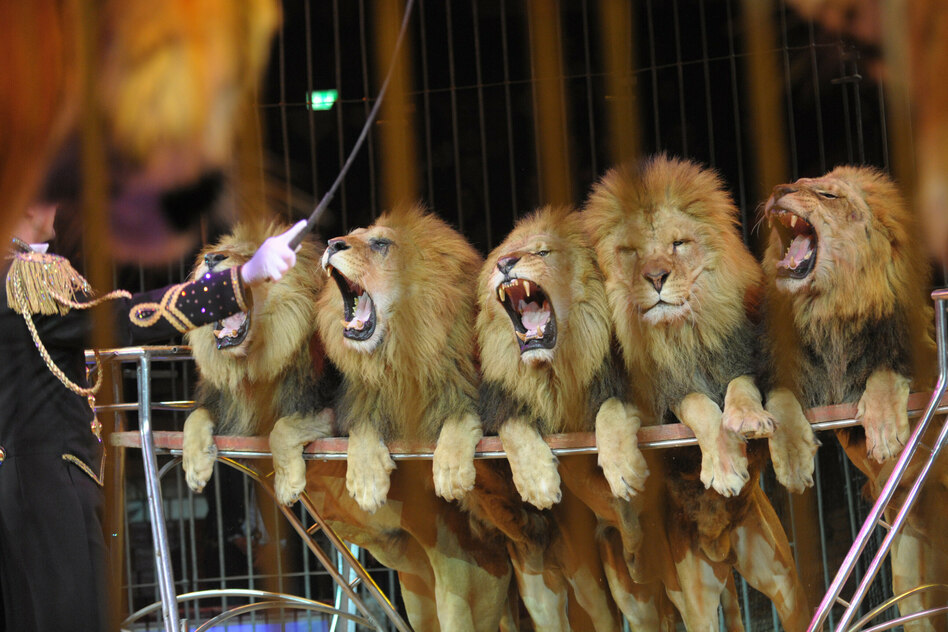
Circus Krone is in town. Even before the premiere last week, it made unexpected headlines. At a height of eight meters, on the roof of the circus tent that is currently standing on Hamburg's Heiligengeistfeld next to the Millerntor Stadium, animal rights activists and circus employees pushed each other. Three activists from the animal protection group “Four Paws” climbed onto the tent with ropes and safety belts to put up a banner against the appearance of wild animals. Circus employees tried to dissuade her. One activist was slightly injured. In the end, both parties were charged: one for trespassing, the other for assault. The premiere of the circus show took place.
Circus Krone, which claims to be the largest circus in Germany, is currently performing for three weeks at Heiligengeistfeld, the largest festival area in Hamburg. There are lions, tigers, horses, dogs and camels. Animal welfare organizations have been criticizing the constant transport and appearance in the brightly lit and noisy ring for the animals as being far too stressful, unhealthy and not species-appropriate. Animal protection organizations have been criticizing them for years. Circus Krone disagrees, pointing out that it adheres to strict requirements, that it maintains higher standards than smaller circuses and that the animals are part of the family.
There are no exact figures as to how many circuses in Germany still have wild animals in their program. An estimate from “Four Paws” is between 30 and 50. In fact, 75 percent of people in Germany are in favor of a ban on wild animals in circuses, according to a survey commissioned by “Four Paws”. There is no nationwide ban in Germany, unlike in most EU countries, but to date there is no ban. The German animal protection law only states that you need a permit for the commercial display of animals in circuses.
However, cities and municipalities have the option to prevent circuses with wild animals from operating in public places. More than 100 cities and municipalities do this.
The Hamburg Senate has repeatedly stated that it does not approve of wild animal shows and is pushing for a nationwide ban. The responsible authority for justice and consumer protection also said this in response to a taz request. It was not until May 2026 that the Senate introduced a corresponding resolution to the Federal Council. A proposal from then Agriculture Minister Julia Klöckner (CDU) failed most recently in 2021.
Other cities handle it differently. Cologne, Munich and some districts of Berlin, among others, have enacted their own legal regulations to prevent wild animal circus performances. Most people take the route of renting municipal space, for example by tying it to certain lease conditions.
This is unthinkable in Hamburg, says the spokesman for the justice authority. As long as there is no nationwide regulation, “a rejection based solely on wild animals would not be legally secure under the current legal situation”.
In fact, the legal situation is quite inconsistent. It is true that circus companies have often taken legal action against cities and municipalities that did not want to let them use municipal event space because of the wild animals they brought with them.
In 2017, a circus sued the city of Hameln in Lower Saxony, which had decided the year before to only allocate municipal land to circuses without wild animals. The Hanover Administrative Court obliged the city to make a new decision on the circus' application. The city took action against it.
The Lower Saxony Higher Administrative Court confirmed: A municipality cannot refuse a circus that has the permission required under animal protection law to use municipal land for general animal protection reasons. This is also about protecting the so-called professional freedom of circus companies.
But there is also a counterexample: in 2014, the Munich Administrative Court decided that the city does not have to allow a circus with giant kangaroos, camels and zebras to perform at its fairground. The ruling was not aimed at an impermissible ban on wild animals by the municipality, but rather at the municipality's right to design its own space and allocate it based on public interest.
However, Hamburg is not taking the risk of a legal dispute. The city is hiding behind waiting for a nationwide rule, says Yvonne Würz, zoo and circus consultant for the animal rights organization Peta Germany. “Many cities and municipalities are cautious, but it is doable – legally speaking,” she says. Peta offers a model application for municipalities to prevent wildlife shows via terms of use.
In Hamburg, Die Linke wants to ensure that the city no longer gives its space to wild animal circuses. She will submit a corresponding application to the citizens on September 30th. Circus Krone will be performing at the Heiligengeistfeld until October 11th.
Read the full story at the source
Source: taz