
World · taz · · 3h
Rebels in Mali: Rebels advance against military junta
Deutsch (original) · Auto-translated to English
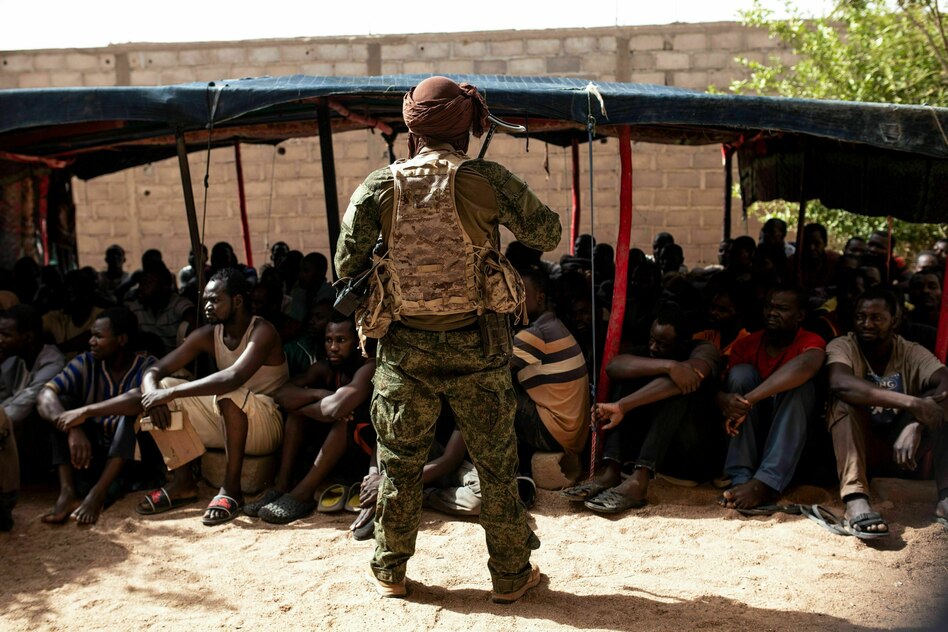
Thick clouds of smoke rose over the village of Dioura in central Mali on September 10th. Blurry video footage from the day on news platform X shows countless uniformed corpses lying scattered in the dust. They are bloody images that give a small insight into the severity of the fighting.
The military camp in the Mopti region was the scene of a large-scale attack by the terrorist organization Group for the Support of Islam and Muslims (JNIM). Just a few days later, further attacks occurred not far away, in Sévaré and Konna. On September 19, the group also reported the capture of army posts in Bla and Kassela, just 70 kilometers from the capital Bamako in the southwest of the country.
JNIM claims to have killed up to 150 soldiers and captured 93 others. Five Russian Afrika Korps fighters are also said to have been killed. This is information that cannot be independently verified, but local sources also estimate the number of deaths to be at least 100.
This makes the attack one of the most costly the Malian army has suffered in the past 15 years. Since the military coup in 2021, Mali has been ruled by a junta close to Russia, which has repeatedly waged battles against Tuareg rebels and Islamist groups in the country.
It was only hit hard in April when an alliance of JNIM fighters and Tuareg rebels from the FLA (Front for the Liberation of Azawad) attacked several strategically important locations and military bases in Mali at the same time. Mali's Defense Minister Sadio Camara was also killed in the bloody attack that severely shocked the country.
Now JNIM has struck again and stolen significant weapons stocks again. These include 19 122 mm caliber rockets, other heavy military equipment and ammunition. Weapons left behind now play an important role in the group's military logistics.
For Mali's armed forces, the attack is more than a bitter blow. Not just because of the bloodbath and the fact that Dioura, an important military base in the center of the country, was destroyed. The attacks in quick succession in several locations painfully show how difficult it is to contain the terrorists' guerrilla tactics.
What's more, they seem to have developed a new clout in recent months. Drones are also being used more and more frequently. A report by the Moroccan think tank Policy Center for the New South dates the first known drone use by JNIM to September 2023.
The pace and regularity of the attacks indicate that JNIM not only has a continuous supply of equipment, but is also evolving its tactics from operation to operation, the think tank analyzed in July 2025.
The development may not have gone unnoticed by the Malian military junta, but they remain silent. Although Bamako admitted losses in the Dioura attack - a rarity - it remained unclear how many soldiers were killed. Instead, the military spread the usual success story: As part of Operation Dougoukoloko, a group of terrorists hiding in the bush who were among the Dioura attackers had been “tracked down and precisely fought.”
Operation Dougoukoloko (“Retaking Territory”) was launched in April with the stated aim of ensuring that Mali would never again be “humiliated or weakened by terrorist groups”.
As the broadcaster Sahel Matin TV now reported, according to the Malian army, foreign fighters were also among the attackers in Dioura. The accusation of outside interference is not new. Bamako repeatedly accuses foreign actors of supporting the junta's opponents in order to bring it down.
At the center of the allegations is not only the former colonial power France but also Ukraine. Malian government officials accuse Kyiv of supporting the Tuareg rebels of the FLA, who are now cooperating with the terrorist group JNIM. An accusation that Ukraine has always rejected.
Now research published by the US broadcaster CNN on September 12th provides concrete evidence for the first time that supports the allegations. According to this, around 15 Ukrainian drone specialists are currently in northern Mali to train and provide operational support to the FLA's Tuareg rebels in the use of drones.
Two Ukrainians involved in the mission confirmed to CNN that they were working with the rebel group. However, they also declared that they would not take part in the fighting at the front themselves. Since April, however, the FLA has joined forces with JNIM in a military alliance against the Malian army. It is still unclear whether the Ukrainian support for the FLA described by CNN also indirectly benefits JNIM - and whether it played a role in the attack on Dioura.
Read the full story at the source
Source: taz