
World · Middle East Eye · · 59m
Debunked: Why Tory claims of UK extremism ‘cover-up’ fail to add up
English (original) · Read in Deutsch ⇄
Debunked: Why Tory claims of UK extremism ‘cover-up’ fail to add up
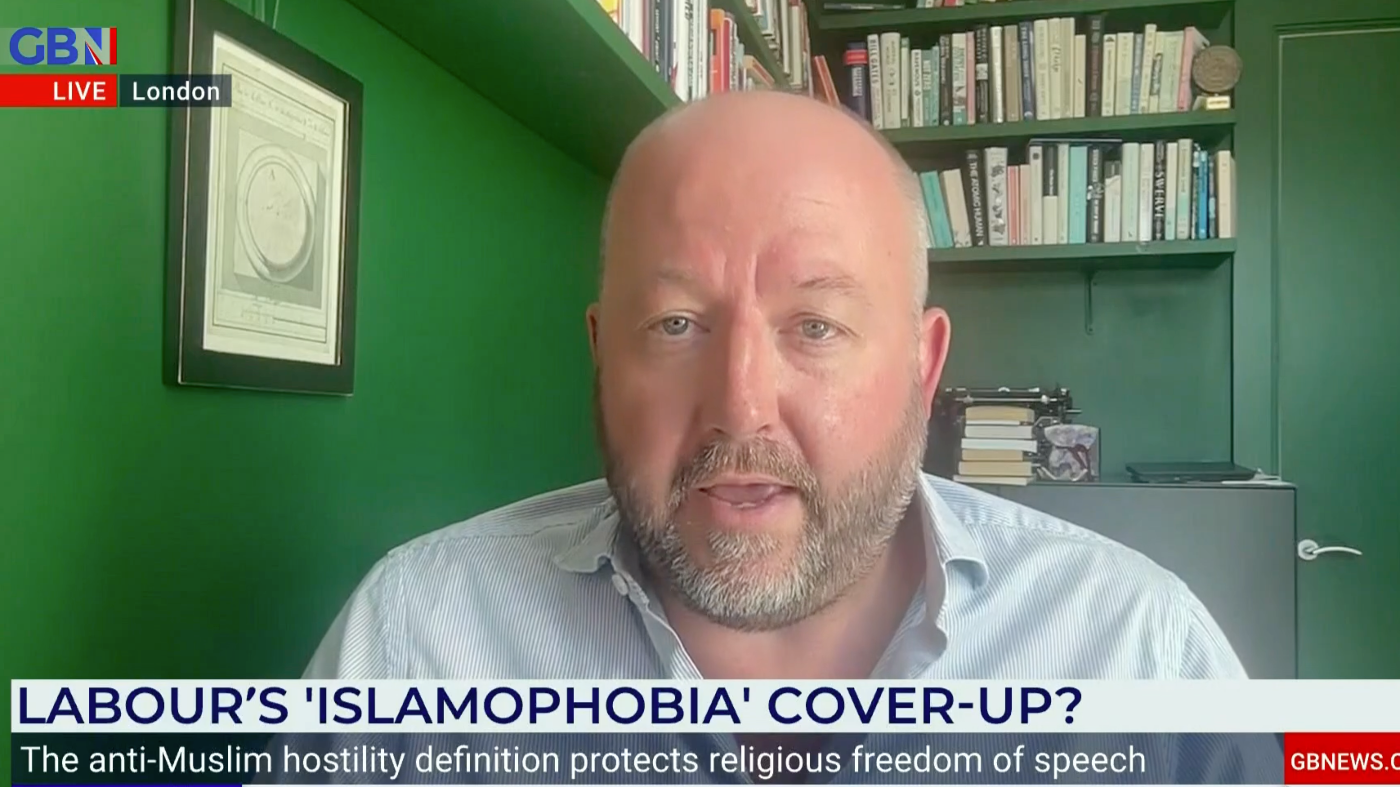
Submitted by Imran Mulla on Tue, 09/22/2026 - 11:51 Senior Tories say ‘extremist’ Muslim groups likely influenced Labour’s definition of anti-Muslim hostility Nick Timothy MP speaks on GB News on Monday 21 September 2026 (Screengrab)
Off
Nick Timothy MP speaks on GB News on Monday 21 September 2026 (Screengrab)
Off
A major political row has erupted as senior Conservative politicians accuse the British government of a “cover-up”, claiming “extremist” Muslim groups likely influenced its definition of anti-Muslim hostility.
But Middle East Eye has previously revealed key details of the definition’s creation which seriously undermine these allegations.
And now Dominic Grieve, a former Conservative minister who chaired the working group on the definition, has made an intervention which further undercuts the claims.
Nick Timothy, the shadow justice secretary, alleged this week that “extremists almost certainly influenced” the definition of anti-Muslim hostility, which the Labour government adopted earlier this year.
Meanwhile Katie Lam, the shadow secretary of state for housing, communities and local government, asked: “What possible public interest could there be in covering this up?”
MEE revealed in July last year that the working group was blocked by the government from engaging with key Muslim groups including the Muslim Council of Britain, but consulted figures themselves accused of Islamophobia.
'Rabble rouser'
Grieve confirmed on Monday evening: “During the course of its work the working group met with a number of individuals and representatives of organisations.
"As the present government has kept the policy of its Conservative predecessors, no meetings took place with any groups or individuals who had been identified as having expressed unacceptable views incompatible with a free democracy.”
This week the communities ministry launched a review into the deletion of submissions to the working group, which Timothy characterised as a “cover-up”.
 Exclusive: Does the UK's 'don't talk to the Muslim Council of Britain' policy actually exist?
Read More »
Exclusive: Does the UK's 'don't talk to the Muslim Council of Britain' policy actually exist?
Read More »
According to the department, the submissions had been destroyed due to the “volume of special category data”, including data on religious beliefs and political opinions, which could not legally be retained longer than it was needed for consultation.
According to government sources with knowledge of the matter, a large number of unsolicited submissions the working group received contained severe abuse, including death threats, directed at members of the group.
Timothy said on Monday: “It is now clear that Labour didn’t want the public to know who influenced their Islamophobia definition, and they have refused to deny that extremist groups were involved.”
Contrary to Timothy’s assertion the definition is not of “Islamophobia”, a term that the government no longer uses, but rather of “anti-Muslim hostility”.
And the government denied the involvement of “extremist” groups in a statement to the Telegraph.
Grieve, who chaired the working group, responded in a post on X: “Nick Timothy needs to decide whether he is a serious politician or a rabble rouser mingling valid points with entirely disreputable and unsustainable ones.”
MEE reported last year that government sources said the working group invited the neoconservative think tank Policy Exchange - of which Timothy himself is a fellow - for consultation, but Policy Exchange declined the invitation. Policy Exchange did not respond to a request for comment at the time.
Yet the think tank has heavily criticised the definition. The Telegraph published an article on 26 August by Paul Stott, the head of security and extremism at Policy Exchange, headlined “The secrecy surrounding Labour’s anti-Muslim hatred definition is chilling”.
In the article, Stott did not mention Policy Exchange having been invited for consultation. He described the “possibility that evidence from extremist groups may have influenced the deliberations.
“Material from organisations linked to divisive Islamist groups overseas, or evidence that was flawed or simply wrong, could also have played a role,” Stott speculated.
Broad consultations
MEE reported last year that the working group consulted groups including the National Secular Society and Humanists UK, which had criticised a previous Islamophobia definition adopted by Labour, and the Community Security Trust, which monitors antisemitism.
The working group also consulted Trevor Phillips, who was suspended from Labour when Jeremy Corbyn was leader in March 2020 following allegations of Islamophobia, which he denied. His suspension was lifted in July 2021 under Keir Starmer’s leadership, a move criticised by some Muslim Labour MPs and members.
By contrast, as MEE revealed last year, the communities ministry told the working group it could not consult the Muslim Council of Britain, the largest umbrella body seeking to represent Muslim organisations, with over 500 affiliates, including mosques, schools, local and county councils, professional networks and advocacy groups.
This was because the government has a policy of “disengagement” with the organisation, sources said.
'There was a call for evidence that allowed anyone to submit their opinion. Many did, including individuals with views right across the political spectrum'
- Dominic Grieve, chair of working group
The government also told the working group it could not consult the Centre for Media Monitoring (CfMM), a watchdog that focuses on media coverage of Muslims. The CfMM was set up by the MCB but says it has now become an independent entity.
An MCB spokesperson told MEE at the time: “We can confirm that neither the communities ministry nor its appointed working group members proactively reached out to the Muslim Council of Britain to participate in this call for evidence. We are mobilising our grassroots membership to share their views anyway.”
An indication of Muslim groups the Tories may consider extremist, which all strenuously deny the characterisation, came in a question in parliament by Tory MP James Cleverly in June this year.
Cleverly asked if the working group had engaged with Mend (Muslim Engagement and Development), Cage, the Muslim Association of Britain or the Muslim Council of Britain.
Nesil Caliskan, the parliamentary under-secretary of state in the ministry of housing, communities and local government, confirmed in response that the “department does not engage with Mend, Cage, the Muslim Association of Britain or the Muslim Council of Britain and the Working Group did not meet with any of these organisations”.
This statement has not been referenced in public interventions by fellows of Policy Exchange or Conservative politicians.
Specific groups
Any individual or organisation was able to respond to the working group’s call for evidence, but the working group only actively consulted specific groups.
Grieve said: “There was a call for evidence that allowed anyone to submit their opinion. Many did including, it was clear, individuals with views right across the political spectrum, including extreme hatred of Muslims. These were not considered individually.”
 UK settlements ban: How conspiracy theory accusing Burnham of courting 'Islamist voters' went global
Read More »
UK settlements ban: How conspiracy theory accusing Burnham of courting 'Islamist voters' went global
Read More »
Grieve added: “It was always for the government to decide what to do with our advice which was private to government. Whether or not the deletion of material received by us during the course of our work follows government guidelines or not is not for me to comment. We did not request it.”
One of the figures the working group consulted was John Jenkins, a former British ambassador to Saudi Arabia and a senior fellow at Policy Exchange.
Grieve, as the working group’s chair, asked Jenkins “whether a definition [of Islamophobia] would be helpful”.
Jenkins published his response to the working group, which included references to 18th-century politics and “social constructivism”, in the Spectator magazine.
Jenkins strongly criticised the working group for all its five members apart from Grieve being Muslim.
“I am concerned that the Working Group may have begun its work with its conclusions pre-determined,” he wrote.
Jenkins said regarding the adoption of “any definition” of Islamophobia: “I have heard it described as potentially the most retrograde step in this country since Sir Robert Walpole’s government in 1737 granted the Lord Chamberlain’s office powers to licence theatrical scripts.”
In 2024 Jenkins was accused of endorsing social media posts that are “Islamophobic”, that “defend Islamophobia” or that peddle in “propaganda against Muslims”. MEE contacted Jenkins for comment at the time but did not receive a response.
'Anti-Muslim hostility' definition
In March this year the government unveiled the definition of “anti-Muslim hostility”, a term it used after having scrapped the term “Islamophobia”.
The new definition is not legally binding. It states: “Anti-Muslim hostility is intentionally engaging in, assisting or encouraging criminal acts - including acts of violence, vandalism, harassment, or intimidation, whether physical, verbal, written or electronically communicated - that are directed at Muslims because of their religion or at those who are perceived to be Muslim, including where that perception is based on assumptions about ethnicity, race or appearance.
'The wording used cannot create one or restrict legitimate freedom of expression, including the right to criticise Islam as a religion'
- Dominic Grieve, chair of working group
“It is also the prejudicial stereotyping of Muslims, or people perceived to be Muslim including because of their ethnic or racial backgrounds or their appearance, and treating them as a collective group defined by fixed and negative characteristics, with the intention of encouraging hatred against them, irrespective of their actual opinions, beliefs or actions as individuals.
“It is engaging in unlawful discrimination where the relevant conduct - including the creation or use of practices and biases within institutions - is intended to disadvantage Muslims in public and economic life.”
Last month it was revealed that a mosque is attacked in the UK every five days amid an upsurge of anti-Muslim attacks.
Government ministers have repeatedly insisted the definition will not harm free speech.
Grieve said on Monday: “It is certainly not a blasphemy law. There was no new law suggested and it was outside the terms of reference of the working group and specifically excluded.
“I would not have chaired the working group if there had been any question of it, as I actively campaigned to get rid of the existing law on blasphemy when an MP and my views have not changed since.”
Grieve added: “The wording used cannot create one or restrict legitimate freedom of expression, including the right to criticise Islam as a religion. To suggest this on the clear evidence of the wording and the text is nonsense.”
Objectionable organisations
Responding to Grieve on Tuesday morning, Timothy repeated his claim of a “cover-up”.
Timothy asked: “Did his working group receive representations from any of the following organisations?”
 Europe's most powerful party is stoking a Muslim scare
Read More »
Europe's most powerful party is stoking a Muslim scare
Read More »
Timothy’s list of objectionable organisations included the Muslim Council of Britain and “organisations that are affiliated to these bodies”.
This casts the net fairly wide, since any organisation was able to make representations to the working group, while only select organisations were invited for consultation.
Plusthe MCB has more than 500 affiliates, including mosques throughout Britain.
In 2009, the MCB was briefly boycotted by Gordon Brown’s Labour government, which later resumed engagement.
Ministers in the coalition government also held meetings with the MCB between 2010 and 2015. Civil servants continued to meet with the MCB until March 2020.
That was when the organisation produced a dossier outlining what it said was evidence of Islamophobia against more than 300 individuals, including Conservative MPs, councillors, party members and special advisers inside 10 Downing Street.
That same month, civil servants reportedly broke off relations with the organisation. The Conservatives subsequently boycotted the MCB, and the Labour government adopted the same approach in July 2024.
UK Politics News Post Date Override
0
Update Date
Mon, 05/04/2020 - 21:19
Update Date Override
0
Post Date Override
0
Update Date
Mon, 05/04/2020 - 21:19
Update Date Override
0Read the full story at the source
Source: Middle East Eye