
World · taz · · 54m
Trial against suspected disposable agents: fine for construction foam attacks on cars
Deutsch (original) · Auto-translated to English
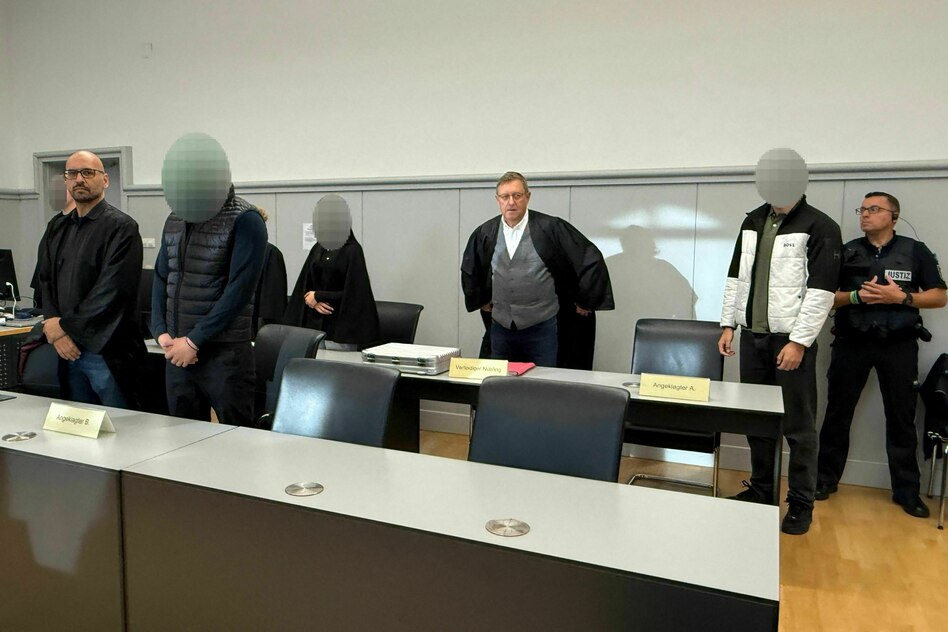
At the beginning of the trial, Adel A. and Nikola B. hide their faces behind respiratory masks, A. also behind black sunglasses. Only Paula Z. looks openly into room 113 of the Ulm youth jury court. Then the defendants, aged 18 to 22, make it short. In turn, they have their lawyers explain that they “fully” admit the alleged acts and that they very much regret them. There is only one thing his client cannot say, says Alfred Nübling, Adel A's lawyer. Who was the person who commissioned these acts. His client is still unaware of this.
These acts were sabotage actions against more than 270 cars in December 2024 in four federal states, shortly before the upcoming federal election - in Ulm in Baden-Württemberg, in Neu-Ulm in Bavaria, in Schönefeld in Brandenburg and in Berlin. The exhaust pipes of the cars were blocked with construction foam and “Be greener” stickers were stuck on them, including a picture of the Green Party politician Robert Habeck, then Vice Chancellor.
But the acts probably had nothing to do with the Greens - but rather with a Russian client. Because on December 11, 2024, police officers in Schönefeld in Brandenburg became aware of Adel A. and Nikola B., who were now accused in Ulm. The two tried to escape into a rented van in which another suspect, Benjamin O, was sitting. But the officers discovered them there - and also several cans of tree foam, for which the trio had no explanation. Brazen: Released from the police checkpoint, the three drove on to Berlin and sabotaged more cars there.
During subsequent searches of the men, all of whom come from the Ulm region and have German, Serbian or Bosnian nationality, the investigators came across cell phone photos of 74 manipulated cars, additional cans of construction foam and a receipt for the purchase of additional cans. And they identified another suspect: Paula Z., whose cell phone also had more than 50 photos of cars with construction foam. Cell phone data also showed that the three were at the crime scenes.
That's why Adel A., Nikola B. and Paula Z. are now standing before the youth jury court in Ulm. The case against the fourth man, Benjamin O., has now been discontinued because he has already been sentenced to prison in another case.
The prosecutor read out the indictment that the damage to the cars amounted to more than 13,600 euros. And she emphasizes that the intention was “to specifically influence the federal election” – by a client who could not be identified. The proceedings against him have now been discontinued.
The defendants follow the descriptions without moving. They were already silent about the client during the investigation, and they will do so again on Monday. The actions were simply “nonsense,” says Alfred Nübling, Adel A’s defense attorney. There was no political motivation for A. He is indifferent to politics and the federal election.
The already convicted Benjamin O., however, told the investigators that the client was a Russian who also spoke Serbian and had called Nikola B. via the messenger Viber. He was offered 100 euros for each damaged car. He overheard that in the conversation. And that they were given extra money to keep quiet about the client.
Judge Stefan Adamski, however, emphasizes that Benjamin O.'s statements should be viewed with caution. He repeatedly got entangled in contradictions and initially claimed not to have been involved in the crimes - until investigators pointed him to images from surveillance cameras. The Russian client could have just been a “fantasy”, there is no evidence of this, says Adamski. “Just because the facts fit our times doesn’t mean they have to be true.” But of course the political content of the stickers is striking, emphasizes the judge - and the proximity to the federal election.
And taz research had shown that Russia, specifically the Russian propaganda agency SDA, was most likely responsible for the construction foam campaign. In a leak of internal current data that the taz was able to evaluate, an SDA employee made a revealing comment on a media report on the campaign itself: “Deutsche Welle is writing about us.”
If this is true, then the construction foam campaign was part of Russia's hybrid attacks on Germany, which the presidents of the German secret services warned again on Monday. And the three defendants in Ulm would be so-called disposable agents - petty criminals recruited by Russia who commit sabotage for money in order to make it more difficult for them to be traced back to Russia.
In fact, the Ulm defendants have so far only attracted attention with petty crimes, with marijuana offenses or theft, but not with political actions. An LKA investigator told the person behind the attack in court that Benjamin O.'s information was too vague to identify a specific suspect. It was also not possible to secure connection data or money transfers. In addition, according to taz information, connections to other sabotages were also tested without success: to pig heads dumped in front of mosques in Paris or concrete skeletons in front of the Brandenburg Gate in Berlin. According to taz research, the SDA was also responsible for these actions, organized by a Serb.
In the Ulm trial, after the confessions, Judge Adamski sentenced Adel A. and Nicola B. to fines of 3,000 euros each for communal damage to property and Paula Z. to 50 hours of community service. The latter smiles with relief. The public prosecutor's office had demanded 5,000 euros and 80 hours of community service, the defense only demanded 2,000 euros and 30 and 50 hours of community service. The court sentenced the trio under juvenile criminal law, taking into account their confessions - and the fact that they have not yet been convicted. All previous cases against her had been dropped.
But Adamski speaks to the conscience of the three convicts. The acts were “not stupid, not a slip-up,” but crimes that harmed many people and were carried out with “considerable criminal energy.” The motive of the convicts was “purely financial”. "They were cheap tools. They could be bought for money without asking what they were used for."
For Adamski, the consequences are fatal; they extend “far beyond the damaged cars.” Because if the impression arises that an election is being manipulated, this will damage everyone's trust, said the judge. “And such damage to democracy cannot be easily repaired.”
In his last word before the verdict, Adel A. apologized to the injured car owners and assured them that he would now lead a regular life and start training. Paula Z.'s lawyer also asserted that her client allowed herself to be drawn into the crimes and did not understand the consequences. But now she has turned away from problematic acquaintances and is planning an apprenticeship. Paula Z. herself explains: “I’m very sorry for everything that happened.”
Adel A. and Nicola B., on the other hand, pose with photos in front of the court after the verdict. Your mood seems good.
Read the full story at the source
Source: taz