
Politics taz
Protests and state violence: who the baton hits
How protests are reported is important. The first source after the incident is almost always the police. This is more than a structural problem. more...
Deutsch (original) ·Auto-translated to English
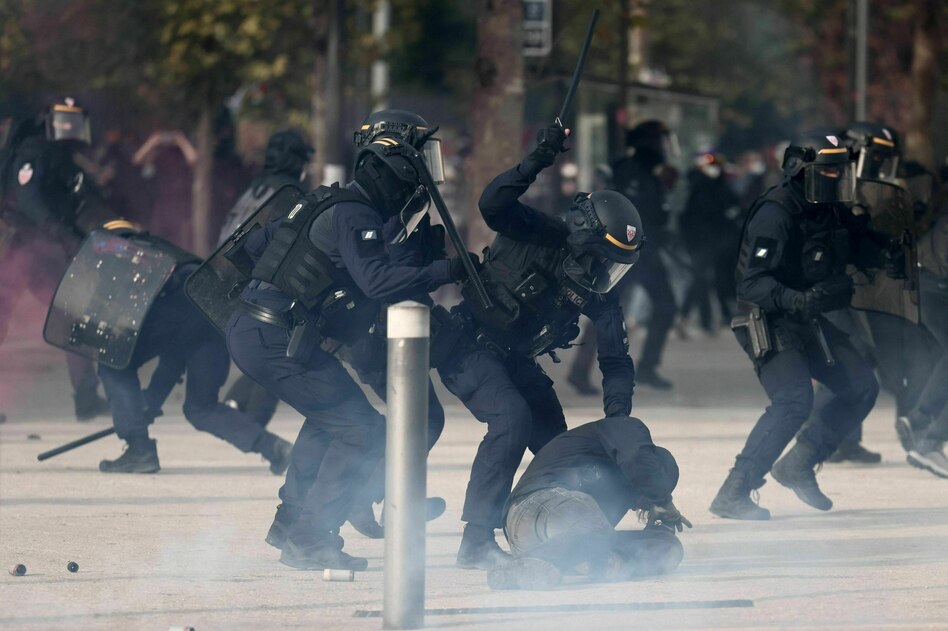
It's banging on the streets of the world right now. Police violence somehow doesn't want to find a place in German media, especially not when it takes place at home. Unfortunately, that's pretty unjournalistic.
According to the Carnegie Foundation, there were more than 120 anti-government protests in at least 73 countries around the world in one year - between March 2025 and March 2026 - more than since 2017. German media prefer to focus on the possible lack of legitimacy of the protest, but do not critically classify state violence. There could be a domestic reason for this.
When reporting on demonstrations in Germany, the choice of words is an initial indicator of how differently violence is discussed. Protesters “riot”, “attack”, “break through barriers”, the police “use pepper spray”, “disperse”, “take personal details”; it therefore acts according to administrative regulations.
Research at least partially supports this observation. After the G20 summit in Hamburg, the Institute for Protest and Movement Research found that the media reported on demonstrations with a focus on violence: As soon as violence is involved, peaceful concerns disappear from the picture. And a large Bochum study evaluated over 3,375 cases of allegedly unlawful police violence.
This is a structural problem. The first source on the evening of a demonstration is almost always the police press office. She delivers quick numbers and is matter-of-fact in her tone. What it doesn't provide is the perspective of those hit by the baton. Journalists on site can conduct counter-investigation, but this also hinders the police. In September 2025, press freedom organizations in Berlin documented how photojournalists at a demonstration in solidarity with Palestine were led away and asked to show their photos.
There is no shortage of warning signals. Amnesty International and the UN Human Rights Council have criticized police actions against Palestinian solidarity protests. Amnesty also criticized blanket bans and preventive detention during climate protests. If such voices appear as fringe opinions in reporting, there is something wrong with the weighting.
Anyone who hasn't learned to critically assess state violence at home doesn't have this reflex when they write about the world: with opponents like Iran or Russia, police violence is a scandal. With partners it is a “crackdown”, an “operation”, a “response to riots”.
In France this October, hundreds of thousands took to the streets against rising living costs, around 2,400 people were arrested and almost 1,000 officers were injured. In Italy, the government reportedly responded with a decree creating a new criminal offense for violent participation in protests and sending soldiers to Milan. All of this deserves more than the question of how violent the demonstrators were. The question deserves to be asked what the state does, with what means and with what control.
What should be done? It's not complicated. A police report is an allegation, not a fact. Video footage should be reviewed before the evening's narrative is established, not after. Those affected and observers belong in the first paragraph and not in the last. And the question of proportionality should not be a special topic for weekend supplements.
Journalism that only describes state violence where it is far away adopts the narrative of those in power. He is no longer a controlling authority.