
World · taz · · 1h
Nostalgia in Great Britain: Was everything better back then?
Deutsch (original) · Auto-translated to English
The British rock band Pink Floyd released their last album: “The Final Cut” in 1983. Translated, its subtitle was “A Requiem to the Post-War Dream.” The gloomy zeitgeist of the Thatcher era was sung, between the threat of nuclear war and social cuts. “Did Dad die for this?” sang Roger Waters in memory of his father, who died in World War II. "What have we done to England? What happened to the post-war dream?"
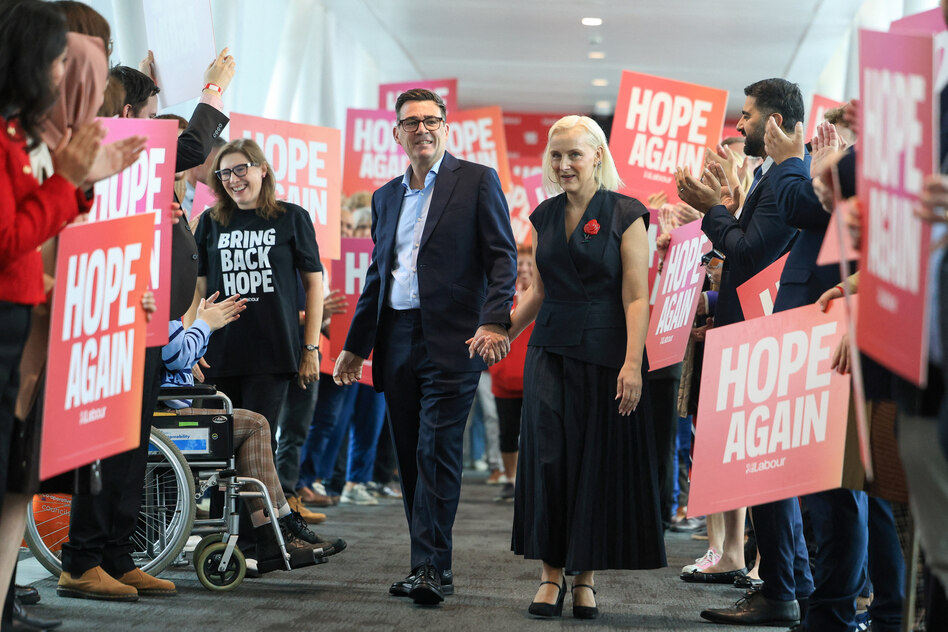
On September 28, 2026, the new British Prime Minister Andy Burnham once again delivered a kind of requiem with his speech at the Labor Party Conference. Moved to tears, he remembered his late father and the Labor policies that had once enabled his family to rise. “In 1945 we had a vision of winning the peace,” Burnham said. "We had the courage to change. We built good houses, secure jobs, health and education for everyone," said the head of government. "We made working-class aspirations feel real for the first time for families like mine. We built the common good. At least that's what we did until the 1980s." That's when the British right started to tear it all apart. “Houses, water, energy, transport, care – smashed and sold out.” Burnham promised: “We will make this country work for you again.”
Burnham received much applause for this speech of nostalgia for an era when “all together” built a better country, “free from want” was the promise.
Conservative Prime Minister Winston Churchill laid the foundation for this in the middle of the war; He had asked the liberal politician William Beveridge for a concept for general social insurance after the war. The Beveridge Report became a manifesto. After the external enemy, the Nazis, the British should work together to overcome the internal one: “lack, disease, ignorance, misery and inaction”.
Unemployment insurance, child benefit, a basic pension, social housing, a free health service, and a new school system - in just a few years, the Labor government elected in 1945 created the foundations of the modern welfare state.
Socialism and freedom - that was worth making sacrifices for in the war. In the catchy lyrics of Pink Floyd: A roof over your head. Enough to eat. The elderly can take to the streets in safety. You can speak your doubts and fears out loud. Nobody disappears, nobody gets kicked in by police boots. Everyone can relax, whether rich or poor. Nobody commits terrorist attacks. Everyone is under the protection of the law. And no one kills the children anymore.
Burnham now wants to build on this post-war dream as if nothing had happened. Not the severe economic crises of the 1970s, with mass unemployment, hyperinflation and constant strikes. Not the legendary inefficiency of state-owned companies and service managers.
Not the exclusion of women and young people back then, not the paralyzing pressure to conform in many areas of life that Pink Floyd sang about in the 1970s, from the threatening madness in "Dark Side Of The Moon" to the "Wall" that blocks children's heads brick by brick.
In 1979, Margaret Thatcher did not attack the British like an evil alien, but rather convinced the electorate with the slogan “Labor Isn’t Working” – Labor doesn’t work or even: the workers don’t work.
Andy Burnham still simply presses the rhetorical reset button. “I will break with the direction of the past 40 years and set Britain on a new path,” he shouted. "I know we can. Because we've done it before. In 1945."
The journalist Patrick Maguire has written a book about the development of the Labor Party in recent years. He calls Burnham's speech a first real break with his predecessor Keir Starmer, whom he replaced as Prime Minister in July. “Burnham speaks a political language that the Labor Party understands and has managed to make it feel at peace with itself.”
Starmer gave Labor bitter medicine, Burnham added the sugar: a state nursing service analogous to the state health service, new social housing without the possibility of privatization, the possible re-nationalization of services. However, there is no money for all of this; these are program items for the next election campaign, which is due in 2029 at the latest.
In just a few weeks, the Burnham government will have to present its budget plans for 2027, its first since taking office. There is a threat of renewed austerity measures. In order to rehabilitate state finances, the Starmer government abolished winter heating allowances for pensioners two years ago. He pointed out that linking pensions to good wage developments would partially offset this. Burnham now wants to decouple pensions from wage developments from 2030. Labor is asking the group of voters who grew up in the good old days to pay.
Exactly 50 years before Andy Burnham, on September 28, 1976, another Labor Prime Minister made his first party conference speech. Labor won the 1974 election, but after two years the hapless election winner Harold Wilson was overthrown by his party. His successor, James Callaghan, gave the opposite of a feel-good speech at the party conference.
The new prime minister shouted that the days when higher government spending solved problems were over. "For too long Britain has lived on credit: borrowed time, borrowed money, borrowed ideas. For too long, perhaps since the war, we have postponed fundamental decisions and perhaps fundamental changes in our society and economy."
The British agreed with him, but not in the way he wanted. In 1979, Labor lost the election to the Conservatives under Margaret Thatcher.
The more Andy Burnham wants to turn back the wheel of history, the more present the risk that it will repeat itself becomes.
Read the full story at the source
Source: taz