
Germany · taz · · 2h
New civil war in Ethiopia: Unscrupulous fight for “peace” and “survival”
Deutsch (original) · Auto-translated to English
A memorable meeting took place in Port Sudan on May 10th. In the port city on the Red Sea, where Sudan's military government has been in office since the start of the Sudanese civil war in 2023, Ethiopian government opponents met with government representatives from Sudan and Eritrea and proclaimed their "commitment to peace in Africa" under the flags of Sudan, Eritrea, Ethiopia and Somalia. Their common opponent: Ethiopia's Prime Minister Abiy Ahmed. Their common platform: “Ximdo”, the Tigrinya word for fraternal cooperation and the name of a movement that Eritrea officially presents as a peace initiative.
“The peoples of Ethiopia are at the lowest point in their history,” shouted an Ethiopian guest speaker. A Sudanese official called the meeting, the third of its kind and the first publicly broadcast, a "turning point." We are moving from solidarity to joint action, he said: “We are going into battles that we did not plan and that we did not cause.” A “new phase” is beginning in the effort to “lead the region to lasting peace”.
Experience shows that the more emphatically politicians in the Horn of Africa talk about peace, the more war inevitably follows. For a few days now, the civil war in Ethiopia between the central government of Abiy Ahmed and the TPLF (Tigray People's Liberation Front) ruling in the northern province of Tigray, which was actually ended by a peace agreement in 2022 after two years of war and 600,000 deaths, has flared up again.
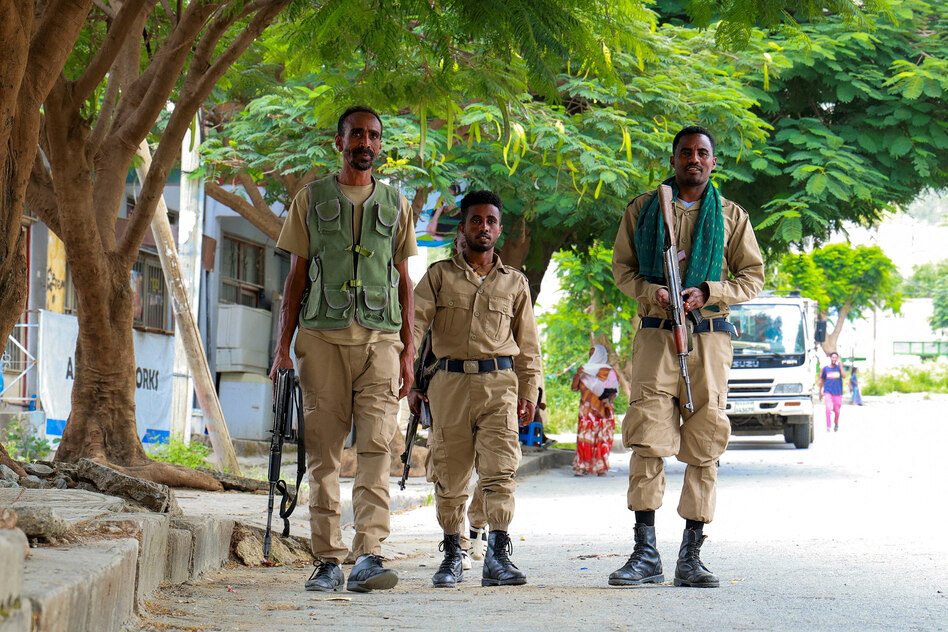
On September 23, the TPLF, one of the world's most experienced guerrilla groups, took control of all of Tigray's airports. TPLF fighters crossed the borders into the neighboring regions of Afar and Amhara and advanced to just outside Lalibela, a world heritage site in the Amhara highlands famous for its millennia-old rock-cut monasteries. Meanwhile, Ethiopian troops are reportedly repelling the rebels. There are conflicting reports of hundreds of deaths. The TPLF leadership spoke of a “total war” on Thursday; on Sunday its TV station in Tigray's capital Mekelle was destroyed by drone attacks and there is no longer any internet connection.
Just three days before the fighting flared up, the TPLF and organizations participating in the Port Sudan meeting had launched the rebel alliance Ethiopian Peoples' Forces Alliance for Survival. In addition to the TPLF, the alliance includes armed groups from the Amhara, Oromia, Somali, Afar and Benishangul-Gumuz regions.
According to the founding declaration, it is about the survival of “all nations, nationalities and peoples” in Ethiopia – a multi-ethnic state with 130 million inhabitants. Ethiopia’s government is described as a “personalized, dictatorial and genocidal regime.” “We, the People’s Armed Forces,” proclaim the rebels, “bear the historic responsibility to overthrow this regime.”
It is a familiar language in Ethiopia. In 1975, young communist Amhara revolutionaries in Addis Ababa overthrew the millennia-old Ethiopian Empire. Their military dictatorship caused a gigantic famine and was overthrown in 1991 by insurgents from Tigray and Eritrea. Eritrea became independent, the Tigray rebels of the TPLF established themselves as the ruling core of the all-Ethiopian EPRDF (Ethiopian Peoples' Revolutionary Democratic Front), which federalized and modernized Ethiopia.
When Oromo politician Abiy Ahmed was elected as the new EPRDF chief in 2018, Tigray's dominance came to an end. In November 2020, the TPLF rebelled against the central power in Tigray, followed by a bloody war that only ended with a peace agreement in South Africa in November 2022. Hundreds of thousands of Tigrayans were killed or died of hunger and disease, and large areas of land were devastated and depopulated.
But neither were most of the several hundred thousand war-displaced people in Tigray able to return home, nor were most of the several hundred thousand TPLF fighters demobilized. The western half of Tigray remained under the control of militia members from the neighboring Amhara region, who themselves went into uprising in 2023. The TPLF was officially dissolved, but the peace-skeptical majority wing around the ex-rebels remained organized and reinstated its own institutions in Mekelle in early May 2026 - five days before the “peace meeting” in Sudan.
Tigray has since returned to rebel territory, led by historic TPLF leader Debretsion Gebremichael, a veteran of the 1980s liberation war. Ethiopia's army has bombed locations in Tigray with drones several times this year. Ethiopia's parliamentary elections on June 1 this year could not take place in Tigray. Voting was only possible in 486 of Ethiopia's 547 constituencies, 438 of which were won by Prime Minister Abiy Ahmed's Prosperity Party (PP), which he founded in 2019 to replace the collapsed EPRDF.
Abiy Ahmed promises Ethiopians a bright future with the PP: opening the economy to foreign capital, an end to energy shortages thanks to the completion of the great Renaissance dam GERD on the Blue Nile and thus an end to mass poverty and recurring famines. He made peace with Eritrea and received the Nobel Peace Prize in 2019. The capital Addis Ababa shines with new developments, modern public transport and the promotion of electric cars.
But political freedoms are narrow and in the rural regions, where most people still live, old authoritarian patterns of rule remain intact: private local land ownership remains forbidden, and all-powerful security apparatuses ensure close control of the population.
All Ethiopian governments have historically maintained themselves by the central power recruiting local allies in different parts of the country and keeping them in line through concessions. Ethiopia is formally a federal republic and the individual regions even have the right to secede. But it is not intended that they actually act independently. When, as in Tigray, the local rulers really rise up, the central power does not accept it.
In 2020, the TPLF was alone in Tigray, Ethiopia's government was able to put down the rebellion and the governments of Eritrea and Sudan helped it. In 2026, Ethiopia's government will be alone. The TPLF under its experienced old leader Debretsion Gebremichael has not only gathered local allies with the “Survival Alliance”. It is also supported by Sudan and Eritrea.
Both of their governments have turned against Abiy Ahmed - Eritrea because the Ethiopian prime minister repeatedly demands its own access to the Red Sea, for example by taking over the port of Assab; Sudan because the Ethiopian military supports Sudan's insurgent militia RSF (Rapid Support Forces).
The war in Sudan between the RSF militia and the military government has resulted in hundreds of thousands of deaths and at times more than twelve million displaced people since April 2023; the RSF has committed massacres of civilians in the Darfur region that have been classified as genocide. The United Arab Emirates supplies the RSF with weapons through Bahir Dar airport in Ethiopia, UN and US experts have found. The RSF capture of the strategically important border town of Kurmuk this year was attributed by Sudan's government to Ethiopian aid. Ethiopia is “a mercenary of the Emirates in the destruction of Sudan,” it was said at the Ximdo meeting in Port Sudan in May.
From the beginning, Ethiopians have played a largely unrecognized role in Sudan's war. At the beginning of the Tigray War in 2020, numerous TPLF fighters fled to Sudan. They formed the Army 70 group, which is estimated to have tens of thousands of fighters. They did not trust peace with Ethiopia's government in 2022, they remained in exile and rushed to the aid of Sudan's army against the RSF in 2023. The resulting alliance between Sudan's military government and the Tigrayan TPLF continues to this day, mirroring the alliance between Ethiopia's government and the Sudanese RSF - even if both governments reject all of this at every opportunity.
While Sudan presents itself as a victim of terror, Ethiopia sees itself as a victim of a conspiracy. Sudan and its protecting power Egypt oppose Ethiopia's GERD dam on the Blue Nile because it changes the flow of water into their countries. Shortly after the dam was put into operation in September 2025, Ethiopia's Foreign Ministry for the first time accused Eritrea and the TPLF of planning a "new war" in Ethiopia and of having founded the Ximdo movement for this purpose. Meanwhile, Egypt has threatened at the UN level to exercise its “right of self-defense” against further Ethiopian hydropower projects, and has found sympathy for this from US President Donald Trump.
The fact that the TPLF is now supported by Sudan and Eritrea is not necessarily an advantage. Eritrea's army fought against the TPLF in the 2020-22 war, committing serious crimes. The popular pro-regime Eritrean singer Awel Seid, who justified the actions of the Eritrean army at the time, is now presenting himself as the public face of the peace movement Ximdo for the reconciliation of Eritrea and Tigray's youth. All of this requires at least some explanation.
Ethiopia's government can now portray its war against the TPLF as resistance to foreign powers. The new rebel alliance, on the other hand, has to convince militarily beyond the TPLF. This is by no means certain. In the June 1 elections, threats from militias in Amhara and Oromia to prevent the elections largely came to nothing.
The newly elected parliament is scheduled to meet for the first time on October 5th. A constitutional change is being discussed - Prime Minister Abiy Ahmed is to be elected president by parliament and then given new, far-reaching powers. So far, every attempt at complete centralization of the multi-ethnic state in Ethiopia has failed due to armed resistance. This test of strength has now begun again.
Read the full story at the source
Source: taz