
World · taz · · 3h
Nationalist resentment: “Let’s see what Poland does without us”
Deutsch (original) · Auto-translated to English
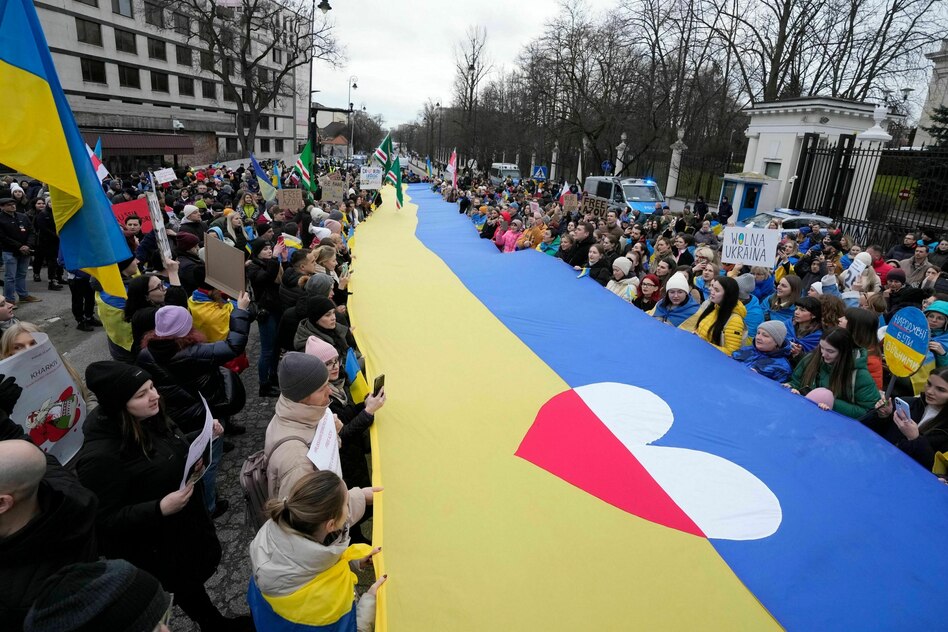
"I'm looking for help for my son, who is being bullied at school by Polish boys. The teacher doesn't do anything about it," complains Lesja K. She waits in a queue in front of the Ukraїński Dom, the Ukrainian house at the Polonia Stadium in downtown Warsaw. "The climate towards us has completely deteriorated. We no longer dare to speak Ukrainian in public so as not to be insulted," reports the woman who fled to Poland from the Ukrainian Dnipro with her son after the full Russian invasion.
Like Lesja K., who does not want to give her full name, many people from Ukraine are in Eastern Europe's largest economy. In the first six months - Poland's police have not yet published more recent statistics - the security authorities received 180 reports of nationalist-motivated crimes against Ukrainians. That is almost a third more than last year. Individual victims had to be hospitalized after attacks.
Within a year, the number of people from Ukraine officially registered as refugees fell from 999,146 in September 2025 to 868,037. In addition, there are an estimated half a million who received permanent residency in Poland before or after the full invasion. For comparison: The UN refugee agency reports 1.27 million Ukrainian refugees for Germany.
Poland is now making things difficult for Ukrainians on many fronts: even entering the country on buses, trains or cars is associated with waiting times at the borders of often up to 16 hours. According to a survey by the CBOS opinion research institute, 52 percent of the population is against further admission of Ukrainians; in 2022, 94 percent were still in favor.
Anyone who does not make sure that “UKR protection status” is expressly noted in their passport when entering the country will enter the country as a tourist and “thus lose their refugee status,” says Dmytro Dymydyuk, who advises compatriots in the Ukraїński Dom. “We have a lot of cases of this,” said Dymydyuk, who came to Warsaw as a student in 2018.
And those who do not have UKR status have had problems with their health insurance since March. Cases have been reported of very old people from Ukraine who no longer receive dialysis because they are no longer insured by the state. The state development bank BGK calculated that people from Ukraine living in Poland pay a good five times as much into the national health fund than they get from it.
Another problem is child benefit. All Polish citizens with children automatically receive the equivalent of 184 euros per month, but grandparents with grandchildren from Ukraine do not. Neither do mothers who don't work because they have several children or are looking after a disabled child. Compulsory schooling for the child and compulsory work for the parents are prerequisites for child benefit.
He doesn't experience open aggression on the street, says Dymydyuk, "but I'm also 1.90 meters tall." Anders Lyudmyla Kurko's 15-year-old daughter. She was out with Ukrainian friends and was beaten so badly by aggressive Polish men that she lost a tooth. "It became dangerous. That's why we emigrated to Spain," Kurko told the Polish-Ukrainian journalist project Sestry.
“We” also includes her husband, who was a volunteer at the front in Ukraine. He was seriously wounded and came to Lydmyla, who had fled with her daughter in 2022. While working in a Polish hospital, her husband was insulted by a colleague and told him to go back to Ukraine.
Mirosław Skórka is certain that the growing aggression “depends only on Polish politicians.” As chairman of the Ukrainians in Poland, he represents the 80,000 Polish citizens of Ukrainian origin. President Karol Nawrocki, elected in 2025, believes that “Poland is better and stronger than Ukraine”. This corresponds to a “post-colonial feeling of superiority,” says Skórka. He worries about a wave of anti-Ukrainian sentiment in the run-up to the 2027 parliamentary election.
In addition to the right-wing populist PiS party, which was voted out, the right-wing extremist party Konfederacija, which was split into three factions in the Sejm, is outdoing itself with anti-Ukrainian slogans - the most extreme being the split from Grzegorz Braun. He posted about how he abused a Ukrainian monument with a sledgehammer.
From an economic point of view, the anti-Ukrainian sentiment is misplaced: “If it weren’t for the Ukrainian refugees, Poland’s gross domestic product would be 7 percent lower,” says Leszek Balcerowicz, former finance minister and former central bank chief. 78 percent of adult Ukrainians in Poland work, they make up 5 percent of all employees. In 2025 they founded 12 percent of all new companies and a total of 123,300 companies since 2022.
Their children can only speak Ukrainian at home, “on the street it is simply too dangerous,” says a lawyer from Kharkiv who lives in Warsaw. “I long for the day when we can go home and finally live again without being unwanted.” Then she adds: “And because I want to see what the Poles will do when we’re all gone.”
Read the full story at the source
Source: taz