
Germany · taz · 7h
State election in Saxony-Anhalt: The thick brown bar
Deutsch (original) · Auto-translated to English
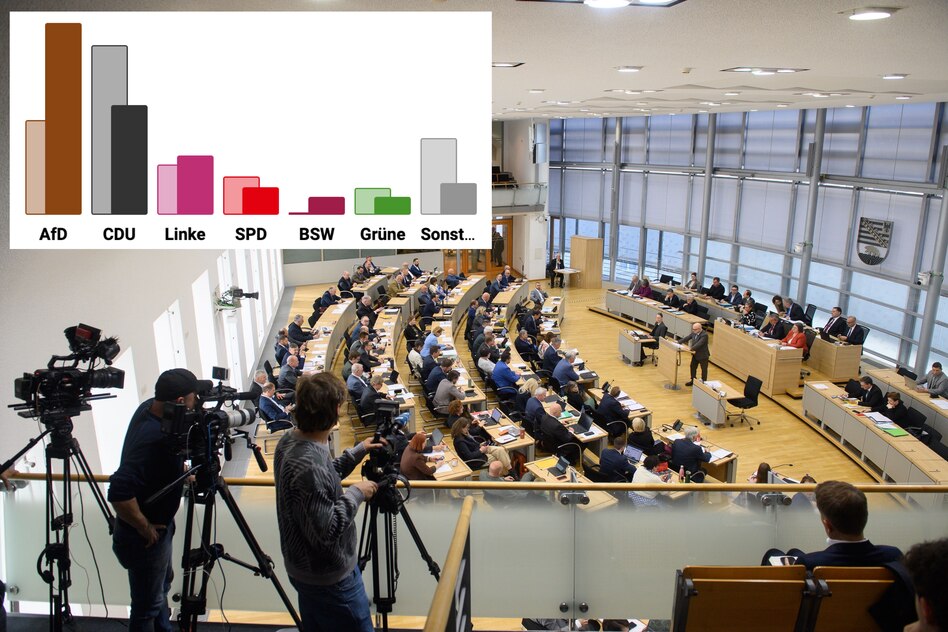
In the election in Saxony-Anhalt, the AfD became the strongest party for the first time - and by a large margin. She lacks the votes for an absolute majority in the new state parliament. Nevertheless, it cannot be ruled out that its top candidate Ulrich Siegmund will be elected as the first prime minister of a right-wing extremist party.
In order to win against Siegmund, another candidate would have to get the votes of the CDU, SPD, Left, Greens and BSW.
The voter turnout was extremely high. It was over 77.8 percent and thus significantly above the 60.3 percent in the last state election in 2021. The right-wing extremists in particular apparently benefited from this.
The right-wing extremist AfD has around 43.8 percent. This is shown by the provisional official final result, which was published by the state election authority on Monday morning. She exceeded all polls she had recently seen between 40 and 43 percent and was able to double her share of the vote compared to the last election. In 2021 it was almost 21 percent. All other parties, on the other hand, look old.
The previously ruling CDU fell from 37 to 17.2 percent - it was another 5 percentage points worse than in the last surveys. It is their worst result ever in Saxony-Anhalt.
The Greens and the SPD, who at times even had to worry about returning to parliament, safely returned to the state parliament. The SPD improved from 7.8 to 9.3 percent, the Greens from 5.9 to 8.9. This is the Greens' best result ever in this state.
For the left, however, the result is a disaster. It loses 2.4 percentage points compared to 2021. And even more compared to the surveys, which had seen it at 13 to 14 percent in the summer. In the end, it only became the fifth strongest party.
The FDP, which has so far sat in government together with the CDU and SPD, is being thrown out of the state parliament. It falls from 6.4 to just 2.6 percent.
The BSW, which competed in Saxony-Anhalt for the first time, achieved a surprise success. With 5.3 percent, it came just over the 5 percent hurdle, making it the sixth party in the new state parliament. The BSW competed in Saxony-Anhalt for the first time.
The AfD will have almost half of the seats in the next state parliament. She gets 39 of the 83 seats. This means she is three seats short of an absolute majority.
The CDU parliamentary group is not even half as large as before; it only gets 15 seats instead of the previous 40. The SPD, the Greens and the Left each have 8 seats. According to the provisional official final result, the BSW is represented by 5 representatives.
This graphic is interactive. You can click together your desired coalition and check whether it could be enough for a majority. It quickly becomes clear that mathematically the AfD would only have to work with one party. Since the CDU, SPD, Greens and Left have ruled this out, only the BSW would remain. The AfD offered this offensively.
AfD leading candidate Siegmund also emphasized on election evening that he only wanted to govern alone. Apparently he is relying on defectors from the other parties.
A collaboration between the CDU, SPD, the Greens and the Left, however defined, does not have a majority because the BSW is represented in the state parliament. Even if the BSW hadn't come in, the four would have first had to agree on some form of tolerated minority government. The CDU has ruled out formal cooperation with the Left.
On election evening, the AfD once again exceeded all polls. But the deviations were even more dramatic for the other parties. You can see this in this graphic especially when you adjust the curves of infratest dimap.
The CDU and the Left Party in particular performed significantly worse than predicted in the surveys. Conversely, the SPD, the Greens and the BSW were able to win over significantly more voters.
This is likely to be the result of the campaign for tactical voting. It was explicitly advocated that the second vote should be given to the SPD and the Greens so that they could get over the 5 percent hurdle - in order to be able to form a stronger barrier against the AfD.
The election results in Saxony-Anhalt had already deviated extremely from the surveys in 2021. At that time, the CDU was able to gain up to 10 percentage points more than expected. This was also the result of tactical voting. Many people in Saxony-Anhalt voted for the Union so that it would become stronger than the AfD. That was successful back then.
This time, according to surveys, it was clear that the CDU had no chance of finishing ahead of the AfD again. This time it was more important for many voters to elect other parties to the state parliament.
This assumption is also confirmed by the analysis of voter migration, which was prepared by the infratest dimap institute on behalf of ARD.
Accordingly, thousands of voters have migrated from the Union to the SPD, the Greens and also the BSW, which can be explained by tactical voting.
However, the CDU's dramatic collapse was caused by the much greater losses it suffered against the AfD, to which it lost around 82,000 votes.
The flow of voters from the Greens and SPD shows that tactical voting worked. Both clearly won from the Union. They were also able to inspire many previous non-voters. To a lesser extent, they were also able to win over former Left Party voters. In fact, the movement here may have been much stronger in the last few weeks because the left did significantly better in surveys in August than in the 2021 election.
By far the strongest voter migration was from non-voters to the AfD. According to infratest, she was able to persuade 170,000 people to go to the polls and vote for her. That alone could account for up to 15 percentage points for the AfD - and was therefore decisive in the election.
The old wisdom of left-wing campaigners that you just have to get people to vote to prevent a strong AfD result has been finally refuted.
Who won the direct mandate and where? Which party was ahead in the second votes in the constituency? This is shown in the following graphic – and it is also brown almost across the board.
Because the AfD also won all direct mandates – except for three.
Only in the constituencies of Magdeburg II, as well as in Halle II and Halle III did the left-wing candidates ultimately come out on top. The right-wing extremists won 38 of the 41 direct mandates.
Only in the Magdeburg III constituency did the CDU candidate come a little closer to the AfD competitor. It was the incumbent Prime Minister Sven Schulze who won 31.7 percent of the first votes there. That was almost twice as many as the CDU received in second votes there. But Christian Mertens (AfD) was still clearly ahead of him with 35.2 percent.
Where did the individual parties perform particularly well or particularly poorly? This shows this map with the strongholds of the individual parties, which you can select with a click at the top left.
The AfD dominates the constituencies almost nationwide, with the first votes even slightly more than the second votes. She achieved her strongest results in Eisleben (55.6 percent of the first votes) and Staßfurt (54.1 percent of the second votes). The right-wing extremists were weakest in Halle. In Hall III they only received 18.3 percent of the second votes. But even there they were able to roughly double their result.
This graphic is particularly interesting when you look at the differences between first and second votes. It becomes clear that the idea of tactical voting has also taken effect here. It's not just Sven Schulze (CDU) that there are extreme differences between first and second votes.
The three Left Party candidates who won their constituencies also benefited from vote splitting. Mustafa Groner got 29.4 percent of the first votes in Magdeburg II. The Left Party received just 12.9 percent of the second votes. But for the Greens there it was the other way around. They were able to improve the second votes from 15.5 to 22.8 percent and were therefore only just behind the AfD (23.6 percent) in second place. However, their direct candidate Madleine Linke only received 6.0 percent of the first votes.
Apparently, a lot of people in this urban constituency have divided their votes between the Left and the Greens - on the assumption that the Left's direct candidate is most likely to be able to prevail against the AfD, but that the Greens primarily need second votes in order to get above 5 percent nationwide. The situation is similar in the Halle II and III constituencies.
Read the full story at the source →
Source: taz