
Germany · taz · · 3h
Artist on emetic memorial: “It’s supposed to be unpleasant”
Deutsch (original) · Auto-translated to English
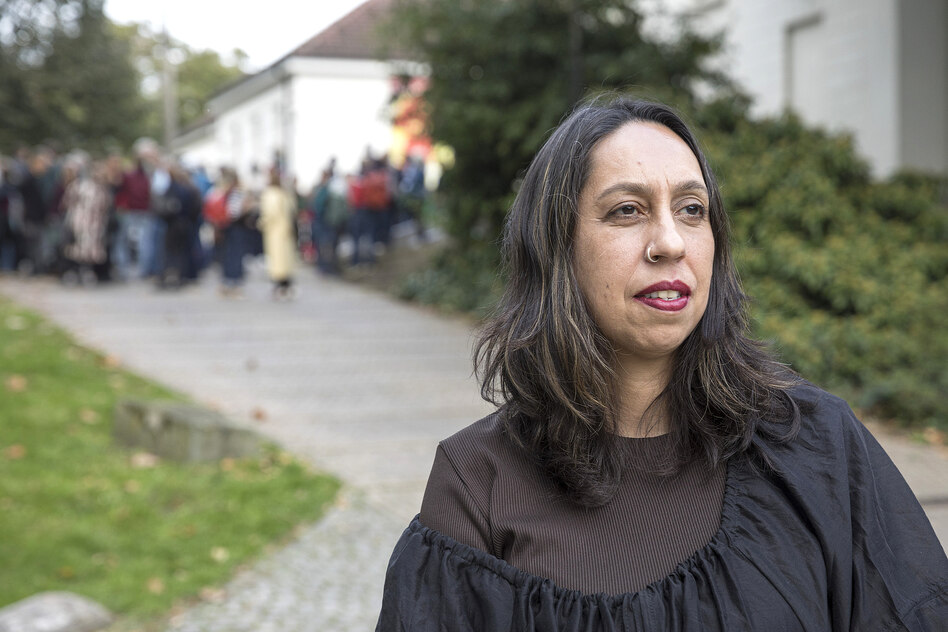
taz: Usha Seejarim, what motivated you to design a memorial for Bremen from Johannesburg?
Usha Seejarim: First and foremost, it was the deep injustice of history. I come from South Africa, where we have a long history of racism and state abuse of power. When my design was selected, I felt very honored to be able to tell Laye Condé's story. And I wanted to do it in a way that brought justice to him, his family and the other victims.
Born in 1974 in Bethal, Mpumalanga Province, South Africa, conceptual artist, lives and works in Johannesburg, where she teaches as a visiting professor of South African art and visual culture at the university. Solo exhibitions in Cape Town, Rotterdam and New York, among others.
taz: Laye-Alama Condé died in Bremen in 2005 after he was forcibly given emetics while in police custody. Between 1991 and 2005, police carried out the procedure in more than 1,200 cases in the city alone. What idea is at the center of the memorial for you?
Seejarim: I made a very conscious decision to use text. Text can be neutral, but it can also be chosen specifically. After reading Laye Condé's story, the word force kept coming to mind. Laye was forcibly arrested. The emetic forced his body to expel the contents of his stomach. Then it was primarily the police force that was involved in his death. And ultimately, it was only the joint strength of civil society (communal force) that made the construction of this memorial possible. The term has many facets. An important step was also listening to interviews with those affected. I wanted to give myself time to let the story sink in. This is an essential part of my work.
taz: Unlike traditional monuments, the focus here is not on Laye Condé. Are you consciously breaking with this classic rhetoric?
Seejarim: Absolutely. Monuments are the legacy of an imperialist time in which heroes were created. That's why I decided on a design that stands in contrast to this.
taz: In Bremen too, street names are reminiscent of colonial rulers and the city's long, violent past. What does it mean that a memorial against anti-black racism is being built here?
Seejarim: First and foremost, the memorial is in Bremen because Laye Condé was killed here. It has to be here. But it is true that his story must also be understood in the context of colonial history.
Seejarim: It's about the question of who has power and who is the victim of this power. Historical and current. We are currently seeing this in a global shift to the right, a fear of those who are different. Black bodies become easy targets.
taz: According to a report published in 2023 by the European Union Agency for Fundamental Rights (FRA), anti-black racism is increasing across the EU. What does it mean that the memorial is being dedicated right now?
Seejarim: When my work was selected in 2020, it already felt relevant. But now she is even more so. The world has moved even further to the right in recent years. It is important to understand that anti-black racism does not only exist in the EU. We are also experiencing increasing xenophobia in South Africa. This is black-on-black violence. In my exhibition, which is currently being shown in the Gerhard Marcks House, I refer to the EU and the slogan “Send them back”. It's about the idea of what one's homeland is. When someone leaves home, it's a matter of pure survival. Discriminating against refugees is such a violation of their rights. And I think the world is moving in a direction where that will be forgotten. The task of the memorial is to draw attention to this. He's trying to say: Wake up, this is happening. And it's happening right here.
taz: In the report, more than every second black person in Germany stated that they had been victims of racist attacks in the past five years. Is this also a reason why visitors can interact with the memorial?
Seejarim: Yes. I want the experience to be physical. Visitors should engage with the place, but it should not be a pleasant experience. The letters are slanted; they are cold like the bed Laye was pinned to. It's supposed to be unpleasant because it's an unpleasant story. And it is also important to me that we understand that we are partly to blame. Passivity means complicity.
In the period from 1991 to 2005, at least 1,200 people in Bremen alone were administered emetics using brute force on police orders by cooperating forensic doctors. The police suspected them of drug trafficking and accused them of swallowing plastic containers containing cocaine.
Following the Bremen example, this method of preserving evidence was introduced by the states of Hesse, North Rhine-Westphalia, Baden-Württemberg, Lower Saxony, Berlin and Hamburg. In Hesse it was ended again in 1996: the Frankfurt Higher Regional Court saw it as torture and therefore a violation of human rights. The assessment was confirmed by the European Court of Human Rights in 2006.
All torture victims known in Bremen are black. Achidi John died on December 12, 2001 in Hamburg and Laye-Alama Condé on January 7, 2005 in Bremen as a result of the procedure.
taz: In other of your works you use irons or clothespins to reflect the relationship between care work, gender and patriarchal oppression. What role do materials play in this work?
Seejarim: For me the material is the starting point. I thought a lot about the visitors' experience and Laye's experience. What were his final moments like? This gave rise to the idea of using steel. It was about finding a material that becomes a metaphor. In my exhibition in the Gerhard Marcks House I worked with coffee bags. The reason for this is that Bremen is known for coffee, but not as a growing region. The coffee comes from Africa or the Global South and is exported from Bremen to the rest of Europe. In my work I draw a parallel between this type of exploitation, the migration of people and a politics of exploitation. Laye Condé's story must also be told in this context. It's almost the same narrative.
taz: What role can memorial sites play in coming to terms with colonial crimes and this more recent chapter of anti-black racism?
Seejarim: The fact that this memorial was created is particularly thanks to Bremen's civil society. But it also requires the city to take responsibility. With the construction, the city of Bremen is not only saying that Laye Condé's death must be told. She puts this story at her own center. This memorial breaks through the oblivion. It is an important step towards recognizing the truth.
The interview was conducted in English and translated into German.
Read the full story at the source
Source: taz