
Climate taz
Climate catastrophe in the Pacific: Mangoes and melons still help against thirst
Many Pacific countries are acutely threatened by global warming. They doubt Australia's role, co-host of the UN Climate Change Conference, as a climate pioneer. more...
Deutsch (original) ·Auto-translated to English
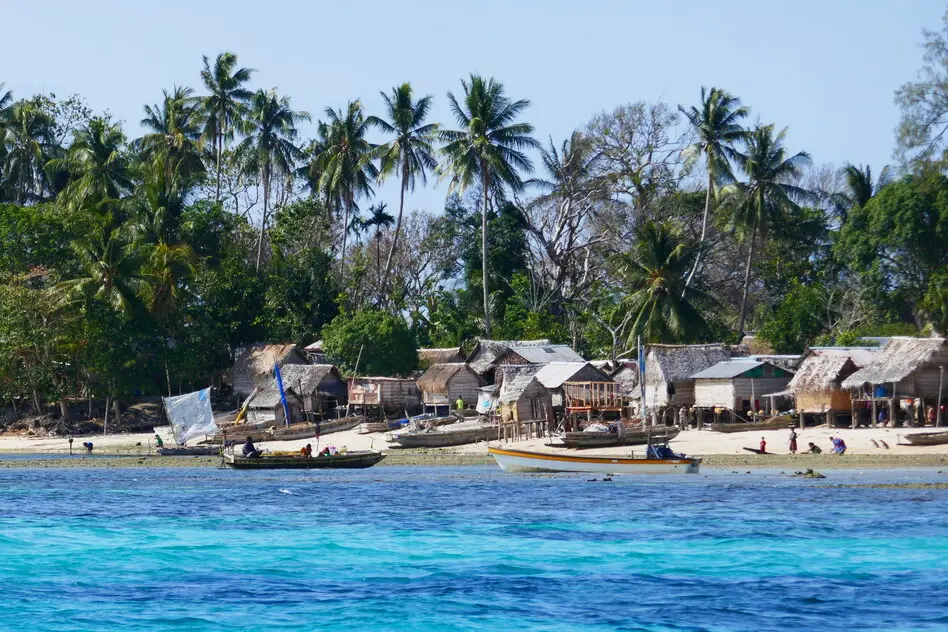
Tonny Mosiyawaoa is finished. “I ask you to buy something,” he begs a group of tourists who have anchored their cruise ship off Kuiawa and are visiting the island for a few hours. A small mortar lies on the floor in front of him, and a few hand-carved figures. It hasn't rained in Kuiawa in Papua New Guinea's remote Trobriand Islands for nine months. A photo on his cell phone shows: His banana harvest has dried up. Mosiyawaoa says he no longer has any income and doesn't know how he can feed his children. He couldn't count on help from the government in distant Port Moresby. Panic is reflected in his eyes. “Everything is dead,” he says.
Kuiawa is one of many islands in the Pacific that are suffering acutely from the climate catastrophe. Australian researchers warned last year of an impending “extreme El Niño that has never been seen before”. This periodic warming of surface temperatures in the tropical Pacific is changing global weather and climate patterns, leading to droughts, heat waves and fires in some regions - while heavy rain and flooding are becoming more likely elsewhere. Scientists say that human-caused global warming is a key reason why El Niño is particularly extreme this year.
Kuiawa is just 1,000 kilometers from northern Australia - a stone's throw in the Pacific. But the fate of people like Mosiyawaoa is hardly an issue for the most powerful, richest and most influential Pacific neighbor. Quite the opposite: The Australian government seems to be little concerned that its policies are at least indirectly contributing to the aggravation of the situation. Australia is not only one of the largest producers and exporters of climate-damaging coal and natural gas, it even wants to further expand these industries. And: This year it is playing an important role as co-host and negotiator at the UN climate conference, which began on Monday in Antalya, Turkey.
Politicians and experts from all over the world are meeting for the 31st UN Climate Change Conference in Antalya, Turkey. From November 9th to 20th, representatives from around 200 countries will discuss the fight against global warming. The taz has a team on site. Follow our reporting on our focus on taz.de, on klima.taz on Instagram, in the podcast klima update°, in the newsletter TEAM ZUKUNFT, in the weekday e-paper and in the weekly taz.
The social democratic government in the South Pacific, which has been in office since 2022, likes to act as a climate pioneer. But Australia's neighbors are increasingly beginning to scrutinize Canberra's promises more closely. While Australian Prime Minister Anthony Albanese is loudly promoting renewable energies and climate protection around the world, his Labor government is approving new coal mines, gas production facilities and export projects worth billions.
The conflict is not new. What is new is the tone in which it is carried out. For decades, Australia was the most important donor, trading partner and security policy reference point for many Pacific countries. Criticism of Canberra was therefore formulated carefully - and when it did, it was usually behind closed doors. The island governments are now appearing more self-confident. They know that their voices have weight in international climate negotiations. And that Australia needs their support, not least for its ambitions on the world stage.
The discrepancy became apparent at the recent Pacific Islands Forum in Palau. The governments of Tuvalu, Kiribati, the Marshall Islands and other low-lying island nations are grappling with rising sea levels, coastal erosion and increasing damage from extreme weather. They see climate change as an immediate threat to their territorial integrity and cultural existence. The region's heads of state and government therefore reiterated their goal of limiting global warming to 1.5 degrees if possible.
At the same time, there was unusually loud criticism of Australia's fossil fuel energy policy. Vanuatu's Climate Minister Ralph Regenvanu put it bluntly: Australia must stop expanding fossil fuel production and accelerate the transition to clean energy. “The least a country like Australia should do is not allow further expansion,” he says.
But Australia is doing exactly the opposite. According to a survey by the non-governmental organization Climate Council, the Albanese government has approved a total of 38 new or expanded coal, oil and gas projects since 2022. This includes extending the operation of the West Australian company Woodside's North West Shelf gas plant, which critics have described as a "climate bomb". The project is expected to result in emissions of around four billion tons of CO₂ by 2070. Meanwhile, Canberra is pointing to its energy transition: In September 2025, the government had already approved 100 renewable projects, including solar parks, wind turbines and battery storage. According to Canberra, they could mathematically supply all Australian households with electricity.
Both developments are taking place at the same time. The revenues, jobs and regional economic interests of the extractive industry have considerable political weight. In addition, lobbyists for coal and gas companies pump millions of dollars each year into support for both the ruling Social Democrats and the opposition Conservatives.
It is probably no coincidence that even senior government politicians repeat the position of industry representatives that the country is only meeting demand with its coal and gas and is not responsible for the consequences of burning the exported raw materials. It's an argument that "a schoolyard drug dealer would make," according to one critic.
The changing geopolitical environment could now mean that Australia will have to listen more to the concerns of its island neighbors. China has systematically expanded its influence in the Pacific in recent years. Beijing finances roads, bridges, government buildings and sports stadiums. According to an analysis by the Australian think tank Lowy Institute, China provided around $230 million in development money for the region in 2023. Beijing is now also presenting itself as a partner in climate protection. In May 2025, China announced deeper cooperation with island states on disaster prevention, early warning systems and coastal protection.
This development is delicate for Australia. When it now organizes the world climate conference COP31 together with Turkey, an uncomfortable question arises: How credibly can a country represent climate protection for an entire region when it is at the same time one of the largest exporters of the energy sources that threaten their livelihoods?
For Tonny Mosiyawaoa on Kuiawa, such questions are academic at best. His problems are immediate: the community's tap has been dry for weeks - the freshwater reservoirs in the coral island's soil are empty. Thirst is now a permanent condition for many people. “We give our children watermelons and mangoes,” says Mosiyawaoa. At least for now. The fruit trees also suffer from the lack of water and the salinization of the soil - a consequence of rising sea levels.