
Germany taz
Church asylum in Germany: Welcome to the rectory
For refugees, church asylum is often the last hope. But politically it is coming under increasing pressure. Visiting two communities. more...
Deutsch (original) ·Auto-translated to English
Two small children race through the church hall on scooters. Ritta Seno watches the game. As the little ones dart past her, the young woman with curls spreads her arms. Naturally, one of the children drops the scooter, runs towards Seno and lets himself be spun around. "I knew it. This is fun for everyone!" she says and laughs. The Syrian woman then carefully places the child on the floor and walks down the hallway.
She wants to know what happened to the church in Cologne-bilderstöckchen where she found asylum for a few months. In the converted sexton's office where she slept around four years ago, there is still a bed with a small shelf above it. There is another mattress on the floor at the foot. The room in which a family of six who fled Afghanistan via Turkey sleeps is perhaps six square meters. “It's small, but it's the best thing that's ever happened to me in my life,” says the 22-year-old. Ritta Seno nods so hard that her hair bounces.
In 2025, over 2,000 refugees were living in church asylum in Germany in former sexton offices or parish apartments of the Protestant and Catholic churches. Among them hundreds of children. Most come from Syria, Afghanistan and Iraq. Pastors and their parishioners thus protect them from deportation to EU countries of first entry. An act of solidarity that only exists in a few EU countries and which is repeatedly criticized because it allegedly undermines common EU law.
There have already been prominent departures from the church, such as that of the SPD politician and former State Secretary in the Federal Ministry of Justice, Christian Lange. He said the church would play into the AfD's hand. In Saxony-Anhalt, church asylum could be stopped completely if there was an AfD-led government there. Church asylum has no legal basis that is written down in laws. It is a quiet compromise between the Federal Office for Migration and Refugees (Bamf) and Christian church communities, such as in Cologne-bilderstöckchen and on Fehmarn, which the author visited.
This text first appeared in wochentaz, our weekly newspaper from the left!
Every week, wochentaz is about the world as it is – and as it could be. A left-wing weekly newspaper with a voice, attitude and the special taz view of the world. New every Saturday at the kiosk and of course by subscription.
“It's not like a serious criminal knocks on the door and we hide him,” says Reinhild Widdig, pastor of the Nathanael Church in Cologne-bilderstöckchen, looking into the former meeting room from the hallway. There are three clothes racks and four refrigerators that the community purchased. The church can now accommodate up to ten church asylum guests.
There is a sofa in front of the window front, which offers a view of the adjacent garden. “The people who come here are exhausted and afraid.” The pastor has been looking after those seeking protection for almost ten years. As a rule, it is refugees who are threatened with deportation or transfer under the Dublin III Regulation because they have already submitted their asylum application in another EU country.
The refugee representatives of the respective regional churches submit a dossier to the Bamf that proves that repatriation would not be reasonable for the people. If the authorities agree, the church asylum is valid until the deportation period for the people has expired. This is usually six months. “After this period has expired, it is as if the sky had opened and man had fallen on German soil,” summarizes Widdig. The asylum application will then be processed in Germany.
The woman in her late fifties takes a loving look at Ritta Seno. “It’s always nice to see how quickly people recover here.” The escape was a difficult time for Seno. "I have to erase what I experienced there from my memory. I don't have to go back to being lucky."
She shakes her head as if to clear the thoughts of it and walks to the other side of the hallway. She carefully knocks on the door of the former archive. “Can I come in?” she asks carefully. A petite woman opens the door. She smiles with dark brown eyes. She casually placed the scarf over her head. “There you are,” says Aissatou happily and kisses Ritta Seno on both cheeks. In her room, the church's converted archives, there is a narrow mattress, a sofa and a closet.
There is a red flower made of Lego bricks on the shelf. Empty picture frames hang on the walls. “We urgently need to do something about it!” says Seno. Aissatou nods happily. The two have only seen each other a few times, but they liked each other straight away. Ritta Seno often comes by to spend time with the asylum guests, cook or play cards.
One condition is that those seeking protection are only allowed to leave the premises during the period of church asylum in a few exceptional cases. “It’s not easy,” says Aissatou. Because her application was not received in time, her transfer period was extended to 18 months. “This is how I calm down,” she says. The 20-year-old fled a forced marriage from a country in West Africa that she does not want to name for fear of her family.
She fought her way alone across the Mediterranean to Spain, where she applied for asylum before fleeing on to Germany. The fact that she experienced sexual violence at all her stations is stated in her hardship case dossier, which is available to the Bamf. Aissatou doesn't want to be found online, so her name has been changed by the editors. Aissatou doesn't want to talk about her experiences either. Instead, she says: “Here in the church asylum I feel safe for the first time in my life.”
“Unfortunately we hear something like that far too often,” says Jan Niklas Collet. The majority of people who apply for asylum in Germany have experienced a lot of violence. Added to this is the stress in the large collective accommodation, where there is far too little space for everyone and far too few skilled workers can ensure a good arrival.
“It is all the more important that we offer a safe space and provide professional support.” Collet is one of three social advisors on the “Refuge” project. In order to be able to accommodate even more refugees in the church, an old used caravan was purchased. He is standing in the garden. Two Uyghur women are scheduled to move in here in a few days.
The church asylum saved Ritta Seno and her father from being returned to their country of first entry. They fled together from Syria via Moscow to Minsk, where they were driven by a team of smugglers to the EU's external border in Poland. The two experienced pushbacks and slept in the forest near the border for several weeks. “I didn’t know what wild boars looked like, but I heard them snorting in the dark forest,” she remembers. “But Dad said: Everything’s OK.”
On her smartphone she shows a picture of herself surrounded by dozens of other refugees; she looks exhausted. Seno and her father were picked up by the Polish police and taken to the refugee camp in Białystok. An area that is surrounded by meter-high walls, fences and barbed wire and that has been criticized for a long time. Journalists and NGO workers have no access. What happens inside can only be found out from eyewitness reports.
Ritta Seno shudders at the memory. "We were locked up. We were watched all day. We didn't know how long this would last. We tried to just get the day over with. I had very bad dreams during that time." The otherwise lively girl who helps the staff translate becomes more and more quiet. After two months, Ritta Seno is so apathetic that the senior doctor orders her immediate release. Father and daughter move on to Germany.
If you ask your father today about that time, tears well up in his eyes. "I was very afraid for my daughter. But I couldn't show any weakness. I wanted a future for all of us." While Ritta Seno and Aissatou take selfies in front of a pool table, Collet, a doctor of theology in a pink hoodie, sits at a table a few meters away.
In the church hall, where services and choir rehearsals continue to take place, he listens to the concerns of the church residents. Sitting in front of the man in his mid-thirties is a couple from Afghanistan who belong to the Uzbek minority. The children are scurrying between the chairs. A two-month-old baby sleeps in a stroller. Collet, who speaks ancient Greek, Latin and Hebrew, takes his cell phone out of his pocket and opens a translation app. “I just wanted to ask you how things have been going for you here over the last few weeks,” he says. The question is translated into Turkish.
The man, in his mid-twenties, hears and speaks something into the cell phone. Then he hands it back to Collet. Half a minute later, the app replies: "Thank you very much. We're doing well. The children aren't missing anything. Just a little education." Collet replies that he will organize a place at school and asks about health. "Almost all people who arrive here have some kind of medical concern. And that usually doesn't come out in the first conversation, but rather it takes a while. That takes trust," says Collet. Knee problems, panic attacks, missed periods. A group of helpers, which also includes doctors, would then be involved.
A church asylum place costs around fifty euros a week. Because the refugees do not receive any government support, the communities rely on donations. In order for a church asylum to be a good time for the refugees, it also needs the support of volunteers. In Cologne-bilderstöckchen there are around 40 people who play, cook and teach German with the residents. Aissatou, who would ideally like to train as a pediatric nurse, spends most of her everyday life studying and reading. Ritta Seno and her father also learned German in the church asylum. “I was able to really concentrate here for the first time.”
Almost 550 kilometers away on Fehmarn is the St. Nikolai Church in Burg, which includes a rectory and a community center made of red brick as well as a cemetery.
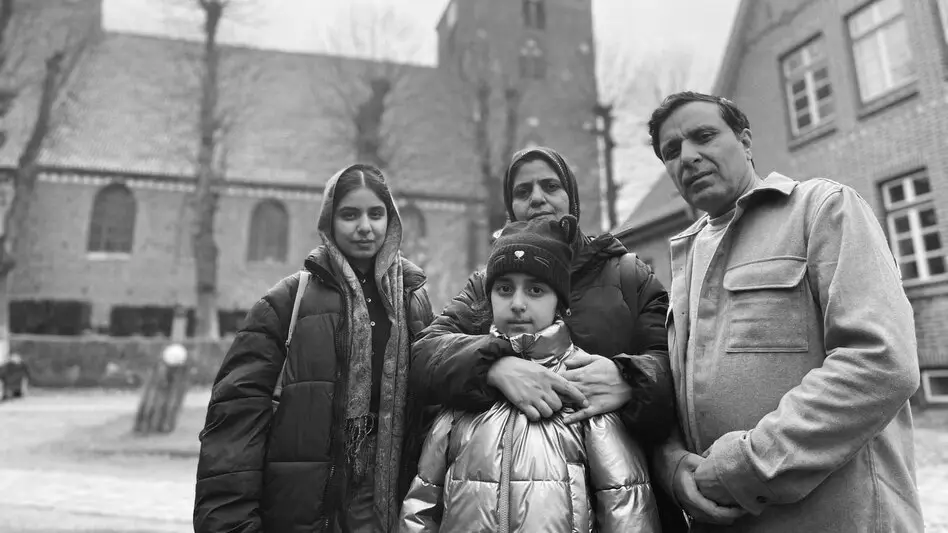
A family of four has been living here in church asylum for five months. Early in the morning, the mother squeezes carrot juice, an old family recipe from Afghanistan. While eight-year-old Nasrin is required to attend school, 17-year-old Laila has to stay at home. Both are actually called differently, but because they are in the asylum process with an uncertain outcome, their names have been changed.
Laila spends her days cooking, reading and learning German. Before church asylum, Laila attended an integration class at a vocational school and learned German four hours a day. Supporters now come to the church three times a week and continue to teach her the language. Laila dreams of staying in Germany, studying law and getting a driving license. Things that would be unthinkable under the Taliban in Afghanistan.
The chance that the refugees will be allowed to stay in Germany after the end of church asylum is over 80 percent. In North Rhine-Westphalia, refugees most often receive asylum in a place of worship, closely followed by Hesse and Bavaria. Meanwhile, the Northern Church has come under increasing pressure in recent years. A church in Schwerin was evacuated at the end of 2023. In Hamburg, an Afghan man was deported from a church asylum to Sweden in 2024. Church asylum only protects against deportation as long as the authorities stick to the informal agreement. The state has the right to enter churches, parish halls and community centers at any time and to take people out.
In spring 2025, this right should also be enforced in Burg auf Fehmarn. Justice employees from Schleswig-Holstein were on their way from the mainland to the Baltic Sea island and wanted to close the church asylum of two Iranian women. Supporter Jutta Paetow is still upset when she thinks back to that night. Together with other supporters, she brought the two women from the rectory to the sacristy of St. Nikolai Church: "We had put up a pinboard. There were two camp beds on one side. And on the other, someone had quickly set up a camping toilet," says Paetow.
Gesine Hansen from the parish council also remembers the night. "I sat here and held their hands. And they just cried bitterly. But they knew we were there and we would protect them." A dozen people took turns keeping watch until the next morning. The church's pastor, Susanne Platzhoff, spoke to the judicial staff and pointed out the lack of a search warrant. Successfully. The Iranians were allowed to stay. "I did exactly what I stand for with my Christian faith because I simply recognized it as right. This is perhaps a kind of Martin Luther moment for me, so: Here I am, I can't do anything else."
This incident brought the people on Fehmarn together. The community in Burg has welcomed around 70 people from Afghanistan, Iraq, Iran and other countries in the past three years. Laila's family also lives in the rectory, which had previously stood empty for years. The church is seeing declining membership numbers. Many congregations are merging and more and more church buildings remain unused. With the church asylum, the community in Burg has reinvented itself a little.
“Not everyone likes that, but many people also seek conversation and realize that they have a lot in common,” says Pastor Platzhoff. Together with her colleague Bettina Axt and the parish council, she initiated the opening. Also those about the Muslim community. She has been holding her Friday prayers in the community center for some time now. This year they also celebrated breaking the fast here for the first time. For Laila, this is an opportunity to meet other girls her age. She takes advantage of the opportunity to practice the German language with an Iraqi woman who also lived in church asylum and a Turkish baker.
Back in Cologne: In addition to his job as a social advisor, Jan Niklas Collet also works for the Asylum in the Church network. The office is in the “House of the Evangelical Church” in Cologne, a white, flat new building. There are bottles of mate on the desks. A self-drawn picture adorns a computer: a stick figure with a roof over his head. “Thank you” is written next to it in scraggly writing.
The network organizes church asylums in North Rhine-Westphalia. Ritta Seno and Aissatou also asked for help here. Collet's team receives over 50 inquiries every week. It can only help very few people. Although 91 people have already been accommodated in the first five months of this year, the team is concerned about the impact of the new EU asylum laws (Geas). The deportation period to the EU country of first entry has been extended from 6 to 36 months if the person is considered a fugitive.
This is generally assumed for people in church asylum. Refugees now have to stay in church asylum for that long so that their application for asylum in Germany can be examined. So there will be fewer places in the communities. “For many refugees this means that they then go into hiding, hide, somehow get by, try to get through these 36 months in Germany on their own,” says Collet. “The new EU laws have nothing to do with solidarity.” Once again, church asylum will have to be reinvented. Collet is confident. The path remains to be seen.
The atmosphere in the Nathanael Church seems cheerful. A man strums a piano. It smells like mint and onions. Ritta Seno did the shopping and cooked in the kitchen with the residents and five volunteers. Aissatou and the Uzbek women carry pots of dishes from Afghanistan and China into the community hall. Ritta Seno looks around happily.
"I'm really very grateful that I was given the chance for a new start. Every person has the right to that." Without church asylum, she would have been deported to Poland, she would not have been able to bring her family with her, she would not have worked as a social worker and her father would not have worked as a bus driver. “This is how we can give something back to the country.”
Lena Reich, the author of this text, is also the author and director of a TV documentary on the subject of church asylum. This is currently available in the Arte media library under the title “Re: Asylum in the House of God”.