
Germany taz
Canada as an associated EU member: More than just a dispute over words
The EU and Canada want to cooperate more closely. But what this connection should be called is controversial in European politics. more...
Deutsch (original) ·Auto-translated to English
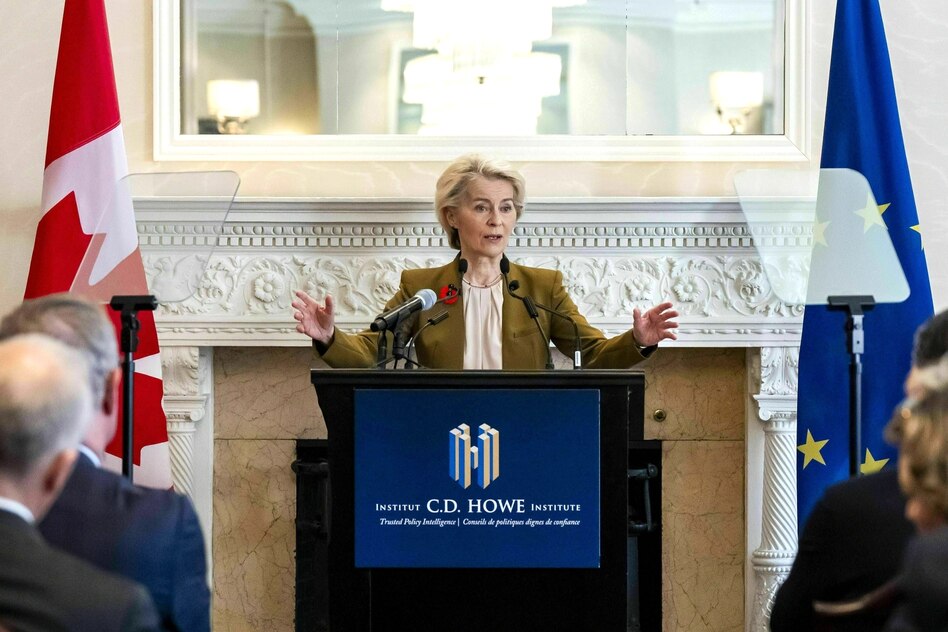
Ursula von der Leyen can be quite stubborn. Shortly after landing in Montreal, where the EU-Canada summit is taking place on Thursday and Friday, the President of the EU Commission sent out a tweet that caused a sensation. Von der Leyen wrote on “X” that she wanted to bind Canada even more closely to Europe and make the North American country an “associated member” of the EU.
The CDU politician knows only too well that Chancellor Friedrich Merz rejects Canada's “associated membership” - the CDU leader has reserved the term for Ukraine. Other countries such as France are also reluctant to grant Canada a special status that is not provided for in EU law. The dispute even overshadowed the preparations for the summit.
But when von der Leyen, EU Council President António Costa and Canadian Prime Minister Mark Carney met in Montreal on Thursday, the dark clouds had blown away. What you call the collaboration ultimately doesn't matter, Carney said: "What matters is the difference it will make to the lives of Canadians." Canada will become “a more independent, sovereign nation” through cooperation with the EU.
This is aimed at the overpowering neighbor USA and its overreaching President Donald Trump. Trump has threatened Canada and imposed punitive tariffs. Carney would like to use the cooperation with the Europeans to put Trump in his place and perhaps even to forge an alliance of the “middle powers” – against the all-powerful USA, but also against Russia and China.
It may come as a surprise that Carney is relying on the EU. After all, the Europeans allowed themselves to be ripped off by Trump in the tariff dispute and accepted a bad deal. The EU is also dependent on the USA in the Ukraine war, as the dispute over Patriots and Starlink has shown. However, the flirtation between Canadians and Europeans has been going on for several months now.
In a speech at the European Parliament in Strasbourg in September, Carney even made a kind of declaration of love. Not only does their shared history connect the two blocs, they are also a “perfect match” economically and militarily. As examples, he cited the Ceta trade agreement, which has not yet been ratified by all EU states, and the aid to Ukraine.
At their two-day summit, Canada and the EU want to further expand their cooperation. A digital trade agreement that enables faster and cheaper online transactions is to be presented in Montreal. The draft summit declaration also envisages deeper cooperation on the infrastructure for artificial intelligence and its regulation.
Canada could also join the European navigation system Galileo, which offers an alternative to the US system GPS. The EU, in turn, is interested in the Canadian deposits of so-called rare earths. The European Investment Bank is considering putting money into Canadian raw materials projects. Brussels and Ottawa are also looking at building up joint strategic stockpiles.
An “alliance for the future” will be forged, said EU diplomats. They have even found a solution to the dispute over “associated membership”: the goal is an “ever closer connection” of Canada to the EU “without full membership,” according to the summit draft. Von der Leyen can probably live with that - there was never any talk of full membership anyway.