
Germany · taz · · 3h
Young electoral arena of the RBB: 16, political, quick-witted
Deutsch (original) · Auto-translated to English
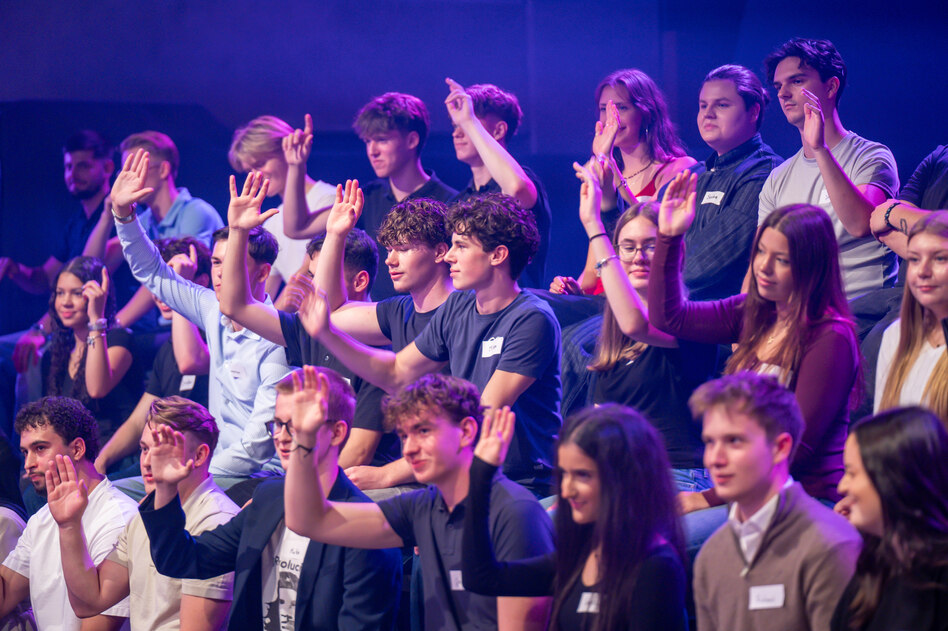
Loud beeping and flashing fill the room. The AfD politician who was just talking becomes silent. A young person in the audience pressed the buzzer and redeemed the joker, so to speak. “Crime is not generally related to origin,” he says in a firm voice, “perhaps you should educate yourself on this in your free time.” The audience giggles, murmurs and claps enthusiastically. The AfD MP Alexander Bertram, who was corrected by a young person, grimaces.
The RBB, together with Fritz Radio, is organizing a young election arena for the first time on the occasion of the Berlin Senate election on September 20th. The set-up is similar to the usual election arena that will also take place next week, except that instead of the top candidates, the youngest members of the party were invited: Lucas Schaal (CDU, 36), Tamara Lüdke (SPD, 35), Klara Schedlich (Bündnis90/Die Grünen, 26), Niklas Schenker (Die Linke, 33), Alexander Bertram (AfD, 38) and Alina Lindemann (BSW, 32). In this format, you will answer questions from first-time voters.
In the upcoming election for the Berlin House of Representatives, many are looking forward to young voters, because 16 and 17 year old Berliners are allowed to cast their vote for the first time. "I think it's important that young people are allowed to vote. This way we can strengthen democracy and a larger spectrum of society is represented," says Chrissi (16) to the taz.
He sits around a table with his friends in RBB's “Studio 14”. The live broadcast with around 90 students takes place on the ground floor, while the rest of the class watches the election arena from this studio. “More and more young people are interested in politics, so it is important that we are heard,” agrees Nikolas (16). “We feel like showing our opinion.” During the broadcast, everyone looks intently at the screen. The evening will be moderated by Selly Kahya and Leonie Schwarzer.
Today's show is about three major topics: housing, mobility and security, education and the job market. In advance, RBB reporters conducted street interviews to ask first-time voters what concerns them. To their surprise, the first reaction was often: nothing. But the longer they probed and talked to the young people, the clearer concrete concerns became. And it became clear how positively surprised young people were that they were listened to.
The RBB took this as an opportunity and designed the young electoral arena according to the concept: listen to first-time voters and give their questions as much space as possible. In a press conference, editor-in-chief Georg Heil explained that they wanted to use the format to bring the Berlin election, the parties' election programs and also the work of public broadcasting closer to young people.
A total of 15 Berlin school classes will be on site this evening. "I found the format super informative. The fact that the politicians only had 30 seconds to answer gave me a good overview and helped me decide which party I wanted to vote for," sums up Paula (16). She also often talks about politics at school and with her family and friends; it is important to her.
A survey commissioned by the RBB showed that young people do not see their concerns taken into account enough by politics: 76 percent of those surveyed between the ages of 16 and 34 said that their interests were poorly represented, and only 15 percent said that politics was taking adequate care of them. The students and their teachers prepared even more for the election arena in order to clearly formulate their questions to politicians.
For example, Noah from the audience asks: "There was a referendum in 2014 that Tempelhofer Feld should not be built on. Why does the CDU still want to do that and not respect the voice of the population?" And Ismael from "Studio 14" leaves the SPD politician speechless: "You have already been in power for the last few years and have been promising free lunch in Berlin schools for a very long time. That still doesn't exist at my school." Tamara Lüdke doesn't know the answer to that now, she's taking the matter with her to her party.
In order to loosen up the show, there was a yes-no format in between, in which the politicians were supposed to position themselves clearly on the respective statements. The CDU and AfD in particular mostly seemed to agree when it came to the expropriation of housing associations (no), separate women's compartments in local transport (no), AI-supported video surveillance in public spaces (yes) and the gender ban in schools and universities (yes).
When MPs Lucas Schaal (CDU) and Alexander Bertram (AfD) justify themselves on the latter topic, there is buzz again. A young person with blue hair stands up: “Considering that the CDU and the AfD apparently want to work for integration, their gender ban is clearly discriminatory and exclusionary.” The audience nods in agreement and claps as the two politicians fall silent.
Paula also criticized the AfD politician's appearance in an interview with the taz: "When he said that his party wanted to support women's shelters, I immediately thought of how the AfD shoots against women. Calls feminists ugly and horrible. That's contradictory." The students do their own fact check, so to speak.
According to the evaluation of the current BerlinTrend by Infratest dimap, the left-wing top candidate Elif Eralp would be ahead with 20 percent among young voters if there were a direct election of the governing mayors in Berlin. However, 60 percent also said they didn't yet know who they would vote for.
For some of the students, the voting arena helped them make a decision. She made the politicians sweat. In an interview with taz, Fabio (17) says: “Young people now have the chance to make a statement.”
Read the full story at the source →
Source: taz