
Germany · taz · · 58m
Kästner's “Fabian” in the Vagantenbühne: It's time to advocate for men's brothels
Deutsch (original) · Auto-translated to English
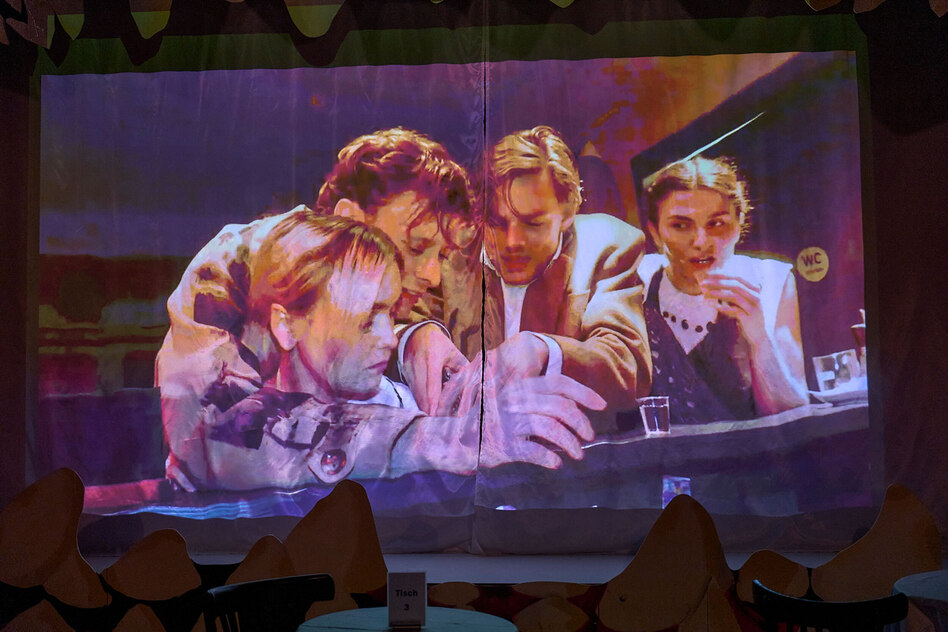
A shrill scream emanates from the stage, surrounded by a shark's set of cardboard teeth. A curtain opens to reveal a filmed scene with characters from the play. These are located in front of the Berlin Vagantenbühne, and shortly afterwards, accompanied by the camera, rush into the hall and onto the stage. It is an evening shortly after the elections in Saxony-Anhalt.
What is being performed here is a stage adaptation of Erich Kästner's novel "Fabian. The Story of a Moralist" (1931), directed by Lily Kuhlmann. Fabian (Philipp Lehfeldt), a German scholar and advertising copywriter by day, and his friend Stephan Labude (Paul Trempnau) stumble into the Berlin nightlife of the Weimar Republic, which plunges into excess while National Socialism is already putting a noose around its neck. They meet women like the nymphomaniac Irene Moll (in changing roles: Victoria Findlay), fighting communists and National Socialists.
From the beginning, the production focuses on being close to the audience. A smoking Fabian in a long beige coat repeatedly asks a guest in the front row what time it is. Later, audience members in the front rows should draw a naked figure on the stage. There is also a constant back and forth between stage, hall and outside space. Music plays almost constantly, sometimes quieter, sometimes louder. This lively back and forth makes for an entertaining evening, but sometimes distracts from what's important: the dialogue. Because the greatest strength of the evening lies right there.
Kästner himself interpreted his time not only as one of political but also of moral decline. The fall of the Weimar Republic apparently did not come as a surprise to him. So he also asks Fabian: "When will there be war again? When will it finally be that time again?", who then states: "We agree that things cannot continue like this in Germany." The hall is silent.
Some of these dialogues are also surprisingly contemporary, for example when the nymphomaniac Irene Moll turns to the audience and pleads for men's brothels: "Those who are for it, raise their hand." There is giggling in the hall and the iconic lyrics by Claire Waldoff can be heard: “Get the men out of the Reichstag.”
At the height of his happiness, Fabian gradually loses everything: his work, his love Cornelia Battenberg, who turns her career to someone else, and finally Labude, who commits suicide because of his supposedly rejected dissertation.
"It's a coincidence that you live. It's certain that you die," says Fabian, his nose covered in blood from a fight. By now it becomes clear: not only the society around Fabian, but also the character himself is approaching the abyss. When he learns that Labude's suicide is based on a misunderstanding, he is completely distraught: "The wrong people die and live." When Cornelia, now his ex, finally opens a film screening, he rushes away. Towards the end, like a gathering storm that can no longer be ignored, Ulrich, a figure in a Nazi uniform, walks row by row through the audience, shaking hands and greeting with “Heil Hitler”.
It's a dark evening that keeps you entertained when you look at some of the election results in Germany. Some of Kästner's last sentences in this piece can be read as an urgent warning: "You must not wait until the snowball has become an avalanche. You have to crush the rolling snowball. Nobody can stop the avalanche. It only rests when it has buried everything under itself."
Read the full story at the source →
Source: taz