
Germany · taz · · 2h
In the house of the artist Hanne Darboven: where she collected things
Deutsch (original) · Auto-translated to English
A few steps in each direction: A large compass rose is embedded in the pavement in the yard, with one of these number games by Hanne Darboven in its center: “2 = 1, 2;” it says, “1 + 1 = 1, 2;” and “e.t.c.”. Here in Rönneburg, on the southern edge of Hamburg, where the houses sometimes have thatched roofs and wide fields begin at the end of the street, she lived and worked, the conceptual artist with a coffee dynasty background who was born in 1941 and died in 2009.
The Hamburger Kunstverein explored for the second time on Saturday in the form of a symposium: “Hanne Darboven’s House Revisited” that her life and work had a very specific relationship to one another – and that neither would be imaginable without this place.
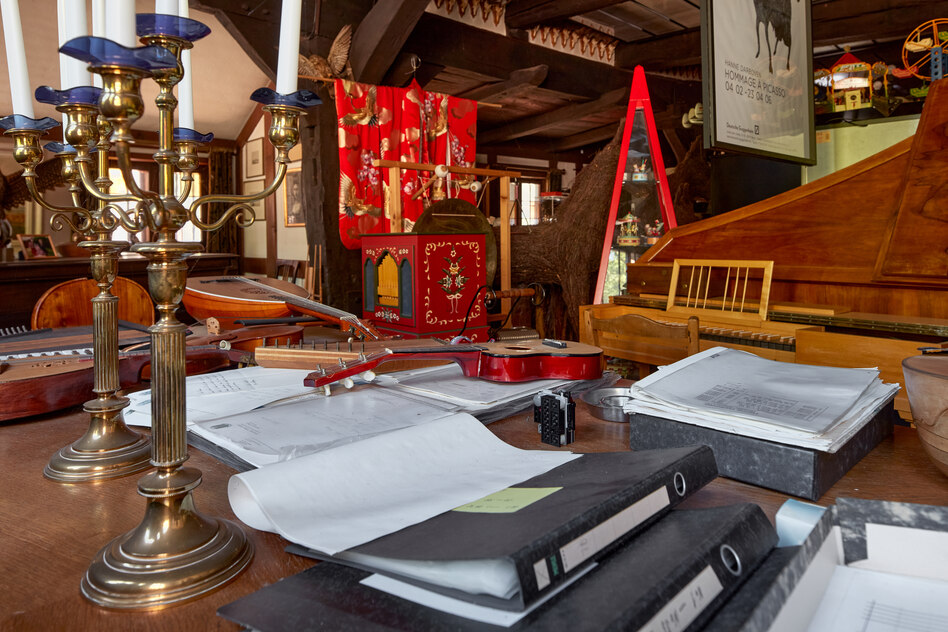
It took place in the old family villa right next door: Darboven's own, former parents' house only allows public access in strict doses. No more than four visitors were led through at any one time, it is so full of things that have been collected, used and even made by oneself: under the dark beams and display cases that cover entire walls, one also comes across sheets of paper with Darboven's famous series of numbers or the seemingly monotonous cursive exercises.
But above all, someone has brought together: dishes and wooden figures, keyboard instruments and stuffed wild animals, pictures, postcards, and always dolls. There is not just one example of the vast majority of objects, just as small work tables can be found in surprising places, always with at least one ashtray on them; Despite all the will to preserve them, they were emptied.
What was once exclusive next to real bric-a-brac, great things between mass-produced items, original works by their New York friends back in the late 1960s are framed here by fading advertising material. The contrast to the severity that radiates so much of Darboven's work is conceivably great, not least her own production with razor-short hair and a man's jacket that is always too large.
Miriam Schoofs then reported a “shock” at the symposium: This is how the then art association boss Uwe M. Schneede described entering the house into this supposed chaos. The art historian, who has long been involved with the artist, the house and the world of things in it, talked about how Darboven got hold of everything he had accumulated, and whether it didn't follow any order.
Would it be noticed if she took something? Sharon Kivland asked this obvious question in her elegantly comic talk “Who lives where”. The London artist and author used her own residences and the things she took with her as a starting point for her essays, including the things on Freud's desk.
William J. Stewart, who teaches at Harvard, dedicated a deep dive to another house, Darboven's New York apartment between 1966 and 1968: According to Stewart, her time there was not an artistic transition phase, but rather the definition of important basic forms for everything that followed. He also touched on the question of what the real estate market and the art world have to do with each other.
The New York experiences were incorporated into Darboven's film installation “Six Books about 1968” (1969), which was analyzed by Matilde Guidelli Guidi, curator at New York's Dia Art Foundation. There, in 2017, Nick Mauss and Ken Okiishi got even closer to one of Darboven's great works, “Cultural History 1880–1983”; They now gave the lecture again - under the impression that they had been in Darboven's house of curiosities for the first time. Although not a visit to this wondrous place, the lectures are documented on the YouTube channel of the Kunstverein zu Hamburg.
Read the full story at the source
Source: taz