
Germany · taz · · 31m
Volcanism in the Eifel: Something is bubbling there
Deutsch (original) · Auto-translated to English
T he water bubbles and boils. Not in a cooking pot, but in a so-called caldera, a cauldron-shaped volcanic crater. We are on the eastern shore of Lake Laach near Glees in Rhineland-Palatinate. The bubbles on the surface of the water are not only clearly visible there, you can also hear them. If you step on the bottom with bare feet, the sole of your foot will tickle. With large bubbles it almost feels like a small massage.
So there's some pressure behind it, pressure coming from the volcano beneath the lake. This is the only volcanic lake in Germany, says geochemist Anna Jentsch from the Helmholtz Center for Georesearch in Potsdam, where this phenomenon can be observed. Gases from the upper mantle reach the earth's surface through so-called gas outlet points, known in technical jargon as mofettes. “At Lake Laach, this gas consists of 99 percent carbon dioxide,” says Jentsch, who is regularly on site to examine the gas leaks and take samples for the laboratory.
In the Eifel, volcanism is not caused by the collision of two earth's plates, but by magma rising from the earth's mantle. The Laacher See is the second youngest volcano in the Eifel after the Ulmener Maar. But why it attracts a large number of researchers from volcanology, geology, seismology and other natural sciences from home and abroad is because the volcano is stirring. “There are a lot of signs that the Laacher See volcano is active,” writes earthquake geologist Klaus Reicherter from the Rheinisch-Westfälische Technische Hochschule Aachen to the taz. "On the one hand, there is the measurable uplift of the earth's surface in the surrounding area. Then there are the earthquakes, which occur quite deeply." In any case, deeper than usual in Germany, and which indicate “that melt is moving upwards”.
The fact that the volcano is active does not mean that it erupts regularly like Etna in Sicily. Science describes a volcano like that of Lake Laach as a dormant volcano; the volcano is asleep and moves very actively. The deep earthquakes cannot be felt on the surface, but they increasingly occur in so-called swarms, i.e. in a series of several tremors. Is this a sign that the volcano will soon awaken again?
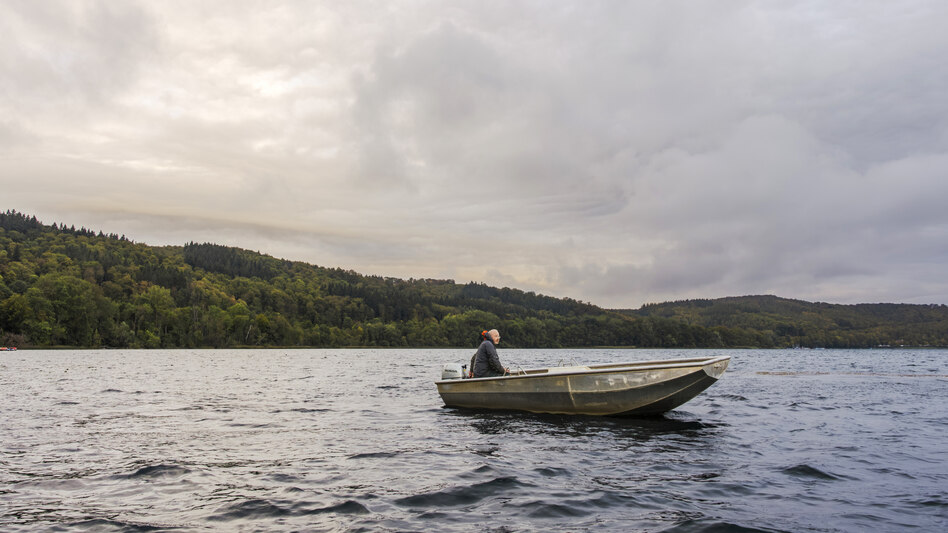
Ansgar Hehenkamp doesn't care about this question. “I’m relatively neutral about the volcano,” he says. "It's fascinating that it was all a mountain 13,000 years ago when it exploded. But it's just a lake." And Hehenkamp's workplace. Since 2007, the fisherman has leased the 330 hectare lake area from the Maria Laach monastery located on the lake. He goes out by boat three times a week to fish; his specialty is bluefish, which appreciate the lake because of its cold water. The lake is particularly deep and much colder than the numerous maars in the nearby Vulkaneifel.
Lake Laacher See in the Ahrweiler district is the largest lake in Rhineland-Palatinate and is the result of a huge volcanic explosion around 13,000 years ago, the effects of which geologists can trace over an area of up to 100 square kilometers around Lake Laacher. The caldera created by the collapse of the magma chamber - a particularly large volcanic crater - filled with groundwater and a lake was created. It attracts thousands of people seeking relaxation and vacationers every year. In addition to a campsite, there is a hotel and two restaurants in the volcano crater.
In 1093, the banks of Lake Laach were settled by monks who founded the Maria Laach monastery there, which is now an important stop for pilgrims and a popular destination for day tourists because of its particularly beautiful Romanesque church architecture.
Thanks to the volcanic relics, a landscape with particularly fertile soil emerged around Lake Laacher, which the monks of the monastery already appreciated. Today, the Laacher See volcano brings the region money primarily through tourism. In addition, pumice is still mined. This building material is one of the relics left behind by the volcano when it erupted 13,000 years ago.
So Ansgar Hehenkamp is a beneficiary of the volcano. He gives him kilos of whitefish, which the restaurateurs in the area are happy to buy from him - because of its firm, boneless meat, the whitefish is considered a special delicacy. Hehenkamp delivers it as a whole fish, fillet or smoked, and he also makes sausages from it. “I can always get rid of it,” he says. Even in winter, when fewer tourists come to visit the famous Romanesque monastery, hike through the dense forest around the lake or camp on the shore. There is a campsite at Laacher See. The swimming area is also open to non-campers and splashing around in the volcano is popular. On hot summer days it's hard to find a parking space here.
The fact that the fisherman repeatedly passes mofettes on his way to work, of which there are numerous in the middle of the lake, has no particular meaning for him. The well-known story in the area about the mysterious deaths of Jesuits doesn't change this. At the beginning of the 19th century, a house was built directly on the lake, which the monks used for relaxation and where they also stayed overnight. It happened repeatedly that one of the young men never woke up in the morning. In total there were eight such inexplicable deaths.
Almost 200 years later, scientists have found a particularly high concentration of CO2 in the mofettes at the former site of the demolished house. Which confirms the suspicion that the monks died from the gas. Carbon dioxide is heavier than air, so it collects near the ground or on the surface of the lake. If a lot of it comes out at once and there is little air circulation, you can suffocate; this happens quite inconspicuously when you sleep.
Of course, the fisherman also knows about the researchers who have begun to systematically investigate the gas leaks - he lends them his boats. And he has met journalists several times who are interested in the mofettes. “A journalist once asked me whether that made me feel dizzy,” says Ansgar Hehenkamp. “Yes, but it wasn’t because of the CO2.” It's the heat that's getting to him. In the summer he has to get out much earlier; people can often no longer stand it on the boat at lunchtime. In general, if anything, it is climate change that worries him.
“Over time you notice that the winters have changed,” reports the fisherman. "Whitefish spawning times start when it starts to get cold. That has shifted by three weeks in the last 15 years." What this means for him is that he can only start work later, because he only fishes when the offspring have been released. If the winters get even warmer, things could become difficult for the cold-water species or even come to an end altogether, according to the fisherman. Added to this is the water level, which has already fallen due to the dry summers. If it continues to sink, this will also contribute to warming of the lake.
Michael Ullenbruch also sees the clearly noticeable climate change as more worrying than the activities of the volcano. The organic farmer and his wife Jennifer Schneider cultivate 60 hectares of arable land around the lake, and cattle, pigs and chickens are kept on another 50 hectares of pasture land. “Due to the severe drought, we had to harvest much earlier,” says Michael Ullenbruch. “We were already finished in mid-July, which is usually when the harvest only begins.”
The farmer is not afraid that the mofettes could pose a danger to his animals: “The pasture is large and the animals move on.” The farmers are concerned about the gas leaks for another reason: “I was surprised that growth suddenly slowed down in two places in the field.” He showed the circular areas to a team of researchers who were working at the lake. “And they then measured that CO2 emissions are relatively high in this area.” However, the only real problem for him is that the high CO2 content in the soil promotes the growth of nettles. “More nettles means less pasture area. And as an organic farm it is particularly difficult to get them under control,” says Ullenbruch.
This text first appeared in wochentaz, our weekly newspaper from the left!
Every week, wochentaz is about the world as it is – and as it could be. A left-wing weekly newspaper with a voice, attitude and the special taz view of the world. New every Saturday at the kiosk and of course by subscription.
The farmer has known Lake Laacher since his childhood - he grew up on a farm in nearby Mendig. He loved the landscape here so much that he wanted to go to the lake after his training. It wasn't until he was a teenager that he realized that this was a volcano that had not yet gone extinct. “Very few visitors know that the lake was created from a volcano,” says Ullenbruch. In an animation in the Lava Dome, the volcano museum in Mendig, he experienced a huge volcanic explosion like the one that preceded Lake Laach. "That's a bit scary. And when I think about the fact that Lake Laacher would erupt again... Then the question arises: how quickly or when will you be told to pack your bags," he says. “Then you try to suppress it and say, well, he’s been quiet for so many years now, why should he break out in my lifetime?”
How dangerous is the Laacher See volcano actually? Geologist Anna Jentsch and earthquake expert Klaus Reicherter agree that there is no reason to panic. Although there is no doubt that the magma chamber under the lake is filling up again, an explosion is probably only expected in a period of between 3,000 and 10,000 years, says Reicherter. “We geologists think in different time periods,” he says. For him, it is understandable that people prioritize problems that are more urgent, such as climate change. The Laacher See belongs to the Ahrweiler district, which is still struggling with the consequences of the 2021 flood. “The volcano is clearly in the second row,” says Reicherter.
However, the Aachen professor still supports the demand of many scientists for the creation of a volcano observatory - there is currently none in Germany. Firstly, to give the expertise in the country the opportunity to conduct research on site - until now, volcano experts have had to travel to Italy and other countries. Above all, there should be precise monitoring of the significantly increasing activity of the Laacher See volcano, also in the interests of civil protection. An eruption is not the only danger posed by the volcano.
Which brings us back to the mofettes, which make themselves known in the water with their loud bubbling, but usually go completely unnoticed on land. “If there is a danger, then it is the gas, the CO2,” says Anna Jentsch, who has been working on the gas leaks at Lake Laach for three years now. So far, the CO2 concentration is so low that the gas mixes well with air, making it completely harmless to humans. "But increasing volcano activity could mean that more CO2 is released into the lake, and also on land. And if more gas comes out, the risk of a gas eruption also increases. The critical thing is that the gas is neither visible nor smellable." This is not accompanied by more steamy hot springs and an increase in the smell of sulfur, as is the case in the Phlegraean Fields in Pozzuoli near Naples. "All the gas is suddenly released from this lake at once and forms a cloud that settles in the crater area. If people are there, they could simply suffocate with a high concentration and amount of CO2." Although such a scenario is very rare, such a gas eruption that occurred at Lake Nyos in Cameroon in 1986 shows the scale of such a catastrophe: 1,746 people died.
The geologist continued that it is important to set up monitoring at the lake; she believes a volcano observatory is absolutely necessary. Because there are usually harbingers such as an increase in the amount and concentration of gases, increased earthquake activity and continued uplift of the surface. “You could work with a traffic light system like in other active volcanic areas around the world,” says Jentsch. “If the warning level switches to orange, it is time to go – especially in summer when Lake Laacher See is busy.”
In addition to monitoring the volcano, an evacuation plan is also needed. Maybe it already exists? At least the earthquakes are already being measured.
No, there is no special plan regarding the volcano, says the press spokeswoman for the Ahrweiler district when asked by taz. But there is a general evacuation plan that also applies in this case.
The campsite manager, Rik Wagemans, knows nothing about the possibility of an evacuation due to volcanic activity, and the volcano has not yet bothered him. He has already been made aware of the mofettes, but only the ones in the lake.
The manager was not yet aware that there could be some in his place - according to Anna Jentsch, this is almost certain - but he has only been here since this season. Either way, he sees the situation as quite relaxed: "Of course I can tell people what's happening here," he says, "but I can't change nature. That's how I see it." Rik Wagemans adds that he would be interested to know what the CO2 concentration is like on the campsite. After all, this also affects him, as he lives in an apartment by the lake.
Concerned citizens' inquiries about the volcano are not received by the mayor of the municipality of Glees, which includes Lake Laach. “We have always lived with Lake Laacher,” says Reiner Hürter. “And we live well with it, tourism is extremely important for this region.” In 2022, 2.6 million day travelers came, most of them to the lake. They contribute the majority of the around 85 million euros in sales in the tourism industry this year.
Apart from a few inquiries from the press, nobody cares about the volcano, says Mayor Hürter. And he also does not discuss the possible dangers of the volcano with the two communities of Wassernach and Nickenich, which also border the lake and with which they have networked for tourism purposes.
“Nothing is happening,” Reiner Hürter is convinced. "The volcano is peaceful and continuously monitored, and we rely on it. That if something really happens, we would be informed."
Read the full story at the source
Source: taz