
Germany taz
Hamlet premiere in the Berliner Ensemble: D for Germany, Denmark and Depression
Despite beautiful legs: Ersan Mondtag's “Hamlet” in the Berliner Ensemble doesn't go beyond a few good gags, current keywords and a sparkle here and there. more...
Deutsch (original) ·Auto-translated to English
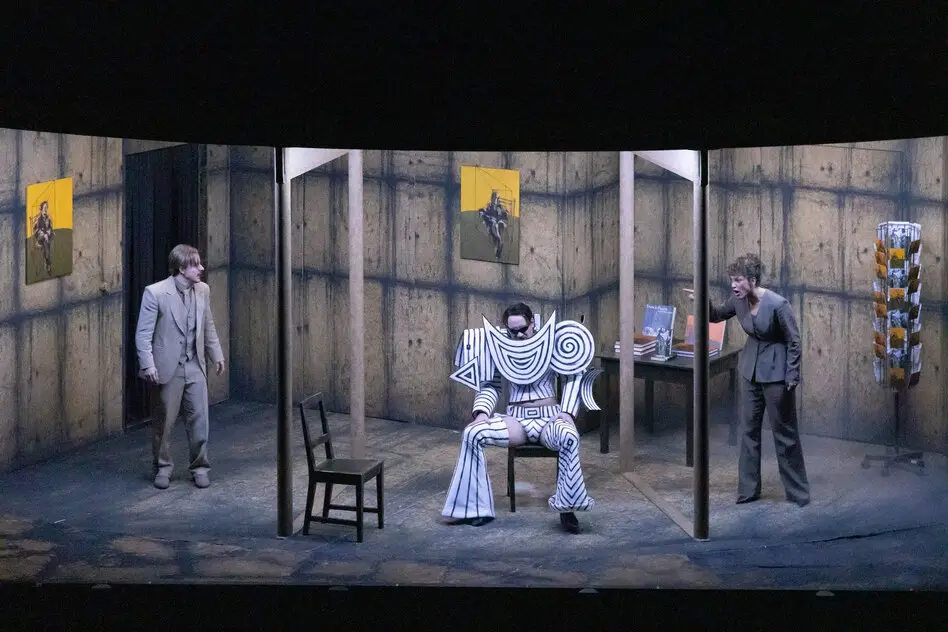
Oh, Hamlet. You have nice legs, really tight thighs. And how you can twitch your buttocks can also be seen in row nine thanks to Josa Marx's revealing costumes.
But with all the coke and sex in the club, let that go. You can't sleep anymore since your silvery friend Ophelia told you that your uncle Claudius probably killed your father. Now you don't know whether you want revenge or disappear into intoxication and nothingness. And so you talk and talk, run up and down the stairs on the revolving stage, brace yourself against its circling or let yourself drift with it, and keep talking and screaming too. But do you ever listen to yourself?
That's tiring. That's what we're trying to do down in the stalls and in the boxes of the Berliner Ensemble. After all, you are Hamlet, a melancholic prince, a powerful and tricky poet whose words can lead you deep into a labyrinth of thoughts. You often lead us to the undead, the ghosts of history, the ghosts beneath the veneer of decency. But this time it's hard to follow you, thoughts burst like bubbles. Concentration, Hamlet, concentration, we miss that.
It might be sexist to admire Hamlet's legs (Sebastian Zimmler) more than his speech, but Ersan Mondtag's production in the Berliner Ensemble invites you to do so. The director is also a visual artist and recently showed much-noticed, large-format reliefs and sculptures at the Dittrich & Schlechtriem gallery that explicitly referred to homosexual practices, spoke of the hunger for touch and the fear of mortality. His Hamlet at the Berliner Ensemble uses a similar imagery when he sets scenes in a night club and sprinkles queer sparkle into Shakespeare's drama with Pierre Emö as Ophelia.
Alone: This remains a beautiful surface that doesn't connect well with the text. It comes not only from Shakespeare, but also from the young author (and theater maker) Wilke Weermann. As has been read and heard in previous interviews, he and Ersan Mondtag thought a lot about Hamlet's father, about authoritarian rulers and war leaders, about sons who don't come to terms with the pot and long for a supposedly better past. But what was intended as a critical reflection on the present and its restorative tendencies crumbles somewhat unconnected due to the Shakespearian drama in the production.
Current keywords are mentioned, but hardly go beyond a brief aha effect. The state in which something is wrong is always just called D., like Germany, Denmark and Depression. Gertrude, Hamlet's mother, uses cosmetic surgery to transform herself into a new woman and prefers to talk to television cameras rather than to her son. She and her new husband Claudias are marking the dawn of a new era by making their castle accessible to the public as a museum. Hamlet cries because his childhood bedroom has now become a ticket booth. But these remain details that don't go beyond a gag. You follow the three-hour game feeling a little bored rather than inspired. This way you don't get to the contradictions in your own thoughts and actions - and that's one of the strengths of Hamlet performances.
The gay magazine Siegessaule was already looking forward to the production as a queer Hamlet due to the participation of Pierre Emö as the gender-fluid Ophelia, more son than daughter on stage. The fact that the dark electronic sound that rumbles in the bowels of the castle and the club comes from Robert Lippok is also one of the promising signs. But unfortunately this is once again the not so rare case that a production does not reach the heights of the previous reporting.