
Germany taz
Talking about the Middle East in Berlin: Get in, listen, endure
With personal stories from Israel, Palestine and Germany, the “HörBus Middle East” brings the conflict to Berlin schoolyards and creates space for empathy. more...
Deutsch (original) ·Auto-translated to English
An eleventh grader with her hair shaved on the sides and lots of black kohl around her eyes sits on a red bench on a bus. She listens to Joana Osman on her headphones. On the tablet you can see the German-Palestinian writer who is currently talking about trauma, especially those since October 7, 2023. Peace, she says, can only come if both sides “recognize each other’s suffering.” The student takes off the headphones. She can't say anything about it, she says in a small voice. "Not yet."
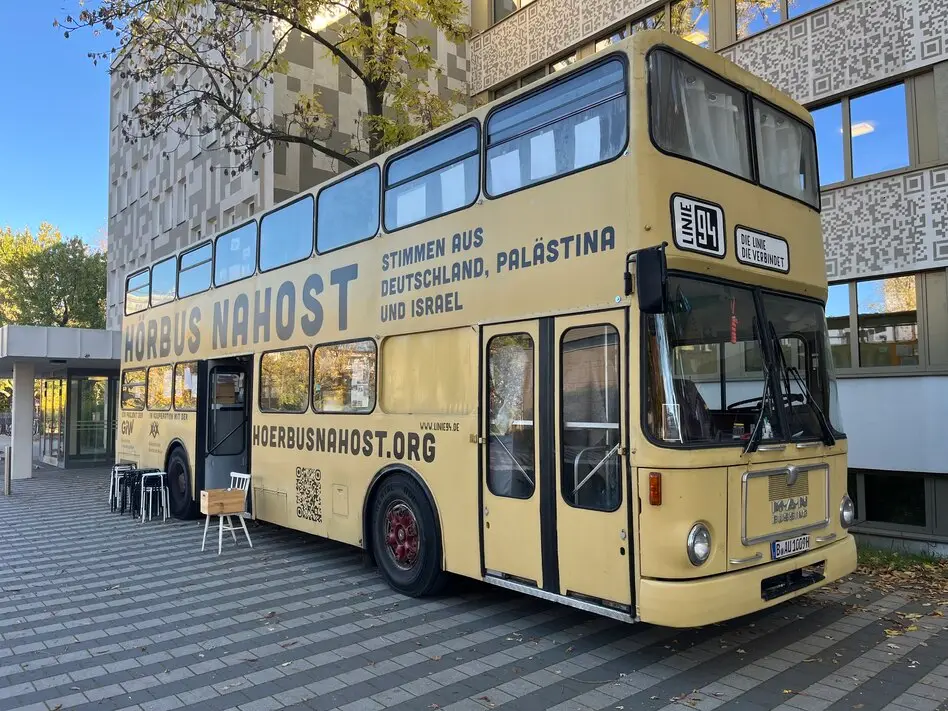
It's a cold November morning. In the schoolyard of the Paul and Charlotte Kniese School in Lichtenberg there is a discarded double-decker bus that has seen better days. It used to transport school children, but today it's about a different kind of movement: the HörBus Middle East takes young people on a journey through the Israeli-Palestinian conflict. But without leaving the schoolyard. At this stop, something should first happen that is often neglected in heated debates: listening.
The school is located in the middle of functional prefabricated buildings that shape the cityscape of this area. The neighborhood is socially challenged and the proportion of people with a migration background is relatively low by Berlin standards. The school provides a good counterpoint to this: as a community school that blind children and children with other physical disabilities also attend, diversity is part of everyday educational life. Consideration, respect and dealing with different realities of life, which is immediately noticeable, are not abstract lessons here.
The HörBus brings voices from Israel, Palestine and Germany to schoolyards. Audio recordings, playlists, videos and texts are intended to provide a differentiated approach to the Israeli-Palestinian conflict; Afterwards there will be a moderated discussion. The project arose from the exhibition "Audible. Voices on the Middle East", which Dora von Soosten and Mutlu Yolaşan developed with students and social workers at a school in Neuss in North Rhine-Westphalia. Together with society in transition, it became an exhibition on wheels. After a successful pilot phase in the summer of 2025, the bus has been on the road nationwide since June 1, 2026, and will be parked in various schoolyards in Berlin over the next few weeks.
At the beginning the familiar melody of the Tagesschau sounds. This creates an audio collage in which news and personal experiences intertwine. The class listens spellbound. It's repeatedly about the courage it takes to listen to others, even if their stories are difficult to bear. The young people are then allowed to move around independently on the lovingly furnished two floors of the bus.
At the listening stations the topics are protest, empathy or generalization. Local people, those affected in Germany and experts from different countries talk about what the conflict is doing to their lives. The young people cuddle on the red artificial leather benches, bend over clipboards, and write diligently. Some move on together, others prefer to stay alone. When you've heard enough, press pause. That's also allowed here: a small emergency brake before the impressions become too much.
In between we talk about French homework or the upcoming break. Someone rummages through a box of books and writes down a title. Another turns a conceptual block with the inscription Zionism in her hand; next to it lies one in Jerusalem. An oriental-looking metal lantern with purple glass panes stands on a table. Fingers play on their roof as stories of loss and fear are told.
“Did you hear that, dude?” a boy asks his friend. Israeli-American activist and educator Rebecca Strober is currently reporting on Israeli Military Order No. 101, which bans Palestinian political gatherings in the West Bank with more than ten participants. The friend replies: “Brother, that’s awesome.” He puts the headphones away and looks out the window for a while.
A student writes something on an anonymous piece of paper for the memory box. “Who is the bad guy?” it says. Anyone who deals with the Middle East conflict encounters violence and fear, but also the expectation of taking a clear position. The student believes that since the war in Gaza, the conversations have become extremely charged. Anti-Semitism and anti-Muslim racism, sadness and anger – “we also deal with it in the classroom,” she says.
Can a bus absorb that? A promise to listen to all perspectives is no guarantee that no one will get hurt on this journey. Empathy must also be precise: recognizing people's suffering does not mean simply letting every political statement stand. And the search for nuances must not obscure the differences between those responsible and the victims. Anyone who drives too fast quickly ends up being blamed, which the exhibition aims to steer away from.
After about an hour, the young people leave the bus quite quietly. They retreat to a safe space at school with an employee of the initiative. The class teacher who was there before is left out, as is the reporter. Not every expression of emotion should be immediately evaluated and defended or even graded.
When the class returns later to get the bags, two friends decide to start a conversation. You want to tell something. One wants to remain anonymous. The other says his name can be in the newspaper: Dzheger Ay Azad. He says he has Kurdish roots. Both seem moved. And that's no small thing for her. In the media, they say, local people rarely have their say. She was surprised that none of those interviewed spoke like Netanyahu or Hamas.
“These people all want peace and humanity…” says Dzheger and turns to his friend for help. “What’s that called again?” The other helps him: “Humanity.” “Yes, exactly, humanity.” They shift from one foot to the other to combat the cold. The bus did not resolve any conflict. But two students found something that often gets lost in the big debates: a word they can agree on.