
Germany · taz · · 2h
GPS transmitters and dreams about animals: “You have to try to get further away”
Deutsch (original) · Auto-translated to English
So far I have only dreamed about animals once. As a teenager, after I shot rats in a garbage pit on the edge of our village, hundreds of them attacked me in my dream.
According to the “dream book” written by Artemidor in the 2nd century AD, there are two types of dreams: “Some indicate memories, wishes or needs, others are signs that come to the soul from outside and can change its course,” writes the French ethnologist Anastasia Martin in her report “In the East of Dreams” (2024).
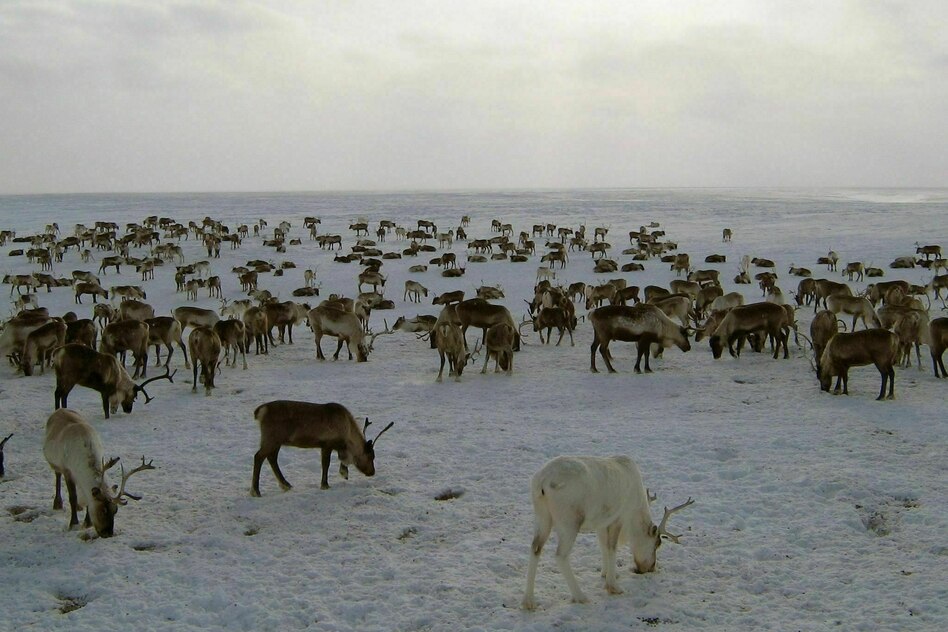
She researched two indigenous groups on both sides of the Bering Strait, in Alaska and Kamchatka. Both had fled to the forests as colonized people, where they tried to live as hunters and gatherers again and to find their way back to their old animistic beliefs. The Gwich’in in Alaska had evaded civilization (oil pipeline, roads, and compensation in the form of stocks). The Even people on Kamchatka had their civilization (their village and collective farm) dissolved. The socialized reindeer herd now belonged to a joint stock company of nouveau riche Russians who would only employ them as “cowboys”.
Both peoples were reindeer nomads, whose reindeer were once taken away and forced to settle down. In order to survive in the forest, they now have to nomadize again and learn from the animals. To do this, they try to dream about them at night, distinguishing between state dreams and event dreams: “Children in the forest practice this from their earliest youth,” writes the ethnologist.
For a few years she lived in the forest on Kamchatka with an old woman, Darja, who asked her about her dreams. Most of the time these are state dreams that psychoanalysts like, but Darja herself found them uninteresting: "You've been circling within yourself. You haven't met anyone. You have to try to get further away. Out of your world. Otherwise you won't get any information about what's really happening outside."
But you shouldn’t “just dream about the spirits of the dead,” Darja explained to the ethnologist, “you also have to dream about the others, the living ones, if you want to survive in the forest.” “The animals?” "Yes, the animals. You have to try to dream with them to understand what they do and where they go." To talk to them, “to know what we’re going to do!”
After Darja dreamed about geese, she told Anastasia Martin: "Tonight I flew with them. I saw the geese leave. I accompanied them through the sky for a while before I came back. The weather will change, winter is coming. We have to prepare."
The ethnologist writes: “In the Itscha forest on Kamchatka, as everywhere where they still move freely, the animals have the reputation of being ahead of humans when it comes to paying attention to the world.”
In her novel “Under Water” (2026), the American literary scholar Tara Menon writes about her father, a marine biologist, and his colleague, who run a research station on a Thai island and research, among other things, manta rays. Meanwhile, she went to school in Phuket. In 2004 she noticed that there were suddenly no more birds in the city, the dogs had also disappeared, and some on leashes were howling in fear. An elephant carrying a little tourist girl on its back suddenly stopped in the middle of the road and didn't move. His mahout, his guide, talked to him in vain. The elephant turned and hurried away in the opposite direction. The girl on his back remained strangely calm. A huge tsunami was approaching the mainland.
In the West, you don't communicate with wild animals by dreaming about them. Here modernity has driven out animism. In his essay “Nature Calls,” the sociologist Bruno Latour writes: “According to Kant, we had to learn not to react too sensitively to nature’s call, because this is the only way we are able to hear the voice of morality, which has no connection with that of nature and is able to elevate us above the latter.”
But we have a highly developed technology that allows us to “address” the animals and “communicate” with them – at least that’s what their users promise. With everyone worldwide, from insects and fish to rodents and land mammals to whales. To do this, a GPS transmitter is hung around their neck, glued or tacked on, which records their movements via satellite and makes it visible on screens for those interested. Thousands of animals from several thousand species have already been radio-tagged at a cost of billions of dollars.
The Munich “communications expert” Alexander Pschera tells us a fairy tale in his book “The Internet of Animals: The New Dialogue between Humans and Nature” (2014): A modern-day Little Red Riding Hood goes through the forest to visit her grandmother and meets a wolf. He is equipped with a radio and Little Red Riding Hood is filming him with her smartphone. When she gets to her grandma's house, she uploads the video to the Facebook page that Wolf fans have set up. Little Red Riding Hood’s video is the first longer document there “and the comments from the wolf community are correspondingly enthusiastic.” Before going to bed, Little Red Riding Hood digitally wishes the wolf a good night.
Pschera assures us: “This story could happen like this or something similar in any part of Germany today... The new fairy tale of Little Red Riding Hood is not a utopia.” For Pschera, virtual reality has long since merged with real life. "In this situation, technology, which has caused the alienation from nature and has continually exacerbated it, appears to be part of the solution. As a 'missing link', it can restore the connection to the world of animals. The Internet of Animals has the potential to revitalize the human-animal relationship on a new level and thus to reinvent nature, so to speak." And further: “The glass animal steps next to the glass person.”
However, this is no fun for the animals with collars. They must first be captured and anesthetized in order to equip them with GPS transmitters. Then the devices on them are definitely a handicap. Instead of constantly trying to find new donors (a good satellite transmitter costs several thousand dollars and the annual fees for satellite use thousands more), broadcasters should learn to patiently observe the animals they want to know more about. If you are not able to dream about them.
Read the full story at the source
Source: taz