
Climate taz
Consequences of climate change: Allgäu Alps are losing their last glacier
The Black Spleen Fern on Tyrolean soil has lost so much mass this summer that experts no longer call it a glacier. more...
Deutsch (original) ·Auto-translated to English
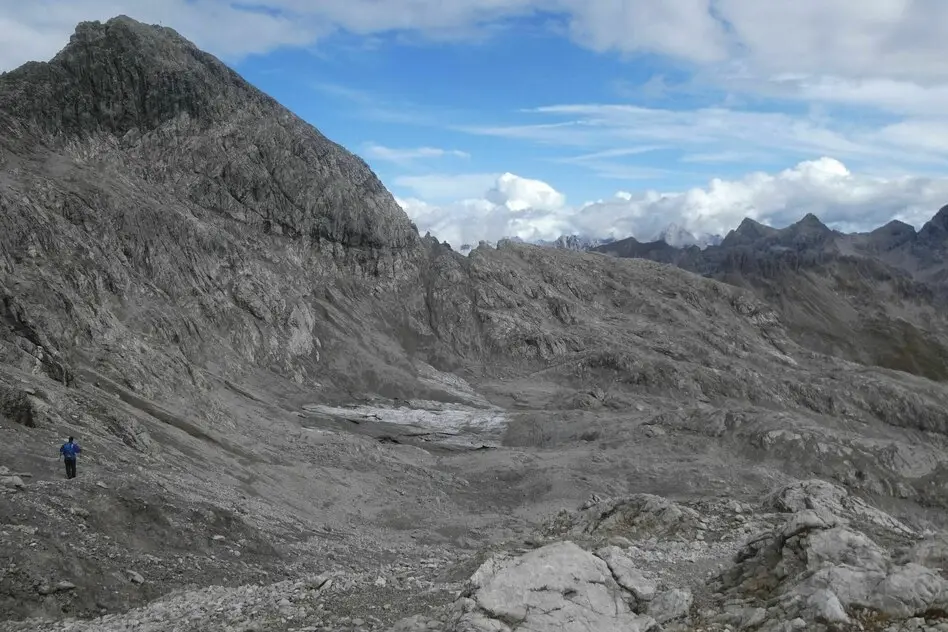
dpa | The Schwarzmilzferner on the Tyrolean side of the Allgäu High Alps has lost its status as a glacier after this hot summer. The warm months cost it more than four meters of thickness and around half of its volume. “After next summer it will most likely have completely disappeared,” said Christoph Mayer, a glaciologist at the Bavarian Academy of Sciences.
For 26 years, he and his colleagues have closely observed what was previously the last glacier in the Allgäu High Alps on the Austrian side. They have been documenting significant losses of ice mass since 2016. “This development has increased again since 2022. Since then it has been clear that the glacier is coming to an end,” said Mayer. In addition to the thickness and volume, what is also crucial for defining a glacier is whether it flows - which is no longer the case in the case of the Schwarzsplenferner.
The ice field on the southeast side of Mädelegabel and Hochfrottspitze at an altitude of around 2,450 meters is not an isolated case. “Several smaller glaciers in the Alps disappear every year,” explained Mayer and believes this development can hardly be stopped. "Even if it snows a lot in winter, the ice masses suffer rapidly. The summers are now too hot for them."
Politicians and experts from all over the world are meeting for the 31st UN Climate Change Conference in Antalya, Turkey. From November 9th to 20th, representatives from around 200 countries will discuss the fight against global warming. The taz has a team on site. Follow our reporting on our focus on taz.de, on klima.taz on Instagram, in the podcast klima update°, in the newsletter TEAM ZUKUNFT, in the weekday e-paper and in the weekly taz.
Mayer's predictions are bleak. “Based on current information, I assume that the entire Eastern Alps will be ice-free between 2060 and 2070.”
Things will probably go even faster in Bavaria. The heat also took its toll on the last four German glaciers there. By 2025, they will have lost more than a quarter of their area in just two years. Around a million cubic meters of ice were lost in total, as a survey by geographer Wilfried Hagg from Munich University and Mayer showed last year. According to the Schneefernerhaus environmental research station on the Zugspitze, significant losses are to be expected even after this summer.
In the coming years, the Blaueis Glacier and Watzmann Glacier in the Berchtesgaden Mountains could fare like the Schwarzmilzferner in the Allgäu High Alps: their pitiful remains could soon lose their status as glaciers. The Northern Schneeferner on the Zugspitze could be affected by the end of the decade. The Höllentalferner in the Zugspitze area is expected to last the longest. But the scientists recently only gave him a maximum of ten years. And by 2022, the Southern Schneeferner had already lost its status as a glacier.