
Germany · taz · · 2h
Fish deaths in the Baltic Sea: just the tip of the iceberg
Deutsch (original) · Auto-translated to English
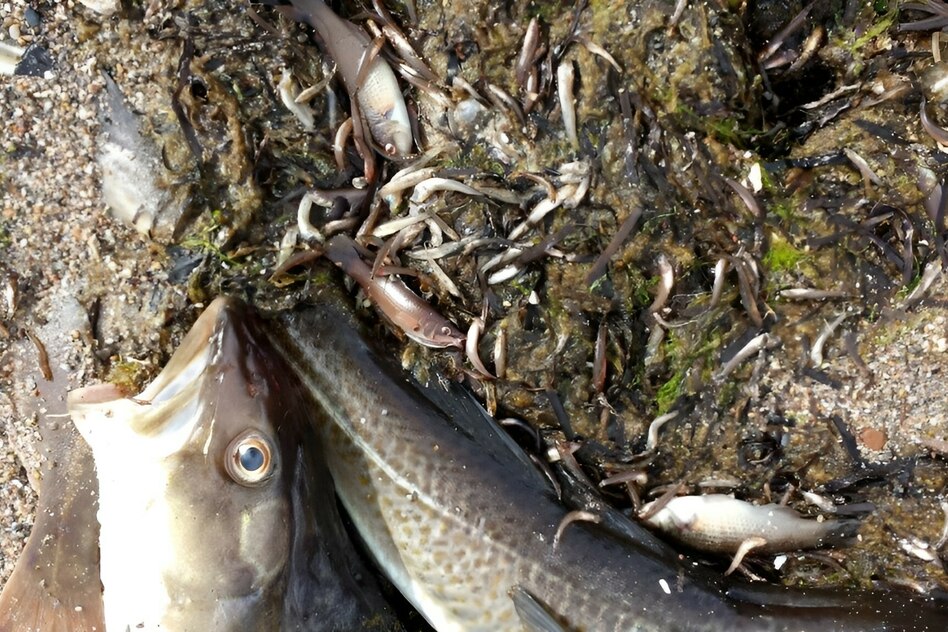
The fish die-off caused by a lack of oxygen in the Baltic Sea, which frightened passers-by at the weekend, including in Kiel's city center at the southern end of the fjord: It was just the tip of the iceberg. That's what Christopher Zimmermann, head of the Thünen Institute for Baltic Sea Fisheries based in Rostock, says.
On the one hand, not all dying or already dead organisms would be washed ashore, such as shrimps, mussels, sea urchins and starfish. On the other hand, the basic problem – oxygen-poor or even oxygen-free “dead zones” in the deeper areas of the Baltic Sea – exists throughout the entire summer months. During this time, the lack of oxygen worsens due to the seasonal degradation processes of organisms.
But it is only in autumn, usually in September, that the problem is essentially washed to the surface due to certain wind conditions, says Zimmermann: when offshore wind, as it did at the weekend in the Kiel Fjord and Lübeck Bay, pushes oxygen-rich surface water out to the open sea and oxygen-poor water flows up from the depths.
There was a similar event a year ago off Warnemünde in Mecklenburg-Western Pomerania, and in 2020 the so-called “upwelling” is said to have been responsible for fish deaths there.
Data on the frequency and extent of these events in the western Baltic Sea and specifically in German waters are not yet available. A former employee of the Thünen Institute dealt with the topic in his dissertation. The results have not yet been published, says institute director Zimmermann.
To do this, the scientist evaluated newspaper reports from the past 40 years. "But we don't know how complete these are: the first time a fish dies, everyone gets upset - if it happens more often, the media may no longer react." In addition, the fish population has declined sharply, which makes it difficult to make a statement about the extent of the mass extinction. “What is no longer there can no longer die.”
The severe lack of oxygen in the deeper areas of the western Baltic Sea has been around for around six to seven years. In the eastern part this has been the case for a long time, in some parts it has probably always been like this.
This is because oxygen-rich water from the North Sea penetrates into the western part of the Baltic Sea - but only when the wind is right. But the first autumn storm from the northwest is still a long time coming.
And for some areas it is already too late: the Danish Vejle Fjord northwest of Funen is considered biologically dead, and other fjords and bays may follow.
“The problem is the cyclical occurrence of events,” says fisheries biologist Zimmermann. In this way, stocks could no longer recover. Young animals die before they can reproduce.
From a scientific point of view, the documentation of the fish deaths in the media was very interesting because video recordings showed large salmon, cod and sea trout - some of which probably survived.
“It would be good if we could predict such events,” says Zimmermann, “then we would be prepared and could be on site in good time, measure the oxygen content and identify and count fish.” Because after one or two days, depending on how quickly the wind changes, the horror is usually over, as was the case in this case.
“It’s frustrating that as scientists we can’t do anything other than watch,” says Zimmermann. The problem has been known for decades and is getting worse with climate change and warming oceans because warm water absorbs less oxygen than cold water. This largely negates the successes that have been achieved in reducing nutrient inputs into water bodies. However, there is still a need for action here too.
In response to the fish deaths, the environmental protection organization BUND Schleswig-Holstein called for an expansion of marine monitoring, which the EU member states had decided on almost 20 years ago.
The accumulation and interactions of various pressures would have to be taken into account: shipping, offshore use, fishing, military, underwater noise, changes in the seabed and climate-related changes, among others, could influence each other. The effectiveness of the protective measures implemented must also be checked.
Read the full story at the source
Source: taz