
Germany · taz · · 33m
San Sebastián Film Festival: They have to work and care for each other
Deutsch (original) · Auto-translated to English
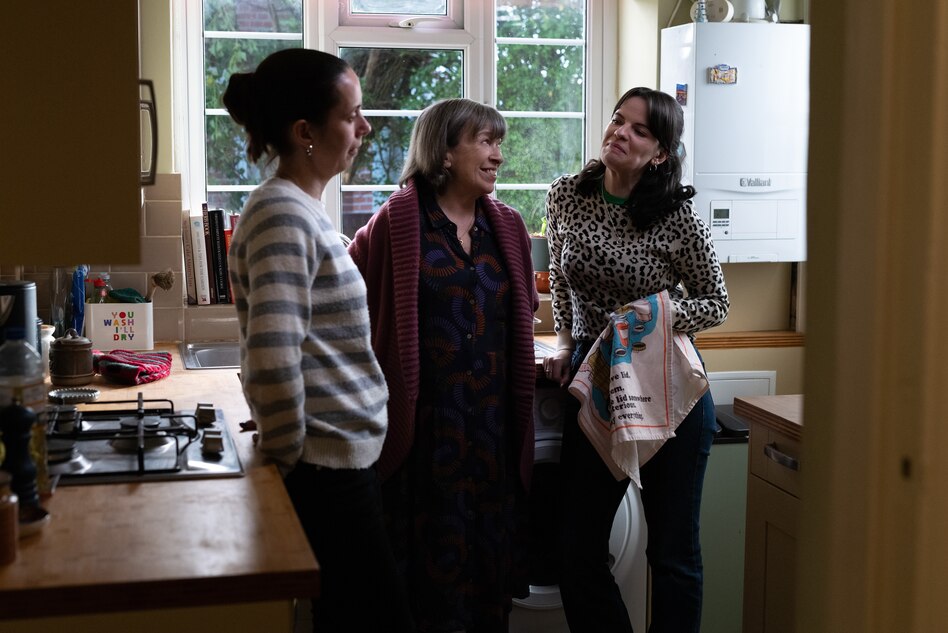
“What is your address?” asks Rosie. The old man gives a number. She asks again, kindly and patiently, but she doesn't find out more. Rosie is a social worker and wants to help him. To do this, she would first have to know where he lives. Mike Leigh leaves this little encounter at the beginning of “Tender Loving Care,” complete with its quiet humor and unease that good intentions aren’t helping here.
“Tender Loving Care” received the Golden Shell at the 74th San Sebastián Film Festival. Leigh also won the screenplay award; Kate O'Flynn shares the award for best actress with Asta Kamma August from "Growth of the Soil." Rosie and Amy, played by Alice Bailey Johnson and O'Flynn, both work in social services. After Amy's relationship fails, she temporarily moves back in with her friend. They drink wine, sing together, and fool around.
Amy initially hides the separation from her parents; The two of them are attached to their current image of their daughter's future. Her father Geoff sometimes seems absent, and her mother Birdie masks her growing concern for him. For her, Rosie has long been part of the family. Leigh tells of kinship, friendship and professional care without conflating these relationships into a single ideal of closeness.
The friends' work takes them out of the apartment and into different living conditions. You meet young people and older people who need support, but whose mistrust has reasons. An overwhelmed mother fears that everything she tells Rosie could later be used against her in court. Their defense cannot be explained away with more patience. Leigh shows how much help depends on who has the files, decisions and consequences. At the same time, he admits that the social workers are exhausted, clumsy and have a private life.
Leigh listens carefully to his characters. They stray from the topic, repeat themselves or resort to a crooked comparison. This is precisely where they reveal what's on their minds. Birdie and Geoff sing old songs; Amy and Rosie have their own silly rituals. The familiarity of these scenes makes the changes that are already on the horizon more difficult to bear. Leigh doesn't push her into a big emotional outburst.
Leigh, 83, was not in San Sebastian for health reasons. In a video link he said that “Tender Loving Care” would probably be his last film. This gives the story about aging and farewell additional weight. But his characters have to continue to live, work and care for each other. The Golden Shell honors more than just Leigh's long career. It was the standout film of this festival.
Hans Petter Moland's "Growth of the Soil", Norway's Oscar entry based on Knut Hamsun's 1917 novel "Blessing of the Earth", opens up a completely different world. At first, Isak seeks shelter from the wind and cold in a crevice. Then Inger comes to him; Together they clear trees, move stones and first build a hut and later a farm for their family.
Oskar Dahlsbakken's award-winning images follow this work through the seasons. The narrow 4:3 format keeps people close to the landscape instead of transfiguring it into a panorama. As the farm grows, demands from outside grow: property must be registered, taxes must be paid; Inger discovers possibilities beyond the life Isak built with her.
While Isak and Inger build an existence from nothing in the Norwegian mountains at the end of the 19th century, the young Ejva in Amanda Kernell's "Brace Your Heart" fights to preserve her father's legacy in present-day Sweden. In a remote Sámi village she takes over his reindeer herd. Kernell, himself a Sámi, shows herding as physically demanding work on thin ice, in the snow and in a community where everyone knows each other.
Your camera stays close to Ejva, the language spoken is Northern Sami; Many of the actors come from families who herd reindeer themselves. So Ejva's conflict becomes the question of how she can remain part of this community and at the same time determine her own life. For this, Kernell received the directing award.
The strongest formal imposition of the competition comes from Ah Biao. His debut “Border,” which won the jury’s special prize, takes us to a remote mining town on the Chinese-Mongolian border. A young miner meets a woman he knows almost nothing about. Then the mine closes and the few security of his everyday life disappear. Ah Biao films empty streets, concrete and snow in long, often wordless shots. His characters remain just as mysterious to each other as they are to the audience, but the film develops a strange pull: in this city, even trying to get closer to someone is associated with dependency and danger.
Tony Vahl's directorial debut “Krux” also takes us to a place whose residents hardly know what is happening outside. In a village in northeastern Germany, bodies are recovered from the river a few days before the surrender, while classes continue at school. Young Greta, played by Jella Haase, marries her fallen fiancé; next to her there is only his soldier's helmet.
The mayor stirs up fear of the advancing Red Army and passes on the order not to give any living people to the enemy. Vahl's foggy images and menacing animal motifs are sometimes overly clear. What is more oppressive than these signs is how willingly the village itself accepts the order to destroy itself.
“Body of Glass”, the final project of dffb graduate Naëmi Ada, won the New Directors section prize. In it, a dancer flees her controlling partner and infiltrates the circle of friends of a deceased young man she never knew. Ada develops a psychological thriller based on her longing for belonging. At the award ceremony, she used her speech to make a political statement: As a German filmmaker, she felt obliged to denounce the “complicity of the German state in the genocide” in Gaza.
This accusation was not alone. When the audience award was given to the documentary “Naza,” Palestinian flags and numerous signs with the inscription “We are Naza too” were visible in the hall; The moderation duo also held them in high esteem. The gesture once again demonstrated the solidarity of part of the festival audience. However, the almost unanimous applause said little about the questions that the film itself raises.
Fatih Akin's melodrama “Ghosts”, in which a youthful love extends beyond death, opened the festival. Werner Herzog and Naomi Watts were honored with Donostia awards for their careers. At the final gala, long applause went to José Luis Rebordino, who has led San Sebastián since 2011 and is now leaving. Maialen Beloki, one of the two deputies for ten years, will be the first woman to take over the leadership in January. Next year she will be responsible for the 75th anniversary of a festival that succeeds better than many others in bringing together established names and idiosyncratic new voices.
Read the full story at the source
Source: taz