
Germany · taz · · 1h
Mass protest by the unions: over 175,000 against social cuts
Deutsch (original) · Auto-translated to English
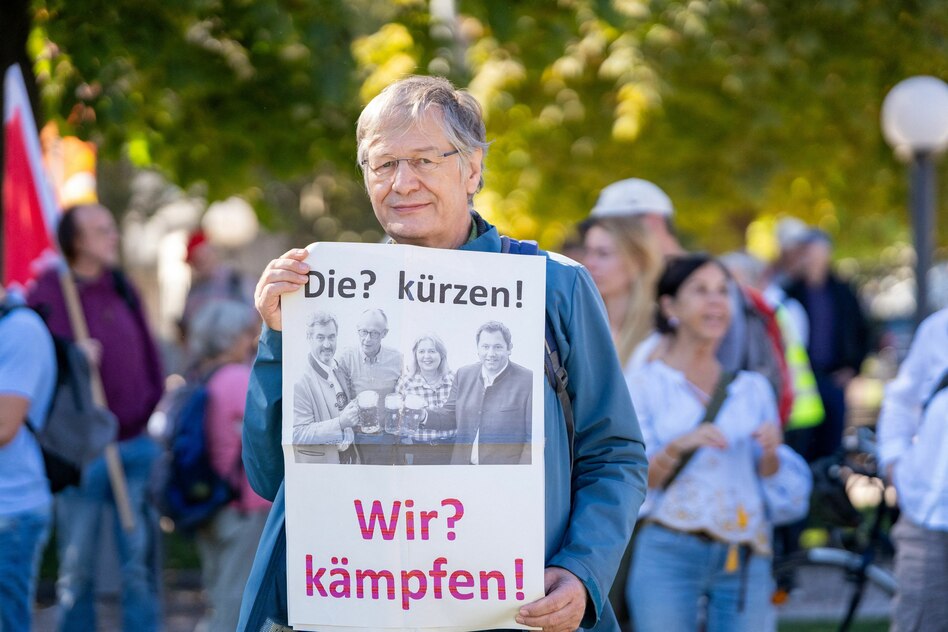
A sea of flags and banners waves on the central Burgplatz in the Ruhr metropolis of Essen early on Saturday afternoon. Well over 10,000 people are demonstrating here, in the middle of the most populous federal state of North Rhine-Westphalia, against the threat of social cuts and thus against the reform plans of the federal government of CDU Chancellor Friedrich Merz, which are perceived as half-baked and unfair.
“Solidarity instead of social clear-cutting”, “Merz is clear-cutting – we are resisting” or simply “Tax the Rich” are written on the posters that people hold up. The left is strongly represented, and the Marxist-Leninist party has also mobilized. There are only a few Green Party flags. There is no sign of the SPD or even the CDU.
The German Federation of Trade Unions (DGB) with its eight individual unions called for the protests - and they can claim a clear success: the organizers had hoped for 10,000 participants - according to the DGB, there were 18,000. The police estimate the number of protesters at around 12,000.
The keynote speaker in Essen is DGB chairwoman Yasmin Fahimi - and she has been mobilizing against the CDU and SPD's austerity plans for months.
“The focus of the current federal government policy is wrong,” explained the DGB leader in advance. We talk about social cuts “every day”. What is needed, however, is an “active industrial policy” – that is, investments and the protection of jobs in Germany and Europe, for example against unfair, massively state-subsidized competition from China.
The black-red federal government is instead signaling that “you can strengthen the economy by restricting labor rights,” criticizes Fahimi, who is herself a social democrat, was general secretary of her party and then served as state secretary in the Federal Ministry of Labor and Social Affairs. The welfare state is “not a gift from politicians and employers,” explains the DGB chairwoman on stage at Essen’s Burgplatz – but rather “hard-earned”.
The unions are also “ready for change,” explains Fahimi – “but not by abolishing our rights, reducing our social security and devaluing our life’s work.” The chairman of the DGB in North Rhine-Westphalia, Thorben Albrecht, had previously made a similar point: “We have to defend what we have fought for and worked for,” warned Albrecht. “And we have to be so loud that we can be heard in Berlin.”
The DGB has already spelled out what this means in concrete terms in the call for the protests on Saturday: The demonstrations were not just for “a pension that is enough to live on”. The unions, which still have almost six million members nationwide, also want to hold on to pension payments without deductions after 45 contributions have been paid.
There are also calls for the retention of the eight-hour day, which the Merz government wants to abolish through a new version of the Working Hours Act in favor of more flexible “weekly working hours”, or more investment in a sustainable infrastructure through more taxes on high assets. The trade union movement is also criticizing the distrust of employees that appears to be prevalent in the federal government, which manifests itself in the “compulsory sick leave on the first day”.
In general: Merz in particular is spreading "false myths" about the unaffordability of the welfare state, criticize the unions. When it comes to social spending, Germany is "only in the middle of the field compared to international standards," argues the DGB with reference to a study by the union-affiliated Hans Böckler Foundation. According to the Federal Statistical Office, Germany's social spending as a percentage of gross domestic product is no higher today than it was ten years ago. The Chancellor's statement that "the welfare state as we have it today" can "no longer be financed with what we achieve economically" is therefore nothing other than "a flat-out lie" for the DGB.
This was well received by the protesters on Essen's Burgplatz: “I'm fed up,” says 57-year-old Kirstin Zeidler. “Anyone who has worked hard for 45 years deserves a pension.” Demonstrator Alexandra Ebert also believes that the federal government is “pursuing a policy that ignores the population.” She is particularly disappointed with the SPD, which is in government:
“They can be integrated, they have far too little defense – even though they have the population behind them,” says the Dortmund resident.
What Ebert, like many others, also worries: Merz is “driving people into the arms of the right-wing extremists,” she fears. This concern is also described on many of the demonstrators' self-made banners:
“Politics for the rich = AfD 43.8 percent,” is written on one as a reminder of the election results of the right-wing extremists in Saxony-Anhalt. “Select Shorten Columns Right” on another.
“The shitty AfD is not a workers’ party,” says former union secretary Michael Müller, who has just retired.
“They're just collecting people's anger and frustration,” says Müller, who worked for 30 years at the Opel plant in Bochum, which closed in 2014, and was a works council member there. The 65-year-old believes that civil society made up of initiatives and associations must form much stronger alliances against the right-wing extremists. Nevertheless, he believes that a large demonstration like the one in Essen is also important: “It shows you that you are not alone.”
The protest in the middle of the Ruhr area was only one of 15 actions that the unions had called for across the country. There were further demos in Berlin, Leipzig, Magdeburg, Frankfurt am Main, Hamburg and Bremen. In Hanover, keynote speaker Michael Vassiliadis, chairman of the Mining, Chemicals and Energy Industrial Union (IGBCE), called for a new focus in reform policy: "For months now, politicians have been consistently off track when it comes to crisis management. With restrictions on pensions, sick leave or working hours, they only burden the employees, but are not helping us turn around our economy at all," criticized Vassiliadis.
Germany's industry is currently losing 15,000 jobs per month, warned the IGBCE boss. "What is being lost are good, collectively agreed jobs and added value that our community finances. Our people are rightly being punished by this."
Another speaker in Hanover was the chairwoman of Volkswagen's general works council, Daniela Cavallo - VW boss Oliver Blume apparently wants to cut 50,000 more jobs by 2030, including 35,000 in Germany.
The future of the VW plants in Hanover, Emden and Zwickau is still considered uncertain - and with it that of entire regions. The employer side has “lost decency,” said Cavallo: “It’s an attack on our working hours, our working conditions, our health, our pay levels and our pensions” – and that makes them “angry because I see it as a real betrayal.”
The auto industry was also represented at the protests in Eisenach, where Marko Schurig, a representative of IG Metall, also spoke at the Opel plant in Eisenach. Like the entire Stellantis group or Ford in Cologne, this location is also under great pressure due to the crisis in the automotive industry.
Nationwide, around 175,000 people came to the day of action against social cuts, the DGB reported in an initial statement - the repeated narrative about the infirmity of the unions as mass organizations from which members, such as the churches, are fleeing in droves, is obviously false. This is also made clear by the number of organized people:
At the end of 2025, 5,432,306 people in Germany were still part of a DGB union - despite the death of entire industries such as mining, despite the isolation of workers in the ever-increasing number of precarious service jobs, that is only 10 percent fewer than in 2015.
Chancellor Merz cannot completely ignore the unions as a power factor, nor can the incumbent SPD chairmen Lars Klingbeil and Bärbel Bas: On Saturday, the DGB warned that the demonstrators had sent a “clear signal” for a change in policy – “for a strong welfare state, secure jobs, good working conditions and the protection of workers’ rights”.
Read the full story at the source
Source: taz