
Germany · taz · · 2h
Film “The Dreamed Adventure”: The murky waters of her hometown
Deutsch (original) · Auto-translated to English
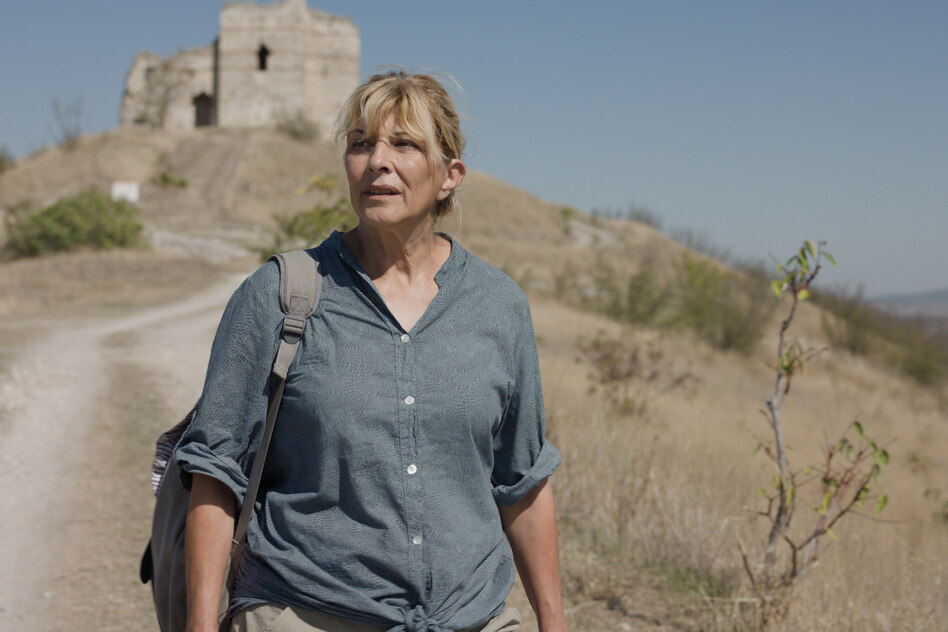
There are faces that you never tire of looking at. Faces in which life has been written. Gnarled facial features, wrinkles deeply etched into the skin, the serenity of a mild smile; It contains the experience of having experienced too much to lose interest in these faces. Just the sight of her on the screen is enough to set a cinema in your head.
Two such faces belong to the Bulgarian amateur actors Yana Radeva and Syuleyman Letifov. The German director Valeska Grisebach has cast her in her new film “The Dreamed Adventure”, although Letifov was already seen in a supporting role in her previous film “Western” (2017).
Letifov actually sells car parts and also works in a quarry. Grisebach discovered him there too. Radeva is a trained geologist, worked in the gambling industry and sells cosmetic products.
“The dreamed adventure”. Director: Valeska Grisebach. With Yana Radeva, Syuleyman Alilov Letifov and others Bulgaria/Germany/France/Austria 2026, 164 min.
They play Veska and Said in “The Dreamed Adventure,” which won the Grand Jury Prize in Cannes this year. Both are in their early 60s, know each other from before and, after decades, bump into each other by chance in Svilengrad, a small Bulgarian town near the Turkish-Greek border. Veska lives in Sofia, but is currently working as an archaeologist at a nearby excavation site.
Said is in town for business reasons. More specifically, he wants to make a nifty diesel deal with “the Raven” (Zhivko Ahopov), a local small-time crook. Since his VW Passat (a perfect smuggler's car, as he is later told) is stolen in broad daylight, Veska quickly takes him with her to her excavation at a tower ruin. Later she accompanies him to his business meeting.
The next day Said is gone. He won't appear again until the end of the film. Before he disappeared, he asked about the sister of a man who was murdered 30 years ago. While the focus was initially on Said, Veska takes over the story from now on.
She begins to look for clues to his disappearance and ventures further into the murky waters of her hometown. State authorities have little say in this.
Veska's job as an archaeologist is also a symbol of Grisebach's aspirations. In the two and a half hours of her film, she carefully uncovers socio-historical layers that have been superimposed in this place on Europe's external border since the collapse of the Eastern Bloc.
After Bulgaria's independence, there was a power vacuum. A kind of gold rush atmosphere set in. There was hardly anyone who didn't do crooked things back then.
But it was also a “time of men,” as the saying goes, who simply took what they wanted. And these were often women who were exploited and abused. People in Svilengrad tell each other anecdotes with cool humor: “Where the law ends, Svilengrad begins.”
Those scenes when people come together at large tables in the evening with too many cigarettes and schnapps are outstanding and seem like documentary vignettes from the everyday life of Svilengraders. Bernhard Keller's camera follows Veska to these extended gatherings like a silent companion.
There doesn't seem to be much left of the dream of a better future. The city seems like an abandoned and forgotten border post in the barren and sun-scorched hilly landscape.
Valeska Grisebach spent several years researching her film, which, like her previous feature films, she cast exclusively with amateurs. She didn't follow a well-developed script or a clear dramaturgy.
Grisebach, whose films are often attributed to the Berlin School, does not work according to the principle of stylized condensation, as her Polish colleague Paweł Pawlikowski recently did with “Fatherland”.
Rather, it follows the opposite, a meandering narrative that literally allows time to melt away and captures with curiosity the nuances that determine life in Svilengrad. The result is demanding, but never lengthy. The film is too tied to the overlooked and tragic history of its setting - a virtual blind spot from a Western European perspective.
Valeska Grisebach already plays with the title genre in “Western”, in which German construction workers are supposed to build a hydroelectric power plant on the Bulgarian-Greek border and are confronted with their own prejudices and the distrust of the local population. The construction workers' camp resembles a fort in autochthonous enemy territory.
Playing loosely with the characteristics of a western or mafia film, “The Dreamed Adventure” descends further and further into the underworld of this border region. Because the actual provincial prince, where all the threads come together, is a certain Iliya (Stoicho Kostadinov), a tanned man, macho type, with bleached teeth and a gold chain around his neck. Veska also knows him from before, when she worked in a discotheque.
He is one of those who emerged victorious in the Wild West of the 1990s and is now acting as autocrat. While the houses of Svilengrad slowly fall apart and empty commercial buildings and hotels tell of better days, he resides in his ostentatious villa with a pool and a garden full of peacocks. There he celebrates shady parties to which his errand boys lure young women from the area.
You won't find the spectacle in “The Dreamed Adventure”. The film is downright unspectacular. Nevertheless, a subtle sense of threat permeates him. And that's exactly where the appeal lies. The mood seems to be able to change at any time.
For example, when Veska ends up with an evening of schnapps-soaked men who blatantly display their sexism. She is just as unimpressed by their sayings as she is by Iliya's threatening gestures as she increasingly gets in the way of his business practices.
Ultimately, she winds up Said's diesel business and delivers the fuel to a completely impoverished farmer. He is harassed by Iliya because he refuses to sell him a piece of land. Iliya's foot soldiers use this to smuggle people from Turkey to Bulgaria. At the same time, Veska tries to prevent a young neighbor from becoming a victim of sexual violence like so many before her.
With Veska, Valeska Grisebach (a striking relative of the name) lets a woman wander through this world of crime, testosterone and misogyny. She fearlessly and unwaveringly follows her inner compass instead of violence, always with a disarming smile on her face. At the end of the film, which is so open, simple and wondrous at the same time, words are said almost casually that resonate long after the credits roll: “I missed you.”
Read the full story at the source
Source: taz