
Germany · taz · · 51m
Essay film “Heart of Light”: Returning to the South Seas
Deutsch (original) · Auto-translated to English
Berlin has long been the center of Cynthia Beatt's life. In the 1970s, the British filmmaker brought her passion for the independent experimental film scene around Derek Jarman with her from England. In Berlin she immersed herself in the program work at the Arsenal Cinema and the Berlinale Forum, worked as a translator and in the video and performance scene. Their film ideas were inspired by the West Berlin cosmos around Heinz Emigholz, Elfi Mikesch and others who didn't care about genre constraints and began early on to merge documentary and staged material with a sound and language level that was anything but illustrative into film essays.
Cynthia Beatt dealt creatively with the basic feeling of alienation in several films. As a foreigner, she once said, she couldn't feel understood in Germany even if she spoke German. “Being evil is also evidence of feeling” (1983), “Cycling the Frame” (1988) and “The Invisible Frame” (2009) – all three long-time Berlin film classics – open-minded and at the same time distantly seek their own language for the perception of living between contradictory cultures and the many traces of history that infect the present.
In 1983, Cynthia Beatt took stock of the strange behavior of West Berliners by walking with Heinz Emigholz through the destroyed Gropius' magnificent building, which was in Sleeping Beauty's sleep, and contrasting it with the monotonous post-war architecture near the walled-off border area at Potsdamer Platz, including drawing conclusions about the West Berlin mentality.
“Heart of Light – eleven songs for Fiji”. Director: Cynthia Beatt. Germany/France 2026, 166 mins.
In the famous short films "Cycling the Frame" and "The Invisible Frame", the camera followed Cynthia Beatt's friend Tilda Swinton on a bicycle tour along the 160 km long border in and around West Berlin, in the older film in disused, absurdly idyllic peripheral landscapes, almost twenty years later on both sides of the former demarcation line in zones that were characterized by demolition, upheaval and investment-driven construction activity.
But there was another impulse. In addition to “The Party – Nature morte” (1991) and “A House in Berlin” (2014), two feature films set in Berlin that told of separation and new beginnings, Cynthia Beatt held on to her longing for decades to return to the South Seas with a film project. In contrast to the first attempt, the feature film “Description of an Island” (1979/1981), co-directed with Rudolf Thome on the Pacific island of Ureparapara, the focus should not be on the discussion about the failure of a group of young anthropologists and their dispute over postcolonial strategies, but rather on the view of a traveler who is re-engaging with a familiar but alien culture.
Cynthia Beatt's magnum opus "Heart of Light - The Silence" (2026) is a film essay in eleven "songs", supported by a personal voiceover commentary and a composition of different, mostly original music. The film takes us back to her childhood on the Pacific islands of Fiji and at the same time discovers moments of the strange, complex present between tradition and modernity that she can only now recognize. Born in Jamaica in 1949, Cynthia Beatt lived with her family in Fiji, where her father worked for the British colonial administration until she finished school in Scotland in the 1960s.
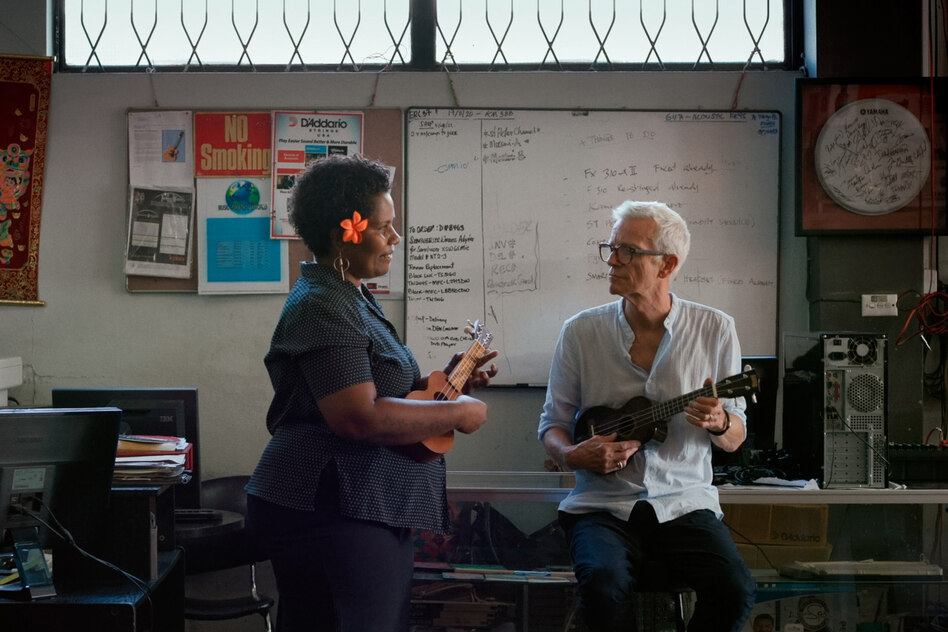
Since then, during longer stays on the archipelago, she has established a network among locals and friends who, as casual, quasi-fictional characters, contribute a rich bundle of sensual experiences and knowledge. For example, when Simon Fisher Turner, the soundtrack composer of "Cycling the Frame", collects nighttime sounds in a staged scene and talks to local musicians, or when in another "song" a group of locals hikes through the hinterland and tells each other the story of historical wars against slave traders and colonial oppressors.
“Heart of Light” lives from a wealth of small observations, stories, encounters and gestures. Jenny Lou Ziegel's images move in the street scenes of the capital Suva, among school children in uniform, in lush vegetable markets, in the harbor at night and on bus rides at a respectful distance. Visits to museums show the pride in the ancient nautical tradition long before colonialism. Impressions of the work of a sugar factory and the extraction of the roots for the national drink kava stand for themselves without explanation.
The calm, stream-of-consciousness commentary voice of Tilda Swinton lends structure to the stages of the journey. She was only able to join the shoot late, and her presence as the director's visible alter ego in the last third of the film tells us what's important. The actress cautiously adheres to the village greeting rituals that stand for peaceful coexistence, quietly accompanies the craft of the mat weavers and carpenters, and seems to achieve a fleeting moment of peace in the other temporality.
Read the full story at the source
Source: taz