
Germany · taz · · 3h
Energy transition in Germany: billions for flexibility in the power grid
Deutsch (original) · Auto-translated to English
With the energy transition, the need for balancing capacities for fluctuating electricity generation is also growing. Accordingly, not only is the expansion of battery storage booming; The operators of pumped storage plants are also looking for ways to make their systems even more efficient.
The Schluchseewerk in the Black Forest, the second largest operator of pumped storage in Germany behind Vattenfall, wants to invest more than one billion euros in its systems over the next ten years. “Pumped storage is a key technology in the energy transition,” says Bodo Mayer, Head of Technology at Schluchseewerk. Due to the volatile feed-in of wind power and photovoltaics, the need for flexibility is increasing.
Pumped storage not only provides high performance in the short term, it also stabilizes the frequency and voltage in the power grid. They operate on various markets, for example on the spot market, by pumping water up the mountain when prices are low and releasing it back through the turbines when prices are high. They also provide necessary system services that are requested and paid for by the transmission system operators.
The Schluchseewerk, a subsidiary of the energy companies EnBW and RWE, is now facing the largest campaign to upgrade its five plants in the company's almost 100-year history. On the one hand, the Säckingen and Wehr cavern power plants on the High Rhine are being expanded. The machines are located in an artificial cavity in the rock. In Säckingen, the generation capacity is to be increased from 360 to 387 megawatts, and in Wehr from 910 to 980 megawatts. “The renewal program in Wehr is the most extensive maintenance measure in the history of our company,” says CEO Mayer. A “low three-digit million amount” is estimated for this alone.
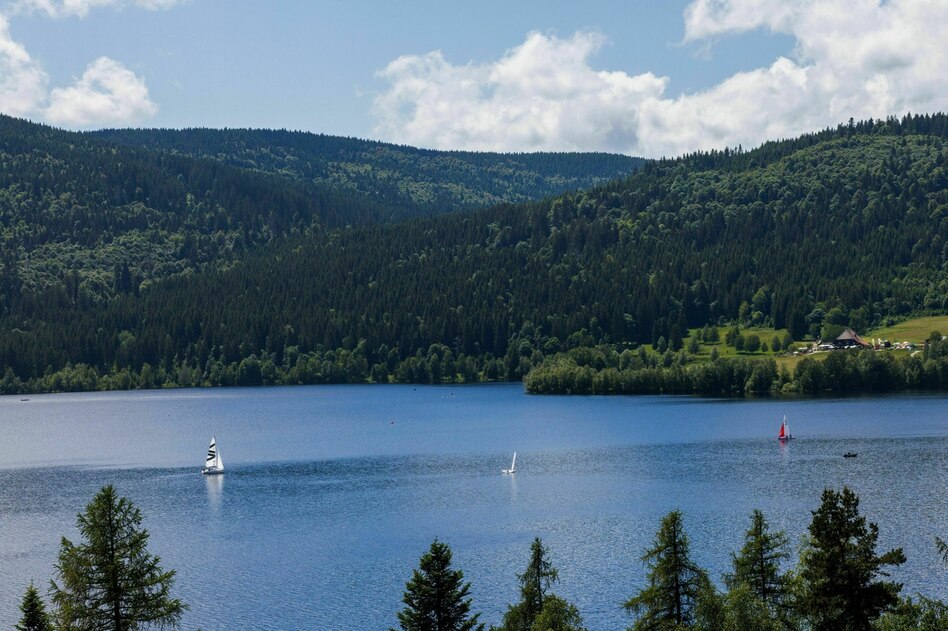
In addition, the company operates a unique storage cascade with three stages between Schluchsee and Hochrhein, making Schluchsee the largest electricity storage facility in Germany. The operator estimates the storage capacity of the lake, which – unlike many other reservoirs – is also used for water sports, at up to 91 gigawatt hours. A gigawatt hour is a million kilowatt hours.
The cascade consists of the Haus, Witznau and Waldshut pumped storage facilities. In addition to the existing power plant, an additional shaft power plant with an output of 106 megawatts is to be built in houses. A similar project is also planned in Witznau. “We are building a new power plant for the first time in 50 years,” says CEO Mayer.
The technology is also new: for the first time, reversible pump turbines will be used in the company's system park - machines that are pumps and turbines at the same time. So far, the power plants have used so-called ternary machine sets, in which the pump and the turbine are two machines. Despite minor disadvantages, such as in terms of efficiency or the switching times between pump and turbine operation, pump turbines have economic advantages in new construction projects, according to the Schluchseewerk.
Read the full story at the source →
Source: taz