
Germany · taz · · 49m
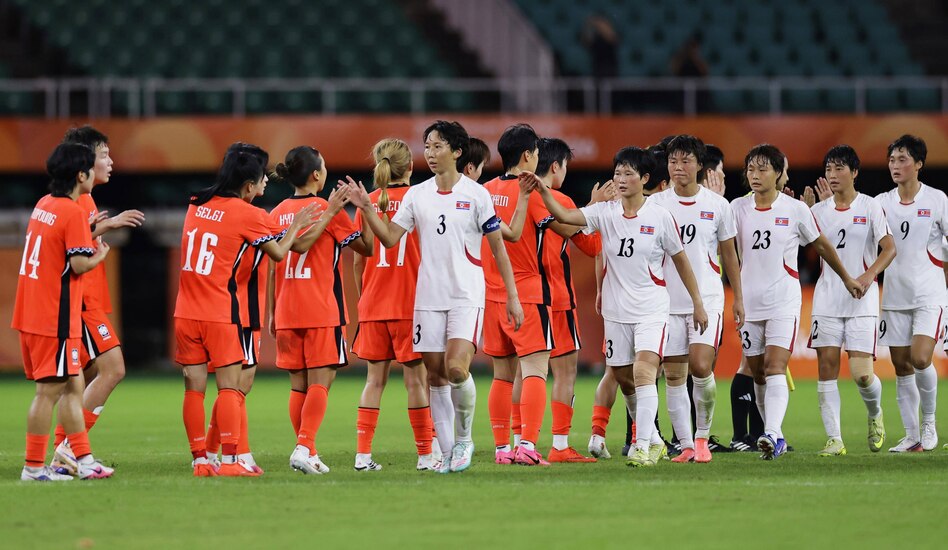
Duel between North and South Korea: Handshake only according to protocol
Deutsch (original) · Auto-translated to English
Ri Chang-rim keeps calling out to the field. You can see his nervousness. No wonder: At the Ecopa Stadium in Fukuroi, it's all about the victory - and about his daughter: "Back then she had the choice of playing for South Korea or North Korea," explains the 58-year-old with audible pride. The decision was easy. "Song-a went to a North Korea-friendly school in Osaka, as did I. We are attracted to North Korea." Ri Chang-rim, who was born in Japan, is cheering for North Korea.
At the Asian Games, which have been running since last weekend in Nagoya, Japan, the Asian sports elite - around 15,000 athletes from 43 sports and 45 countries - come together. The encounter on Monday afternoon was particularly delicate: in women's soccer, North Korea and South Korea meet in the group game.
And the North Korean squad includes the daughter of Ri Chang-rim, who is cheering in the stands: 27-year-old Ri Song-a, who has brought a fan club with her - not from North Korea, but from Japan. Because Ri never lived in North Korea, was born in Japan and grew up there. She is one of 400,000 people of Korean descent from Japan whose ancestors came to Japan around 100 years ago, when Korea was a Japanese colony.
Since 1950 - when the three-year Korean War broke out shortly after the end of the Second World War and with it the end of Japan's colonial era - North and South Korea have remained in a state of war. And today, those of Korean descent who remain in Japan often support North Korea, as player's father Ri Chang-rim explains: "I've been to North Korea twice. The people there are warm-hearted and open," he shouts against the noise of the stadium.
When it comes to this topic, he is often asked about human rights, which are not so important in the North Korean one-party state. Ri replies: "But I'm not saying that I support everything in the country. And by the way, the USA, Japan and South Korea are not innocent when it comes to a lot of politics!" North Korea's government sends critics to labor camps and does not allow freedom of expression, assembly or movement.
How does it come about that there is so much support for North Korea, at least in terms of sport, among the Korean community in Japan? Experts emphasize that the “zainichi,” as people of Korean descent are called in Japan, experience a lot of discrimination in the country. In addition, the North Korean state has often been more interested in this group than the South Korean state. To this day there is a network of schools in Japan that receive support from North Korea.
Elsewhere at the Asian Games, North and South Korea also have to deal with each other. There was also another showdown at the beginning of the week when the South Korean An Jeong-eun met the North Korean Jong Se-ri in the quarterfinals of the karate competition (under 61 kilograms, kumite). “South Korean karateka An wins the first inter-Korean duel of the 2026 Asian Games,” reported the South Korean newspaper Joongang Ilbo with legible satisfaction. More duels follow.
There are no winners in football on Monday. After North Korea found its way into the game better and went into halftime 1-0, South Korea equalized after the restart. In the end it is 1:1. Both teams reach the knockout rounds. There is no handshake between the coaches – usual for fair play reasons. In the press conference after the game, North Korea coach Pak Song-jin said: "We played football, nothing more and nothing less. I won't say anything else about it."
When asked, Pak's translator and press spokesman explains: "Everything at the Asian Games follows a strict protocol!" There were handshakes between the players, which was mandatory. So what should the question be? When someone asks what a handshake between the two trainers looked like, the translator looks irritated: “No.”
South Korea's coach Shin Sang-woo regrets this: In his post-game press conference - which takes place separately from that of the North Korean coach - he says: "You know, in North Korea they probably don't do that handshake thing." Shin would have appreciated a handshake. “But we only played football here, so it’s a shame.” Between North and South Korea, even a sporting encounter is still an encounter in a state of war.
Read the full story at the source
Source: taz