
Germany · taz · · 1h
Germany's Olympic bid: Munich is already glowing
Deutsch (original) · Auto-translated to English
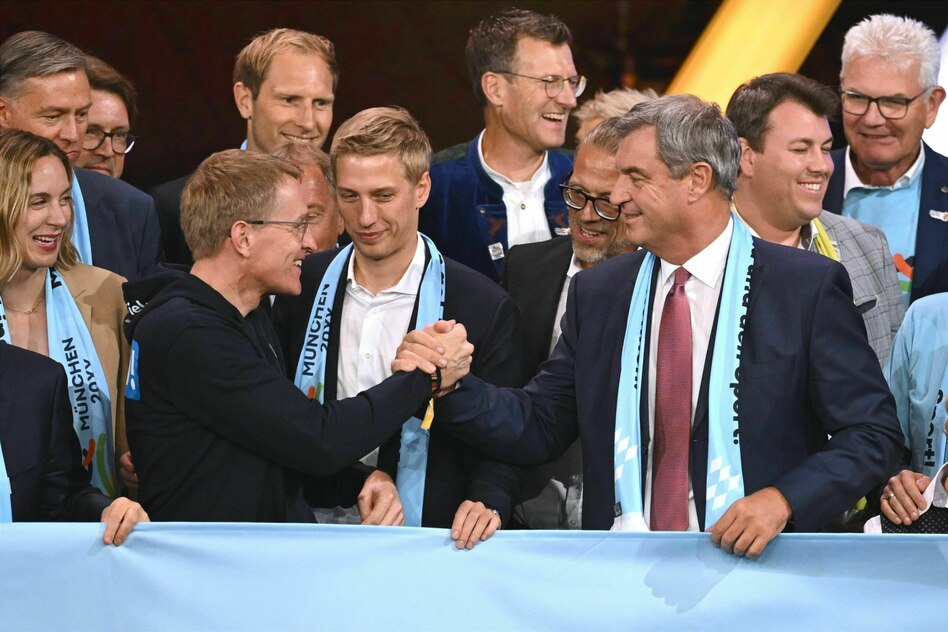
Losers rarely shine like that. The smile on the face of Hendrik Wüst, Prime Minister of North Rhine-Westphalia, didn't shine quite as brightly as the huge chandelier in the foyer of the noble Kurhaus in Baden-Baden, but he really did everything he could to pretend that it didn't bother him at all that Munich and not Cologne was entering the race for the Summer Olympics with the Rhine/Ruhr region. “Germany has won,” he said after the defeat in the vote at the extraordinary general meeting of the German Olympic Sports Confederation on Saturday afternoon.
The Olympic sports associations had just voted in favor of the Bavarian capital with a clear majority of 91 to 50 votes, when Wüst dutifully took on the role of the Olympic fan who now wants to do everything to ensure that the Games come to Germany again after 1972. The representatives of the winners this Saturday afternoon, Bavaria's Prime Minister Markus Söder from the CSU and Munich's Green Mayor Dominik Krause, were just as dutiful in thanking the losing applicants from North Rhine-Westphalia for the fair competition.
At the general meeting of the German Olympic Sports Confederation (DOSB), the second part of which was broadcast live on ARD, everything was done to ensure that there were no losers. Even before the day of the vote, there were two defeated applications that had invested a lot of money in the candidate race. In total, more than 50 million euros were invested in the race for the status of a German Olympic candidate.
In Hamburg we have known since the end of May that the games in 2036, 2040 and 2044 will take place somewhere else. And after the election victory of the anti-Olympic city left, Berlin withdrew its application two days before the vote in Baden-Baden. The fact that the DOSB evaluation commission had previously rated the capital significantly worse than the plans from Munich and North Rhine-Westphalia was ignored by the Berlin applicants when they announced their withdrawal.
In Baden-Baden they presented themselves as lucky losers, just like Hendrik Wüst. Kai Wegner, who will soon be leaving the office of Governing Mayor, was allowed to go on another business trip and said in the Kurhaus that he was “grateful that I can be here today”. Sure, of course. Once again he was allowed to appear statesmanlike when he said that now it was important to stand united behind Germany's application.
The assembled political and official elite had often heard how important cohesion was in Germany and how great the role of sport could be for the German nation. It was very German that day, and if ARD hadn't taken over the afternoon part of the event, one could have easily gotten the impression that the Olympic Games were a purely national affair. The super swimmer and 26-time Olympic champion Michael Phelps from the USA and Usain Bolt, the sprinter from Jamaica who won eight Olympic gold medals, were also seen in clips.
Previously, welcoming speakers such as Baden-Württemberg's State Development Minister Theresa Schopper and the State Minister for Sport in the Chancellery, Ronald Rauhe, had invoked the energizing and healing power of sport. Anyone who endured this terrible German navel-gazing must have thought that Germany was a doomed patient who should be kissed back to health as soon as possible through the Olympics.
One of the real winners of the day, Daniel Günther, the Prime Minister of Schleswig-Holstein, in whose state capital the sailing competitions will take place if Munich wins the IOC contract, did not want to see the event in such a negative light. Germany finally told a positive story again.
In all the German sensibilities, it was tennis icon Boris Becker who was the first to broaden his perspective. Becker, who won gold in doubles together with Michael Stich at the Games in Barcelona in 1992, said in a small group of celebrities on stage that the Olympics have no religions and are limitless. Then he turned his back on the world again and dreamed of “positive patriotism” in Germany, just as Jürgen Klopp, the coach of the German men's national soccer team, would like to see spread throughout society.
In general, Jürgen Klopp. Although he was not in Baden-Baden, he was one of the main actors in this launch of a German application to the International Olympic Committee. In the early afternoon, shortly before the result of the national preliminary decision was announced, he appeared large on the screen behind the podium in the Kursaal. In a recorded video, he talks about how his father took him in the car to Munich in 1972 to watch a few competitions at the games. He was there five times and experienced something unforgettable. Then he remembered the summer fairy tale, the 2006 World Cup in Germany. “We liked each other more than ever before and possibly never again after.”
Germany's highest representative couldn't keep up with Germany's current favorite person. Federal President Frank-Walter Steinmeier was chauffeured in front of the Kurhaus in his luxury limousine, which was much admired by a few onlookers, and addressed the meeting. He also invoked, how could it be otherwise, “the unifying power of sport”.
His presidentially routine appeal: “Let’s break down barriers, use the momentum to move our country forward and reaffirm who we are and what we want to remain.” He called Germany a “cosmopolitan, liberal country” that should present itself to the world, as if one could seriously describe the Federal Republic after the AfD's victory in the state elections in Saxony-Anhalt in the same way as was usual before the vote.
When Markus Söder was asked after the results were announced how he planned to approach the possible 2036 Olympic Games in Germany, 100 years after the Nazi propaganda games, he stated: “Germany is a completely different country than it was in 1936.” He's certainly right. However, even he cannot know what Germany will look like in ten years. “We must not leave our country to radical forces,” is all he said. As usual, he refrained from naming the danger from the far right. He also said: “The Olympics are a boost for democracy.” Games in Germany are now supposed to unite the country and also save democracy.
Maybe someone can tell him that the Olympic Games are anything but catalysts for democracy. Should Söder come to Baden-Baden again, he might like to take a look at the bust of Pierre de Coubertin, the founder of the modern Olympic movement, which can be admired on the edge of the spa park. It was donated in 1938 and is said to have been erected as a thank you from the Nazis to the Frenchman and leader admirer after the athletes from France held their arms up in the Hitler salute when the athletes marched into the Berlin Olympic Stadium in 1936.
Munich's mayor Dominik Krause, who really wants to ride a ride on the “Olympia Looping” roller coaster with Markus Söder at the Oktoberfest in Munich to celebrate the voting success, then pointed out how hard the city has to work if it really wants to intervene in the race for the 2036 Games.
The IOC will evaluate the expressions of interest received as early as March 2027. Only those who pass the first test make it into the “targeted dialogue” with the IOC before the host is voted on at an IOC general assembly in 2029. More than ten applications are expected from all over the world, including from Doha, Istanbul, Ahmedabad in India and Budapest.
The Munich city society can now prepare for discussions about the costs of the Olympic Games. Krause is not afraid of that. He feels “the vibe in the city” when it comes to the Olympics. Then he presented the Munich bill again, saying that the Olympics in his city would cost 10 billion euros. Half of these are the “event costs”, which can be refinanced 100 percent through sponsorship and ticketing. The other half is the cost of investing in infrastructure like the Olympic Village.
There are already good discussions with the Free State of Bavaria, now it's important to get the federal government on board. “Germany is the third largest economic power in the world,” said Söder, adding that they would probably manage that. And the country, which had just been portrayed as so small and despondent, became extremely strong. Was the previously invoked healing power of Olympia already at work?
Read the full story at the source
Source: taz