
Germany · taz · · 1h
The home visit: “I have already lived a thousand lives”
Deutsch (original) · Auto-translated to English
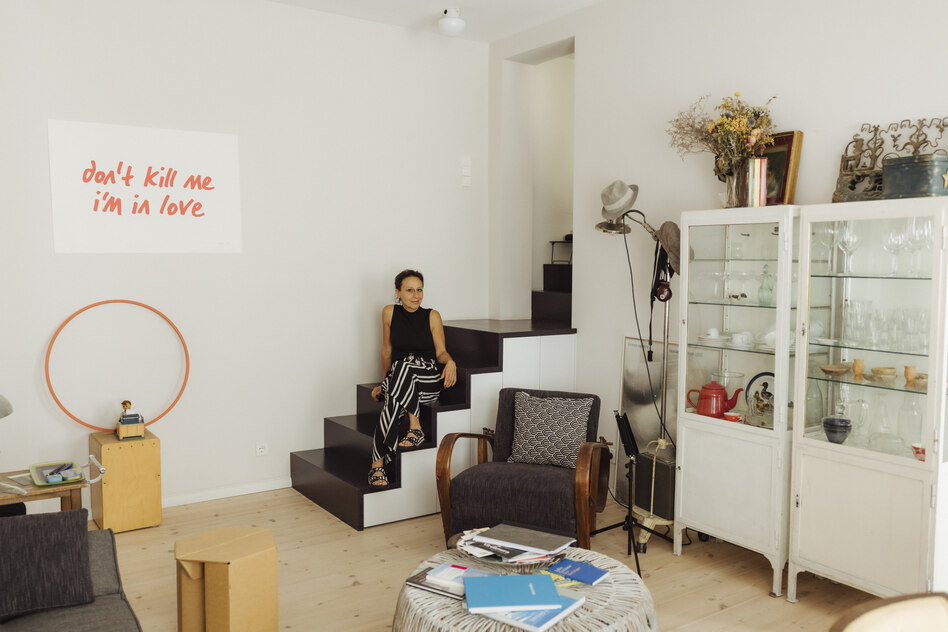
For Etta Scollo, Mascha Kaléko's texts are highly topical. During the Nazi era, the Jewish poet had to emigrate from Germany. It makes Scollo angry that we're about to repeat history.
Outside: At the end of the street is the park she loves: Viktoriapark, one of the oldest parks in Berlin, the only one with a waterfall. The area has old buildings with pretty facades, flowering front gardens, café terraces and small shops - Etta Scollo feels at home in her Kreuzberg neighborhood. She comes up the stairs to her apartment with dark glasses and shopping bags. She apologizes for the many steps. The picture of a laughing Maria Callas is stuck to the doorbell. “That’s not me,” says Scollo, “unfortunately!”
Inside: There is a postcard hanging in Scollo's kitchen with the sentence: "Life is too short for bad coffee." She hums to herself as she makes a cappuccino. The sun falls through the window onto the hand-painted tiles. The bedroom is elevated on a platform, “like on a stage,” she says. Her study is full of instruments, and portraits of nephews and godchildren hang on the walls. Your favorite guitar is in a corner.
Love: “Don’t kill me, I’m in love” is written in red on a white poster in the living room – a work by the conceptual artist Bruno Nagel. “The feeling of love touches me most deeply,” says Etta Scollo. “I fall in love with people, but also with stories, with songs, with objects.” That's what happened with the marble mask of Medusa that lies on the floor in the living room: When Scollo moved by train from Vienna to Hamburg 20 years ago, she saw the hundred-year-old mask in an antique store on the way to the train station and took it with her. And so it was with a book by the poet Mascha Kaléko that she found in a small bookstore in Catania. "That's my Bible. I always had that with me, and then I thought: sooner or later I want to put that into music." A famous line from Kaléko's poems reads: “I choose love for my homeland”.
Nowhere: Together with her good friend, the actress Eva Mattes, Etta Scollo brings Kaléko's words closer to the audience. Mattes reads, Scollo sings in her melancholy deep voice. They called their homage to Mascha Kaléko “Nowhere”. The poem from which the word comes is actually called “Not a Children’s Song.” "Wherever I travel, I come to nowhere. I go to nowhere," Scollo quotes. That has a lot to do with her: “Being everywhere and nowhere, having several homes and none at the same time.”
A thousand lives: Etta Scollo spent her first 21 years in Catania in eastern Sicily, where she was born 68 years ago as the third of four children. She lived in Vienna for ten years, with the mask in her luggage she moved to Hamburg and stayed there for ten years “because of love” – her partner at the time lived in Hamburg. She has been in Berlin for twenty years now. The singer says: “I have already lived a thousand lives.” She has owned an apartment in the center of Catania and in Kreuzberg since 2019. “Living here and there is a gift,” she says, folding her hands in a gesture of gratitude.
Longings: After so many years abroad, she felt a longing. "It wasn't romantic, but physical. I suddenly desperately needed the light and air of Catania," she says. There she found an old building with six-meter-high vaulted ceilings and a round room. As a child, however, she dreamed of the “north” and of metropolises with gray weather. "I never once wore gloves when I was a child. I didn't know what winter was."
Two worlds: Etta Scollo says she loves contrasts, like the one between the weather in Berlin and Catania or between her two apartments. In Catania she lives in an old palazzo, here in an attic, “almost like a student,” she says and laughs. Opposites are inspiring for her character and her music. “An apartment is not just an apartment, but reflects the reality of a person, their inner being, with all their dreams and challenges.” There were always contrasts in her parents' house too. “I have always carried two worlds within me.”
Family History: Scollo's mother was the daughter of a wealthy naval captain from Catania; her father came from a simple rural family. After the Second World War he spent three years as a prisoner of war and then studied law. All that remained of her mother's family's former prosperity was the large villa. To earn money, they rented out rooms - including to students like Scollo's father. Her mother, a young woman who studied fashion, was closely guarded by her jealous father and brothers. But one morning, after an emergency in the neighborhood, she was left alone in the kitchen with the law student. He got on his knees in front of her and asked her if she wanted to be his wife. She said, “Yes.” Although both families were against it, they married.
The father: “My father worked as a lawyer against the mafia and for poor people,” continues Scollo. He was a special person, also full of contrasts. “Sometimes he would watch football, then listen to the news and later stand there in his white undershirt and play the mandolin,” she says. He read a lot, “even while eating.” There were books everywhere in the house. “We grew up in this culture.” Her parents raised her and her siblings freely: “They never told us where we should go.”
Passion: Her first memory of music also has to do with her father. She is two years old, standing on a chair, her father holding her while she sings: “Marina, Marina, Marina”. Everyone in the family played music, she says. Grandmas, uncles and cousins played mandolin or just sang. She went to Vienna to study music at the conservatory. At the beginning she didn't want to become a professional musician. "I also studied art and architecture until I realized: music was my life. Then I gave up everything else to devote myself to my passion."Golden record: In 1988, Etta Scollo recorded an Italian version of "Oh! Darling" by the Beatles, which had great success and received a gold record. “It was all crazy,” she says. In the 90s, when she moved to Hamburg, she continued to develop her music. She composed her own works and film music and released numerous albums. Today she combines music and language in literary projects, such as the Elena Ferrante saga “My Brilliant Friend” or most recently in her homage to Mascha Kaléko - together with actresses such as Corinna Harfouch, Maria Schrader and Eva Mattes.
This text first appeared in wochentaz, our weekly newspaper from the left!
Every week, wochentaz is about the world as it is – and as it could be. A left-wing weekly newspaper with a voice, attitude and the special taz view of the world. New every Saturday at the kiosk and of course by subscription.
Contemporary: From the little Kaléko book that Scollo calls “my Bible,” she reads a fragment of the poem “Contemporary Address” that touches her: “How is it that we still laugh / That bread and wine still make us happy / That we don’t stay awake all night long / Haunted by a thousand cries for help.” The poem, published in 1945 and written against the backdrop of the Second World War and the Nazi era, is “very relevant today,” says Scollo. “How can it be that when we look at what is happening in Gaza, in Ukraine, in Iran or in Lebanon, we look the other way as if it is none of our business?”
Heartbreak: What is currently happening in the world is also our responsibility, says Scollo. "We all have to say 'No' together in Europe. We have to say: 'We want it to stop.'" She apologizes for the outburst of anger and says that if Mascha Kaléko were alive today, she would "die of heartbreak."
Amazement: How does she manage to be happy despite the world situation? “I always learn something new and am amazed,” says Etta Scollo. "Amazement is one of the most beautiful feelings ever, it's like falling in love. I don't want to lose this feeling. Not even when I'm 100 years old."
Read the full story at the source
Source: taz