
Politics · taz · · 3h
CSD demos in Halle and Wismar: Colorful majority against the AfD
Deutsch (original) · Auto-translated to English
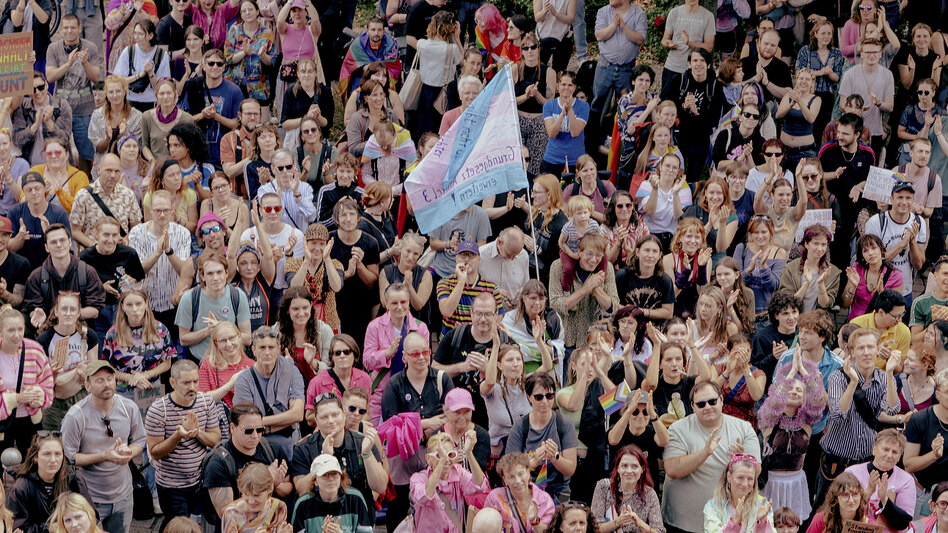
Luna Möbius feels fear and anger when she thinks about the election results in Saxony-Anhalt. This is what the trans activist says into the microphone from the balcony of the opera in Halle an der Saale. On the square in front of her: thousands of demonstrators at the largest CSD the city has ever seen. The state election was less than a week ago. The AfD received more than 43 percent of the votes.
With the microphone close to her lips, she says in a calm voice: "The next few years will be hard. The next few years will be shit..." For a second or two there is silence at the interim rally in front of the opera. Until Möbius finishes the sentence: “… shitty for the fascists!” Cheering, clapping. “There will never be a right-wing extremist government anywhere that will not experience our resistance,” she shouts to the applause. Then the demonstrators chant: “Alerta, Alerta, Antifascista!”
A few minutes later, the CSD moves on to the city in the south of Saxony-Anhalt. This Saturday, according to the organizers, around 8,000 people will demonstrate at the CSD in Halle or celebrate at the street festival on the market square. That's about four times as many as a year ago. And they are not the only ones taking to the streets in Germany on Saturday. 127,000 protest against the AfD across Germany. And on the Baltic Sea coast in Wismar, hundreds are also demonstrating at the CSD for sexual freedom and gender diversity. There, in Mecklenburg-Western Pomerania, the state elections are coming up next weekend. How are people feeling a week after and a week before the election?
Among the thousands cheering in front of the Halle Opera is a person who introduces himself as T - just a letter, pronounced in English. A rainbow flag was placed around their shoulders. "It feels good that so many people are coming together. It gives a feeling of security." T is holding a cardboard sign in both hands with a shark painted on it and the words: “Eating Transphobes Alive.”
From Hamburg to Munich After the AfD's election success in Saxony-Anhalt, according to organizers, tens of thousands of people across the country took to the streets on Saturday for democracy and against right-wing extremism. The “Test” initiative, which called for the demonstrations and called for a review of the AfD by the Federal Constitutional Court, spoke of a total of 130,000 participants in more than 20 cities. There were protests in Berlin, Hamburg, Düsseldorf, Magdeburg and Munich, among others. The “test” demos take place in the state capitals on the second Saturday of each month.
In Berlin, a broad alliance of trade unions, initiatives against right-wing extremism and climate groups also called, and according to police reports, 18,000 people followed. The organizers spoke of 32,000 participants who marched in front of the Red Town Hall in a star demonstration. On September 20th, Berlin will elect a new House of Representatives. In a survey on Friday, the AfD is the third strongest force with 17 percent, behind the Left (23 percent) and the CDU (21 percent).
According to taz research, at least 170,000 people have demonstrated against the AfD since the election in Saxony-Anhalt. Almost two thirds of the demonstrations took place in smaller towns and attracted three to four-digit numbers of participants. (epd/taz)
They come from Halle-Neustadt, says T. This was once a model socialist project in the west of the city. Today the neighborhood is known for its poverty. And of the people who voted there, more than 50 percent voted for the AfD. That was scary, says T. “But it wasn’t surprising either.”
It wasn't just in Halle-Neustadt that things went well for the AfD a week ago. In Saxony-Anhalt, the party received the most first and second votes almost everywhere. The only exception, however, is in Halle. In the center of the city, in constituency 37, the Left received the most first votes (39.9 percent) and the Greens received the most second votes (33.7 percent). The CSD is running through exactly this constituency on Saturday.
A truck equipped with speakers fills the middle of the colorful demo with electropop. “I don’t care, I love it,” sings Charli XCX and the participants. On the second floor of a house on the side of the road, the curtain behind a window slides aside. A person with a child in their arms waves outside with a smile.
Gerriet cycled to the CSD from the rural region north of Halle this Saturday. He uses male and female pronouns alternately. The election result didn't surprise her either, says Gerriet. “And yet I still haven’t figured out what that means for the next few years.” The mood in Saxony-Anhalt has been changing for a long time. “As a queer person who lives in the countryside in Saxony-Anhalt, I ask myself more and more often whether it is still safe for me in the evenings.” Ten years ago things were different.
But again about the election results: He thinks the people in Saxony-Anhalt are rightly angry. Many wondered how they would pay rent, electricity and food. “But the AfD directs this anger against people who can’t do anything about it,” believes Gerriet. She fears that society could break down further as a result. For her, moving away is only a matter of time. Until then, however, it is important to build networks and show solidarity with people from other cities and countries. "We need other skills: How do we not spin the wheel without ignoring politics? How do we support those affected? How do we de-escalate?" Just being loud is no longer enough.
Police officers are constantly visible around the demonstration and the queer city festival on the market square in Halle. Plainclothes officers watch whoever approaches the hustle and bustle. In recent years there have been counter-protests and attacks, today things remain quiet at the CSD. In the middle of it all, a group of teachers from Saxony-Anhalt is having a conversation. They prefer not to publish their names. One of them says that “the mood has absolutely changed” at her school in the past week. Some of the young people celebrated the election results and were happy that the AfD got so many votes. “And others are afraid as to whether they will even be allowed to exist at school.”
The end of the demonstration cannot be seen from the first car of the CSD in Halle, and the speeches on the first car cannot be heard at the back. Colorful flags, soap bubbles and demonstration signs sway above the crowd to the beat of the music and in the wind.
A week after the election, there are still many election posters hanging on the lanterns in Halle. In one, Sven Schulze, CDU Prime Minister and former top candidate, is smiling. His party came in second, but its share of the vote has more than halved since the last election. 17 percent are left, a historic low in Saxony-Anhalt. It is said that the CDU will now go into opposition. But who will succeed Schulze as head of government is unclear.
At 43.8 percent, the AfD does not have its own majority in the state parliament. Until the last day of the election campaign, the right-wing extremist party had announced that it only wanted to govern alone and without compromises. Now she claims the opposite and has sent the other parties offers to talk. The CDU, SPD, Greens and Left rejected this. Only the BSW addressed it. During the CSD, a demonstrator grabs some make-up and paints two rainbows on the cheeks of the incumbent Prime Minister. At least that's how Schulze looks happy on the poster.
The election manifesto talks about “rainbow ideology”, “rainbow doctrine” or “perverted rainbow propaganda”. Germany is “helplessly at the mercy” of their influence. An “LQBTQ movement” – it is exactly that wrong twice – is destroying the “traditional normality” of society. A “trans lobby” promotes a “mental disorder” in children of not being able to identify with their own gender. To prevent this, the AfD wants to ban rainbow flags in schools, for example.
The low birth rate in Germany is due to the fact that “sexual deviations” are accepted. The AfD, on the other hand, wants to put the “normal family” of father, mother and as many children as possible at the center of a state government advertising campaign. Whether on the big stage at the market or during the demonstration: every speech at the CSD in Halle a week after the election is about the result for the AfD.
At the same time in Wismar, around 350 kilometers north of Halle, a CSD is also moving through the city on Saturday. But even there it's always about the result in Saxony-Anhalt. “Half a stalemate, half the end of the world, a bad situation,” says Luis Dannewitz, for example. “For me there is the greatest disappointment, sadness, powerlessness,” says Sebastian Hülser. And here too the impulse: “We’ll now convert that into anger.”
The 25-year-old musician Dannewitz and the IT coordinator Hülser, who is one year older, helped organize the CSD in the city of 43,000 residents on Mecklenburg's Baltic Sea coast. Around 2,000 participants, roughly the same number as at the first Wismar CSD two years ago, march across the city center in the afternoon to the sound of hardtech and gabber. Dannewitz says that for a state like Mecklenburg-Western Pomerania this number is “simply cool and impressive”.
What is initially impressive is the mix of political directions. It is hardly surprising that the Greens, the Left and the SPD are there with their own vehicles. More like the group with the FDP banner that runs along in the demonstration without confrontation not far from a group of the left-wing authoritarian Red Youth shouting Palestine slogans. In between is the Adenauer SRP+, the extremely loud campaign vehicle of the Center for Political Beauty.
The initial situation before the election in Mecklenburg-Western Pomerania next Sunday is somewhat different than in Saxony-Anhalt. According to the latest pre-election polls, the AfD is also in the lead with 36 to 38 percent. The SPD of Prime Minister Manuela Schwesig follows closely behind with 30 to 34 percent.
It's the final stretch of the election campaign. So the head of government herself came to Wismar to promote a “strong” Mecklenburg-Western Pomerania “without agitation, without exclusion” at the CSD opening rally on the market square. And therefore for herself. “Hate, discrimination and right-wing extremism must have no place in our country,” she said in a thoroughly combative speech. Leading SPD politicians elsewhere can probably only dream of the applause she receives.
The region around Wismar is considered a stronghold of right-wing extremism. The “National Socialist model village” of Jamel, which has been populated by neo-Nazis since the 1990s, is less than 15 kilometers from the Wismar market. At the CSD two years ago, 250 neo-Nazis gathered not far from the train station and shouted “All of Germany hates the CSD”, “East, East, East Germany” and “Nazikiez”. The following year, at the CSD in neighboring Grevesmühlen, 350 right-wing extremists marched.
There were great concerns that this would happen again this year. Especially since a previously unknown young Nazi group called “Jägertruppe MV” mobilized against the CSD in advance. “If possible, travel in pairs, preferably in affinity groups,” said the organizers of this year’s CSD in the “safety instructions” distributed via Instagram. “Particularly colorful outfits” should only be worn on site. But above all: “The demo route will not be published in advance.” Federal police are already lined up at the train station. A total of around 100 officers are on duty that day.
However, the counter-demonstration “for the protection of our children” that was registered within sight of the Wismar market square simply canceled. There simply weren't enough neo-Nazis. Two men, one wrapped in a German flag and the other in an AfD flag, go around shouting. Her articulation leaves a lot to be desired due to alcohol. “You still haven’t woken up” is simply to be understood. There are a few young Nazis hanging around in the old town. Threatening enough.
Sebastian Hülser says: “It is noticeable that this year, compared to 2024 and 2025, things have generally become quieter at all CSDs in Mecklenburg-Western Pomerania.” At the CSD in Neustrelitz, for example, the widely announced counter-protest was limited to just twelve right-wing extremists. Hülser assumes that this has to do with the AfD structures. “The right-wing radicals are now putting their energies into the election campaign and are currently tied up.”
Both Luis Dannewitz and Sebastian Hülser are nevertheless optimistic that things will “work” next Sunday: that in the end there will be a stable democratic majority in the state parliament. “I think things will go well here again,” says Dannewitz. “It won’t be another Saxony-Anhalt,” adds Hülser. Simply because the Mecklenburg-Western Pomerania AfD prime minister candidate Leif-Erik Holm is “not a Siegmund”. Unlike the top candidate in Saxony-Anhalt, he has “no charisma”.
Shortly before 2 p.m., Martin Thiele climbs into the first loudspeaker car of the CSD demonstration train at the Steintor in Halle. Like Dannewitz and Hülser in Wismar, he is a co-organizer in Halle. In the past week he made a lot of phone calls, looked for speakers and ultimately wrote his own speech. With a microphone in his right hand and a note in his left hand, he makes it clear to the demonstrators what could happen in Saxony-Anhalt after the election.
“If the AfD joins the government, Saxony-Anhalt will become a fascist experimentation ground.” That's scary, says Thiele, looking into the crowd and back at his piece of paper. Advice and meeting rooms for queer people would struggle with closure, and queer people themselves would become targets of right-wing attacks. "But the ethnic-national evil spirit that is now taking hold doesn't know our queer movement history. He doesn't have the slightest idea that we are damned survivors."
A few minutes later, Thiele hands the microphone back and puts his notes away. Then he puts on an orange high-visibility vest and runs to the front of the CSD demo. A pop song is now playing again from the loudspeaker: “Wannabe” by the Spice Girls. How does Thiele feel at this moment, around a week after the AfD won in Saxony-Anhalt? “Right now my mood is incredibly good.” So many people, so much solidarity. Thiele smiles. This is not a normal CSD. “With so much support we can get through the difficult times.”
In front of the opera in Halle, Luna Möbius ends her speech with an announcement. "I moved away from Halle two years ago because I was afraid of the fascists. I'm moving back." She won't let the AfD ruin her home.
Read the full story at the source →
Source: taz