
Politics · taz · · 1h
After the AfD election victory: hostile takeover
Deutsch (original) · Auto-translated to English
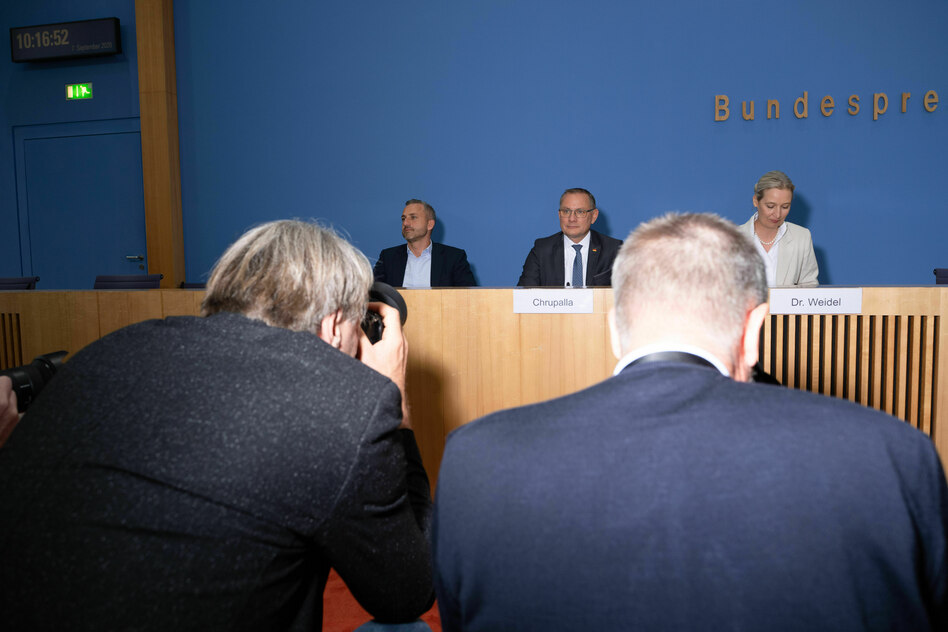
Just four days after his election victory in Saxony-Anhalt, Ulrich Siegmund disappointed. Not his voters, but all those who hoped that the AfD's imminent takeover of power in Saxony-Anhalt would moderate the right-wing extremists. After he was unanimously re-elected as parliamentary group leader, he appeared before the press in the Magdeburg state parliament on Thursday. When asked how he felt about the planned settlement of the Elbit arms company in Sangerhausen, Siegmund replied: “We do not generally demonize the production of armaments because we will of course also need appropriate aids in later remigration and deportation offensives.” So that Putin doesn't worry, he adds that they are firmly against sending military equipment to "foreign wars".
Siegmund appears relaxed. As always, he is surrounded by exactly the hardliners from his staunchly nationalist-ethnic regional association who will soon form his cabinet.
With its anti-human program, the AfD won 43.8 percent in the state elections in Saxony-Anhalt. The result produced shock waves not only in Germany. For the first time since 1945, power in a federal state is within reach for an extreme right-wing party. She is only three MPs short of an absolute majority.
This text first appeared in wochentaz, our weekly newspaper from the left!
Every week, wochentaz is about the world as it is – and as it could be. A left-wing weekly newspaper with a voice, attitude and the special taz view of the world. New every Saturday at the kiosk and of course by subscription.
The AfD has been in a power frenzy since election evening. In the general debate in the Bundestag on Tuesday, party leader Alice Weidel told CDU Chancellor Friedrich Merz: “Your time is already up anyway.” The AfD's medium-term goal of destroying the CDU also appears to be within reach.
The AfD won the election with the promise of disruption. Their election program calls for turning Saxony-Anhalt into an illiberal enclave. Not only did the pro-Russian right-wing extremist Hans-Thomas Tillschneider play a leading role in writing it, but several former officials of the Heimattreuen Deutschen Jugend, which was banned in 2009, were also involved - an organization that indoctrinated children into National Socialism and discultified the Hitler Youth. They could now gain control of the levers of power.
The 100-day program that the AfD wants to implement after taking over the state government provides for the barracking of refugees and “special classes” for refugee children in schools. In addition, the state media treaty should be terminated, ministries should be cut, and money should be cut off from politically unpopular initiatives. And of course rainbow flags should be replaced by German flags. The state motto of Saxony-Anhalt is to be changed from “think modern” to “think German”.
While some of their voters are currently intoxicated by the racist brutality, for another part the charismatic top candidate Siegmund was decisive. During the election campaign he proved to be a people catcher and literally started a movement - including a personality cult. He also linked up with explicitly East German worlds of remembrance with events such as GDR cult moped tours. His slogan “Everything is possible” sounds like a promise to some; threatening to many others at home and abroad.
Siegmund's supporters were not bothered by nepotism scandals or AfD candidates who took part in solstice celebrations and sang along to Hitler Youth songs. And neither is the scandal surrounding a member of parliament who is said to have beaten a 14-year-old with a baseball bat. Political and economic arguments also didn't work. The AfD electorate, 65 percent of whom considered themselves to be economically poor in post-election surveys, wanted to be part of a hopeful movement that promised a nationalistic heaven on earth, a “good old Germany”. It doesn't matter that it never existed like that.
In addition to the fear of losing status, another catalyst was the unpopular federal government. The widespread feeling is that a lot of things need to change fundamentally in Germany. All the other parties had already had their turn.
The AfD's election results show a familiar pattern: the party moves where political alienation is widespread, there is less trust in institutions and there are large socio-economic and spatial inequalities. Here the right-wing extremists mobilized masses of people to the ballot box who had not voted in the last state election in 2021 - 42 percent of AfD voters in Saxony-Anhalt.
Political scientist Claus Leggewie is not surprised by the recent election success. In an interview with the taz, he names three factors that were crucial for this. Firstly, the party managed to focus its political agenda entirely on the migration issue. The right-wing extremists thereby distracted from two more relevant topics: climate change and war.
Secondly, it is important to understand that the AfD and its voters have long since abandoned rational political discourse. “The lie takes the place of the truth – like in Putin’s system: Nothing is true and everything is possible.” It is correspondingly difficult to deal with a “gang of brutalized anti-discursive people” with facts and arguments.
A third, underestimated problem is the brutalization of young men: "As a side result of emancipation, young men feel marginalized and deprived. That's why they run after characters that are essentially fun: be it brutal-sadistic fun or fun in the sense of entertainment culture," he says. "Siegmund just sits on his moped and grins. That gets caught in a society that likes images and gets informed, or rather misinformed, via social media."
Even in the AfD, people did not expect the result of the state elections to be so strong. Siegmund initially seemed to be weak in the knees on election evening: he wanted to win over CDU defectors to his side in order to govern with a "stable majority," he said - otherwise there would have to be "new elections." Before the election, he had announced that he only wanted to govern with an absolute AfD majority.
On the evening of the election, however, the party leadership demanded that Ulrich Siegmund deliver on all his promises and accept the government mandate. Federal spokesman Tino Chrupalla even said that a minority government was also an option in Saxony-Anhalt.
After the election, the AfD Saxony-Anhalt actually wanted to lure renegade CDU direct candidates to their side with government positions and thus get the parliamentary majority through the back door. However, the party became so strong that several of the planned CDU defectors never even made it to the state parliament. And 14 of the 15 CDU members elected to the state parliament said this week that they did not want to change sides under any circumstances. The only exception: CDU MP Lars-Jörn Zimmer, who did not answer questions about this, including from the taz.
Because three votes are missing for a majority in the state parliament, the AfD also sent invitations to exploratory talks to all parliamentary groups. Only the BSW accepted it and announced in advance that it would also elect an AfD state parliament president. The Wagenknecht Party announced on Wednesday that they now wanted to discuss “energy supply, education and peace policy”. So the Kremlin wins, one way or another.
Torben Braga, a radical strategist close to Björn Höcke, meanwhile also advocated governing without a majority if necessary: The AfD doesn't have to do more than run for the office of prime minister in the state parliament; in the third round of voting, according to the state constitution, you don't need an absolute majority, but only the simple majority that is within reach: “No tolerance, no lazy compromises for access to power,” Braga demands, “because even a first A Prime Minister elected in the third round without a stable majority would not be the prisoner of the state parliament that some are now swearing to be.”
A Siegmund government would run the administration and the protection of the constitution even without a parliamentary majority, said Braga. It occupies top positions, determines curricula, personnel and police work, is the voice in the Federal Council and shapes migration policy: deportations, detention pending deportation, benefits in kind and payment cards, residency requirements, the duration of compulsory accommodation in the initial reception, state reception programs and hardship commission. “Everything is the responsibility of the executive, none of it is reserved solely for the state parliament,” Braga complains.
Contrary to what many now hope, the AfD does not seem to be afraid of “disenchanting” itself. Rather, it seems as if she wants to come to power at all costs and, if necessary, even without a legislative majority, in order to turn Saxony-Anhalt into a laboratory for politics that she later wants to roll out nationwide.
In the background, AfD strategists say that once in power you just have to do what you said you would do. You're going to kick up dust anyway. The objection that much of the AfD program is illegal is answered in the following way: If the courts or the federal government say that this is not possible, then it will be paid into the AfD. One could always claim: You see, Berlin is to blame, they are against the will of the people. One rarely hears about a desire for moderation or even a fear of disenchantment.
On Thursday, Siegmund announced “five good years for everyone in Saxony-Anhalt”. Except for those who, in his view, "came here to abuse the system. They should say that those were five unpleasant years," said Siegmund. And grinned.
Read the full story at the source →
Source: taz