
Politics · taz · · 1h
Chancellor Friedrich Merz: Does Merz have to go?
Deutsch (original) · Auto-translated to English
A few weeks ago, a 50-year-old video ended up with the CDU. A man, played by Loriot, wants to straighten a picture on the salon wall. As a result, a second one slips out of the frame, a third falls, and disaster begins. From order to chaos in less than three minutes, that is the story of Loriot's classic sketch “The picture hangs crooked”.
The video went viral in CDU chat groups; the connection to Friedrich Merz was immediately clear to everyone. “He can't do it,” was often heard from the CDU these days, even semi-publicly. The Chancellor had just stumbled in a personnel castling, the hoped-for awakening fizzled out, parts of the CDU attacked Merz. In the end, his authority was damaged and the party was worse off than before. That was eight weeks ago.
Since Sunday, the CDU's situation has worsened dramatically. Or better: The CDU's dramatic situation is more visible than ever. In the state elections in Saxony-Anhalt, the Christian Democrats fell to 17.2 percent, and of the 40 seats so far in the Magdeburg state parliament, only 15 are left. Together with the Greens, the Left and the SPD, the CDU has as many representatives as the AfD; the old party order has slipped. The right-wing extremists could soon take power in Saxony-Anhalt. It's a turning point.
This text first appeared in wochentaz, our weekly newspaper from the left!
Every week, wochentaz is about the world as it is – and as it could be. A left-wing weekly newspaper with a voice, attitude and the special taz view of the world. New every Saturday at the kiosk and of course by subscription.
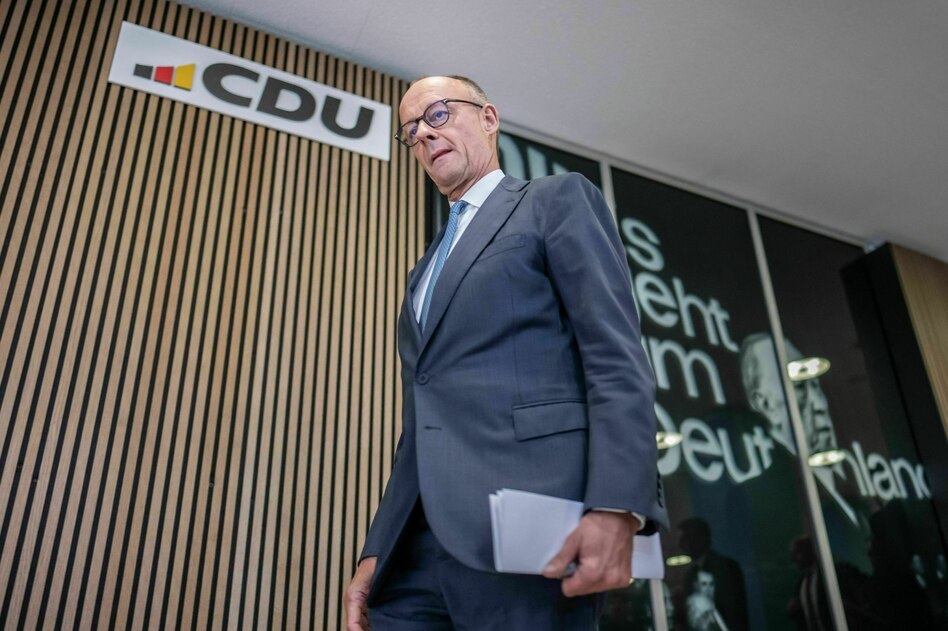
Merz, who wanted to halve the AfD, played a large part in this, as shown not only by the experiences at the campaign stands between Altmark and Zeitz, but also by surveys after the election. Three quarters of those surveyed are of the opinion that the Chancellor has damaged the CDU's performance, and almost half of the CDU supporters see it that way. “Nevertheless, it is of course true that I have the problem that many people cannot or do not want to follow me in my thoughts and in the way I judge them, that is my responsibility and I accept that,” said Merz on Monday at the CDU headquarters in a self-critical moment. Now he wants to reach people “in their full emotionality” and find a “better narrative.” But why should he suddenly succeed?
Given the situation, things have remained relatively calm in the CDU. But what happens if the party performs in the single digits in the upcoming state elections in Mecklenburg-Western Pomerania and undercuts the worst state election result there - 9.1 percent in Bremen in 1951? And what if she loses the position of head of government in Berlin to the Left? To the left! Then all the anger at Friedrich Merz could break out again, more vehemently than ever before.
One person has already ventured out of cover: “He has to get off his chair and someone else has to get up there,” said Tino Schomann, deputy CDU state leader in Mecklenburg-Western Pomerania. After September 20th there will be more such voices. “There could be a knee-jerk reaction among the excited base and the nervous parliamentary group – and that without a well-thought-out strategy,” says party researcher Julia Reuschenbach.
It sounds so easy: we replace the unloved frontman and then maybe not everything will be fine, but it will be significantly better. Only: There is currently neither a suitable script nor a protagonist who wants to take on the role of the regicide for a chancellor's resignation.
“Giving up is not an option for me,” Merz said on Monday; he doesn’t want to give up voluntarily. There are hardly any advisors outside of his loyal circle who thought bigger and whom he listened to. The far-sighted strategist Wolfgang Schäuble is dead, Roland Koch recently announced that the problem was not Merz, but the difficult coalition with the SPD. Merz's wife Charlotte is said to be at least as attached to the Chancellery as he is.
If Merz blocks himself, the only remaining procedure is a constructive vote of no confidence. According to this, the Bundestag can only dismiss the Chancellor if it elects a new one at the same time. This has only happened successfully once in the history of the Federal Republic, when the FDP switched sides in 1982 and gave its votes to Helmut Kohl. Today, however, there is no alternative to the current black-red coalition - and given the poor polls, it has no interest in new elections. Therefore, the CDU, CSU and SPD would have to agree on a new candidate who is ready to run against Merz.
Many believe that it could only be Hendrik Wüst, the relatively popular Prime Minister of North Rhine-Westphalia, who governs there quite quietly together with the Greens. Political scientist Reuschenbach also believes this. "But the risk is huge. There will be elections in North Rhine-Westphalia in just over six months. Who should replace Wüst in the election campaign there? In the worst case scenario, the most important state association will be burned down at the same time. And if the CDU were to lose North Rhine-Westphalia, then nothing can be taken for granted anymore."
Reuschenbach believes that, also with a view to the party's stability, it could be strategically wiser to win NRW first and keep the black-green coalition option open there.
Bavaria's Prime Minister Markus Söder and Interior Minister Alexander Dobrindt, both CSU, are also mentioned as possible candidates for chancellor. Reuschenbach considers both to be rather unrealistic. In short, strategically, from their point of view, a change of chancellor currently makes little sense.
If Merz is overthrown, the AfD's howl of victory is likely to grow even greater; the right-wing extremists have successfully brought the chaos from Saxony-Anhalt to the capital.
Behind closed Union doors, a wave is nevertheless building up and could, quite unstrategically, develop its own dynamic.
It is true, Reuschenbach admits, that it is unlikely that the CDU will get out of its hole with Merz. One possibility is therefore to diversify the team. “The party must become active as a whole.” In this turbulent, unsettled, polarized society, the major conflict issues must be enacted into laws: pensions, care, taxes. And you also have to get the economy up and running again, even though you have little influence on many factors.
Perhaps a new chancellor would find “a different approach,” says Reuschenbach. "But he would also have to expect different groups to do something that they don't want - and the sympathy can quickly be over." In addition, there would be a loss of time resulting from the change, and the announced reforms would be delayed even further.
One should not imagine the rise of the AfD as a daily political protest phenomenon against Merz, says Reuschenbach's colleague Marcel Lewandowsky, who researches populism and parties at the University of Halle-Wittenberg. "There are no short-term tactics that will win people back. This is a very long-term break with the values of the democratic system that we see in this milieu." It is important to invest in the local presence in the long term. "You have to win back the spaces that the AfD occupied. Structures in rural areas, attitude to life, representation. That's hard work."
And of course you also have to see that the Union has contributed to making the AfD strong. “The culture war rhetoric, the Greens as the main opponents and of course the migration policy: the ‘cityscape’, the ‘little Pashas’. We have to get away from that.” In addition, the reforms remained economically liberal, even if they were presented in a friendly manner. Something else is more helpful than changing the chancellor: concentrating on what are the CDU's core issues beyond identity, culture and migration. "You don't even know where the CDU stands between the reactionary AfD and the centrist SPD. What does conservatism mean today in a liberal immigration country? The CDU has to provide answers to that."
Hendrik Wüst, the favorite of many, has so far let the debate about changing the chancellor slide. After Merz, visibly shaken, practiced self-criticism at the CDU headquarters on Monday, the Prime Minister stood just a few hundred meters away at the Brandenburg Gate and took selfies in a good mood. Wüst is campaigning with Berlin's top candidate Stefan Evers; unlike Merz, he also sought contact with citizens in Saxony-Anhalt. The appointment may be a coincidence, but it is also clear that someone is in conversation here.
Read the full story at the source →
Source: taz