
Climate taz
COP31 starts: How does a climate summit work?
Who negotiates, how decisions are made and what the states are arguing about in Antalya: The most important questions and answers about COP31. more...
Deutsch (original) ·Auto-translated to English
1. What happens at a climate conference?
197 countries have now joined the UN FCCC Framework Convention on Climate Change, which officially declared global warming to be the most acute threat to humanity in 1992. The convention also establishes “Conferences of the Parties” – abbreviated as COP. The schedule in Antalya is to negotiate a contract text by November 20th.
At a COP, many different conferences take place at the same time. First of all there is the CMP, the “Conference of the Parties serving as the meeting of the Parties to the Kyoto Protocol”. All states that once signed the Kyoto Protocol are sending their diplomats to this conference. Although this is no longer quite as important, the signatories are meeting in Antalya for the 21st time to discuss how parts of the first binding climate agreement from 1997 can be further developed.
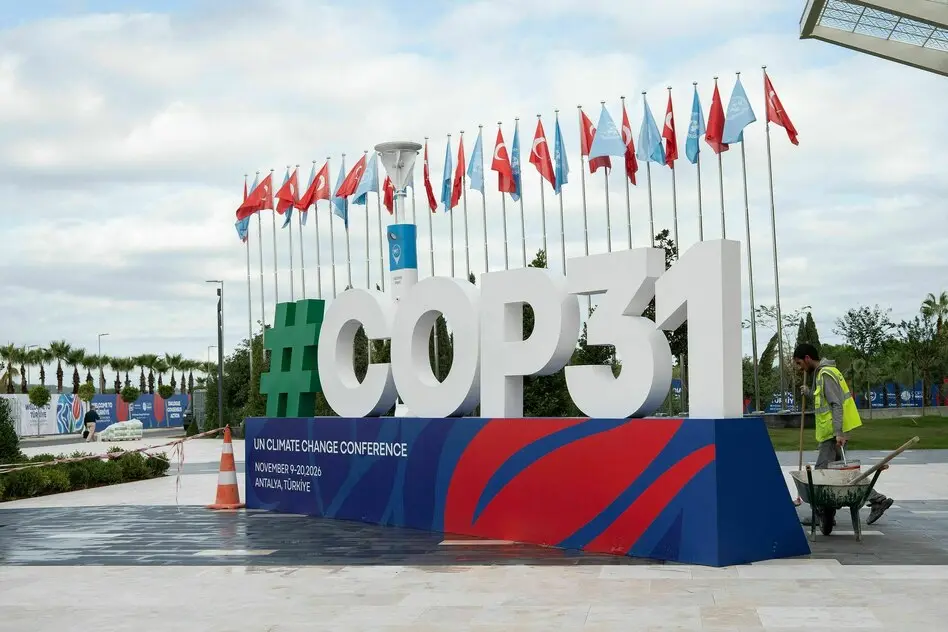
Politicians and experts from all over the world are meeting for the 31st UN Climate Change Conference in Antalya, Turkey. From November 9th to 20th, representatives from around 200 countries will discuss the fight against global warming. The taz has a team on site. Follow our reporting on our focus on taz.de, on klima.taz on Instagram, in the podcast klima update°, in the newsletter TEAM ZUKUNFT, in the weekday e-paper and in the weekly taz.
The second conference, abbreviated CMA, is more important: this is where the parties to the 2015 Paris Agreement meet to make decisions on how the protocol can be implemented. All states that are contracting parties to the Paris Agreement are sending diplomats - currently including the USA, although it has withdrawn: This withdrawal will only become legally valid one year after it is announced - i.e. at the end of January 2027.
To put it simply, the SBSTA is a subconference that deals with “knowledge”, i.e. with questions such as: Does a bog in the tropics store as much CO2 as one in the north? The SBI is also a subconference, where “administrative questions” are on the agenda, i.e. questions like: “Who is entitled to apply for money from which fund?” Money plays a big role at climate summits: industrialized countries have pledged to transfer $100 billion annually to the Global South from 2020 so that these countries can adapt to the consequences of global warming. There are also sub-negotiating groups on specific topics such as forest protection, land use, climate insurance and adaptation.
2. How are the decisions made at the climate conferences?
Climate conferences always start in spring: the climate diplomats meet at the headquarters of the UN Climate Secretariat in Bonn for the opening conference of the year. A roadmap is decided there: What problem do we put on the agenda? Which interim conferences are necessary to find compromises? From this, a contract text is formulated that contains various formulations that are in square brackets. By the start of the COP, climate diplomats will try to remove as many of these brackets as possible. The responsible ministers will arrive in the second week to address the sticking points.
The UN principle of unanimity applies. This means: No state can oppose it. More than 120 heads of state and government traveled to Copenhagen for COP15 in 2009, but this COP still failed due to objections from the small island state of Tuvalu. And because all subnegotiations correspond to each other, a compromise at the end is always difficult: it is not uncommon for the clocks to be stopped at the end in order to continue negotiating until the last state gives up its resistance.
3. Who else is traveling to the climate conferences?
The work of climate diplomats is followed by tens of thousands of specialists. For example, there are many scientists with their expertise, for example from the Intergovernmental Panel on Climate Change (IPCC), who prepare the status reports. Because economic interests are being negotiated, lobbyists try to influence the negotiations in their favor. This in turn brings environmental groups into action, which try to expose special interests to the world public.
Anyone who registers a legitimate interest with the UN is admitted as an “observer”: women's groups observe the COP from a gender perspective, indigenous people send representatives to monitor minority rights, youth organizations because the climate diplomats are negotiating their future.
The Landless Movement has access, as do the Organization of Islamic Cooperation, the World Bank and the Organization of Petroleum Exporting Countries (OPEC). Everything is of course accompanied by an army of journalists: While 3,969 participants came to the first COP in 1995, there were already 27,301 accredited people at COP15. Last year, 42,618 people traveled to the COP30 in Belém, Brazil.
That depends on the perspective. A group of states wants to decide on a roadmap for phasing out fossil fuels; banks could then calculate when loans for such projects can no longer be refinanced. Countries like Saudi Arabia already abandoned such efforts at the last COP.
The countries of the Global South are pushing for more money: They complain that the industrialized countries are not keeping their promised transaction – 100 billion US dollars annually. What is particularly controversial is whether investments in the south by corporations can be counted towards this amount. The African negotiators are also calling for a tripling by 2035.
The “Just Transition Mechanism” approved last year is to be fleshed out at the CMA in Antalya. It is intended to support countries and communities worldwide that are particularly affected by climate change. It is unclear who pays in and what tasks they take on. The host's “Action Agenda” is also controversial: Turkey wants to increase the share of electricity in global final energy consumption from the current level of around 23 to 35 percent by 2035.