
Politics · taz · · 3h
CDU exit in Mecklenburg-Western Pomerania: disbelief after the disaster
Deutsch (original) · Auto-translated to English
“Yeah,” he drawls. The moderator of the state press conference of Mecklenburg-Western Pomerania seems perplexed. "Why the CDU didn't come? We don't know." The general secretary of the state CDU, Katy Hoffmeister, who was expected to give a statement on the election results on Monday afternoon in Schwerin Castle, has gone diving.
When asked by taz, the spokesman for the Christian Democrats also had no idea where Hoffmeister might have gone. His explanation: "It wasn't our event, but an invitation. Sometimes you don't follow invitations."
It's the day after the catastrophe. The CDU in Mecklenburg-Western Pomerania is out, thrown out of a state parliament for the first time in the history of the Federal Republic. The party that shaped and co-governed the country in the northeast for many years is now APO, the extra-parliamentary opposition.
Even at the mourning event called the “election party” on Sunday evening in a dance school in Schwerin, it became clear that some in the CDU state association were obviously caught off guard by their party's fall from the already paltry 13 percent five years ago to a truly catastrophic 4.9 percent. Others say they had a very uneasy feeling from the start.
Dirk Petersen is one of the early skeptics. The 66-year-old was once the CDU district chairman of Bad Doberan, and he is still involved locally as a member representative. Petersen was there when Friedrich Merz made an extremely short visit to nearby Kühlungsborn on the last day of August to support CDU top candidate Daniel Peters. "This appearance with Merz – what was that about? That was nothing," Petersen tells taz.
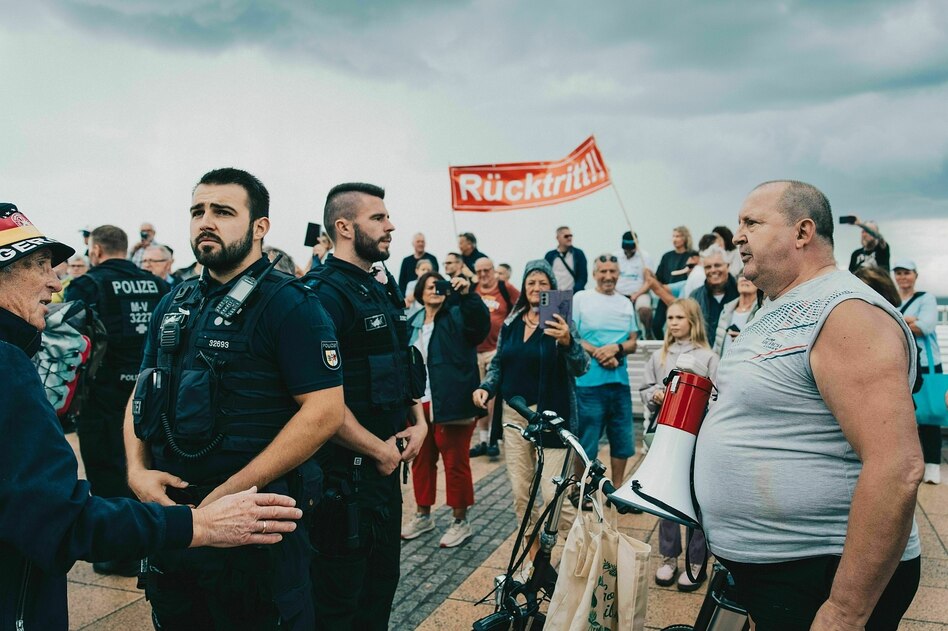
First the Chancellor spent ages in a fish restaurant for the media, and when he finally ventured out onto the Kühlungsborn beach promenade, he was booed. “As bitter as it is, I knew then that it was the beginning of the end,” says Petersen the day after the election.
The CDU campaign with its fish sandwich motifs also did not fit “this highly explosive election campaign”. The CDU man believes that the election program was not bad. But the CDU simply wouldn't have gotten through with its central demands - a building allowance for children or a subsidy for driving licenses for young people - according to Petersen.
“The campaign hasn't mobilized incredibly well,” says Jascha Dopp, who ran as the CDU direct candidate in Schwerin with absolutely no chance against, of all people, SPD Prime Minister Manuela Schwesig and AfD challenger Leif-Erik Holm. Dopp, who is also the CDU district leader in the state capital, says looking back: “Actually, nothing worked.”
The fish sandwich number convinced him at the beginning. Here on the left, there on the right, the CDU like the fish in the middle, says Jascha Dopp to the taz: This "perhaps comes across as an upbeat hook and gets me attention at first. But then there has to be more to come afterwards." And that wasn't the case.
Neither Petersen nor Dopp want to blame the result exclusively on the federal CDU. “Of course,” says Dopp, “there was no tailwind from the federal level.” But that doesn't explain everything. “At the state level, this polarization between red-red and AfD had really stark effects, for all small parties.”
CDU veteran Dirk Petersen does not exempt the state association's appearance from his criticism. "After the 13 percent five years ago, there was another small interim high in the surveys, so they rested on their laurels again. Or have you really seen the CDU as big since then?" he asks rhetorically.
For the MPs and employees of the party, who, according to Petersen, have so far occupied “the most beautiful rooms” in the Mecklenburg-Western Pomerania state parliament building, it will be time to leave in the coming days. "It's crazy. It's all over now."
And it certainly doesn’t get any easier now. “These will be very, very difficult years,” Oliver Kaiser fears. In an interview with the taz, the former deputy government spokesman warned of a vicious circle. "If the MPs are eliminated, if the constituency offices are eliminated, if the employees are eliminated, it will be difficult to establish a presence in the area. At the same time, that is our only way: that we go more into the area and be present there."
What is currently not needed are personnel debates. In this case, it would be “somewhat undisputed that we had to contend with a very bad national trend,” says Kaiser. He is therefore certain that the party will not place “the main blame” on the state chairman, top candidate Daniel Peters.
Schwerin's district chief Dopp sees it similarly. The regional association has had five changes at the party leadership in the past six years, with Peters only taking over in 2024. “It would be far too simple to blame the result on the person who took responsibility at the very end and stepped forward,” says Dopp.
The debates have long been underway on Monday. In the Northeast CDU, reference was primarily made to Philipp Amthor in this context. The 34-year-old from Western Pomerania, who despite his age has already had a number of scandals and was recently promoted to State Minister for Federal-State Cooperation in the Chancellery, was already General Secretary of the state CDU until May last year.
Dirk Petersen sees it this way: "Nothing against Daniel Peters. He's a good guy." But unfortunately Peters was crushed between right and left during the election campaign - and of course the party should think about how to reposition itself after this "sad day".
“We now have to take care of the voters of 2031 – and that also means the young voters.” On Sunday, the CDU won just one percent in the 16 to 24 year old age group. But they are the future. Philipp Amthor would be an attempt to get back on track here, according to the old leader from Bad Doberan.
By the way, Daniel Peters is as talkative on Monday as his general secretary Katy Hoffmeister. He was originally supposed to show up and say something at Chancellor Merz's post-election press conference in Berlin. Unfortunately, Peters was also unable to attend, explains Merz. He stayed in Schwerin “because he called together the state parliamentary group there, which will now be dissolved.”
At least Peters let one thing be known later: “We have nothing more to say.” Deputy party leader Ann Christin von Allwörden has already announced her resignation.
As it turns out later, she doesn't go alone. Daniel Peters resigned on Monday evening. His position will be taken over on an acting basis: Philipp Amthor. This means that the CDU Mecklenburg-Western Pomerania has at least compensated for the previous skewed number ratio and now has six changes in six years.
Note d. Editor: The article was updated on Monday evening with a view to the resignation of Daniel Peters.
Read the full story at the source
Source: taz