
Germany · taz · · 2h
Federal government after the state elections: Merz is trying to turn things around again
Deutsch (original) · Auto-translated to English
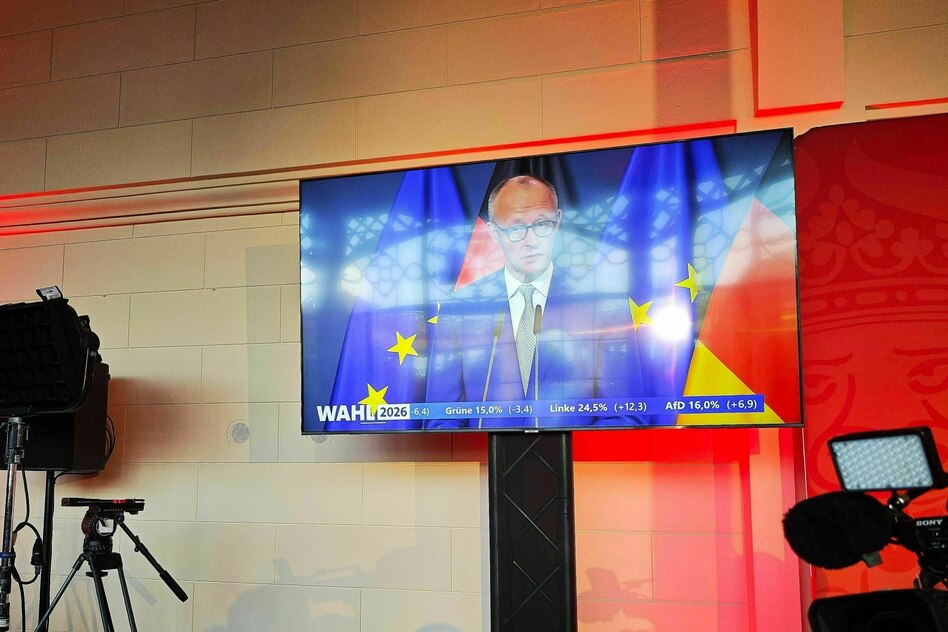
The Chancellor needs three attempts before anyone can listen to him at the CDU headquarters in Berlin on Monday - there are problems with the sound technology. When it finally works, Friedrich Merz speaks of a “deep turning point” and a “heavy blow” that will “reverberate for a long time”. We are talking about the catastrophic election results of the Mecklenburg-Western Pomerania CDU, which missed entry into the state parliament on Sunday; For the first time in the history of the Federal Republic, the Union failed to pass the five percent hurdle in such a major election.
Merz admitted complicity for this, but at the same time said: “The reasons go beyond me personally.” In doing so, he continued the strategy he had already adopted on election Sunday of putting a stop to the tiresome debates about his resignation and presenting himself as a reform chancellor. According to the Chancellor, “great efforts” are ahead. Stability and a clear course are important.
However, the debates cannot be completely shaken off. Merz had secured the support of the eight CDU prime ministers, seven of whom dutifully traveled to the executive committee meeting in Berlin on Sunday. But they then met until shortly before midnight in the Rhineland-Palatinate state representation, without Merz. Were new plans for a coup made there? Those around Merz say that everything was agreed upon with the Chancellor and that it was about the multi-year European financial framework. Whoever believes it?
In any case, Merz made it clear again on Monday that he does not intend to resign - neither as chancellor nor as party chairman. Instead, he announced a kind of self-reflection seminar for the party: Fundamental questions now arose for the CDU and they would talk about the party's profile and program. The CDU actually only developed a new basic program in 2024 and as a result made a proper turn to the right. Is this now being questioned? In any case, he hasn't been particularly successful so far.
It's almost ironic: In view of the power vacuum that is opening up in the CDU, the SPD is trying to present itself as a stability factor - as if Bärbel Bas and Lars Klingbeil, as party leaders, were not themselves in great need of explanation because of their roles in the unpopular government. Both made it clear several times on Monday: The coalition will not fail because of the SPD, on the contrary: “The top premise is that we stand by this coalition,” said Klingbeil.
In the same breath, he rejected Merz's plans to implement the planned social cuts. “The way things have been going for the last few months cannot continue,” said Klingbeil. Without naming the Chancellor, he criticized his speech on Sunday evening. “Simply continuing to bang your head against the wall won’t work.”
Bärbel Bas saw it similarly. “It would be nothing more deadly than to let this coalition break up over a factual issue,” she said, referring to the discussions about the abolition of the early retirement without deductions at 63. She described the reforms of the social systems as “necessary” and said that the pension commission had made good proposals. But now it is important to further work out the solutions together in the coalition. “We need to give the reforms a reality check and a justice check,” said Bas.
Will this reality check also include the fact that Manuela Schwesig was so successful in Mecklenburg-Western Pomerania because she took a position against the government? At least on Monday she didn't shy away from continuing to take Merz harshly to court. The Chancellor had previously complained that the CDU in Mecklenburg-Western Pomerania had been lost in the dispute between Schwesig and the AfD. “Merz’s statements show that he misjudges the situation,” said Schwesig. Rather, the Chancellor should be self-critical. If he wants to regain trust again, it is not enough to “point the finger at others.”
At least this message initially seemed to have reached the Chancellor. Merz thanked the SPD for wanting to remain part of the coalition. At the same time, he admitted that many people have the feeling that things are unfair in society. When asked, he did not mention the announced abolition of pensions after 45 years of contributions as a problem, but rather the coexistence of statutory and private health insurance as a problem.
“There are good reasons for both systems,” said the Chancellor, who is himself privately insured. "But if the population sees this as such a massive problem - and I share their assessment - then we have to do something about it, and that's exactly what we'll talk about." He didn't elaborate on what Merz wanted to talk about.
For the social politician and chairman of the workers' group in the Union parliamentary group, Stefan Nacke, it is obvious that the CDU must address social concerns differently. “The CDU must become a people’s party again and therefore position itself more broadly in terms of content and personnel,” Nacke told the taz. However, this is not yet visible.
Meanwhile, SPD member of the Bundestag Hakan Demir is campaigning for his party not to allow itself to be driven further to the right. “We need a more left-wing social democracy,” the Berlin politician told the taz. The SPD lost most of the votes to the Left Party in the elections for the Berlin House of Representatives. “Anyone who now says we have to become more conservative has understood nothing.” Rather, it is now important to protect employee rights and strengthen social security.
Demir also speaks out against wanting to ban the expropriation of housing companies with a federal law. “A federal law that would no longer allow the nationalization of private rental housing stock through socialization laws at the state level is politically and legally impossible to implement,” said Demir.
The Chancellor saw it differently. While he was still looking for explanations for the election disaster, he announced that the bill against expropriation would be coming soon. He had already announced this together with Klingbeil in the summer. “It’s not just about banning something here in Berlin,” said Merz. It's about keeping Germany attractive for private investors.
Read the full story at the source
Source: taz