Politics · taz · 8h
BSW after state elections in Saxony-Anhalt: Wagenknecht party in love with right-wing extremists
Deutsch (original) · Auto-translated to English
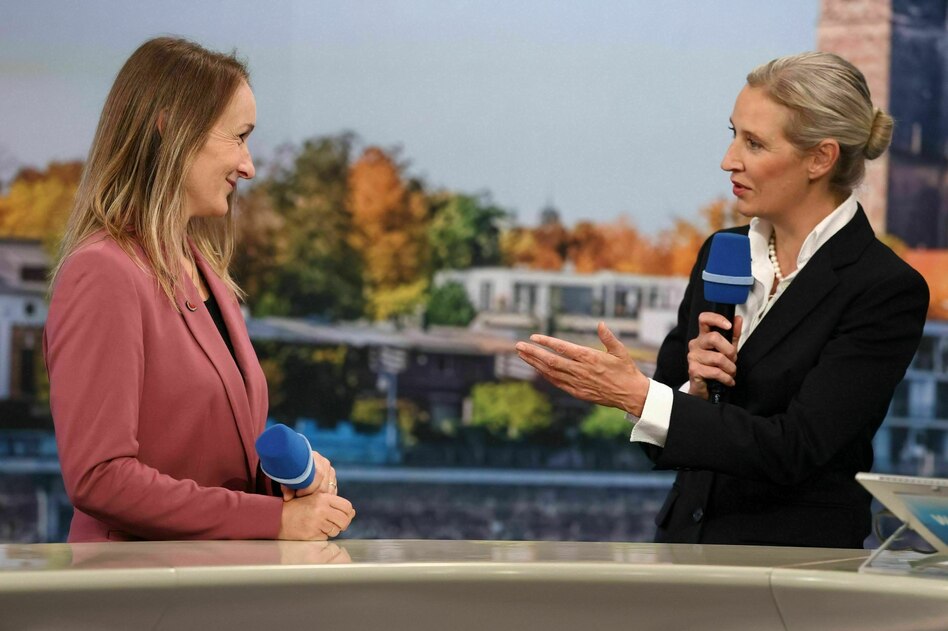
The Sahra Wagenknecht alliance had to tremble for a long time on Sunday evening. It was only after 9 p.m. that it became clear that there would be enough to enter the state parliament of Saxony-Anhalt. Most recently, the anti-Western and now decidedly anti-Israel protest party was at 5.3 percent. She will enter the Magdeburg parliament with five members.
“The comeback of the BSW has begun,” said party founder Sahra Wagenknecht on Monday morning. It is undeniable that the jump over the 5 percent hurdle is a great success for the BSW, which has made a name for itself in recent weeks with quarrels and arguments, offers of talks to the AfD and resignations from the party. But it is also a triumph for the federal leadership in other respects: With the entry of the BSW into the state parliament, Saxony-Anhalt is facing ungovernability.
The AfD with top candidate Ulrich Siegmund missed the absolute majority of seats, as did an alliance between Prime Minister Sven Schulze's CDU and the SPD, the Greens and the Left. The Wagenknecht party itself does not want to govern at all so far, but - as of now - continues to rely on its fixed idea of a non-partisan prime minister who should organize his majorities on a case-by-case basis.
“We want a non-partisan prime minister,” said BSW top candidate Claudia Wittig, repeating the mantra of party founder Sahra Wagenknecht on election evening. And then added: “I don’t want to vote for Mr. Siegmund and I just as little or maybe even less want to vote for Mr. Schulze.”
Now it's not what the top candidate and the other four BSW MPs in Saxony-Anhalt want when the day is long. It depends on what the federal leadership in Berlin and Sahra Wagenknecht and her husband Oskar Lafontaine want in distant Saarland.
Wagenknecht has recently set the line again and again. First: Participation in an anti-AfD coalition is categorically ruled out. Second: You want someone who is non-partisan. Thirdly: If there is no non-partisan party and the AfD - as is now happening - falls short of an absolute majority, the BSW representatives in the state parliament will abstain from the election of Ulrich Siegmund as head of government in the third round of voting and thus help the right-wing extremist into office.
“Now hopefully there are majorities in the Magdeburg state parliament for a change of course in energy policy, an end to the Russia sanctions, better education and a fundamental reform of public broadcasting,” said Wagenknecht the day after the election in the direction of the AfD, which is also demanding exactly that. The BSW, that much is clear, wants to “use” these new majorities with the firmly right-wing extremist party.
The BSW is obviously only concerned with tolerating an AfD minority government: to govern without having to bear responsibility. Top candidate Claudia Wittig has now made it clear once again that she does not intend to step out of the Wagenknecht ranks. “If there is no other way, then we will abstain and then the voters will have decided who the Prime Minister should be.”
The loyalty to the party's general line is no coincidence. Before the election, all BSW applicants for a seat in the state parliament not only signed a declaration of commitment to “loyally support the specific political orientation and the central political projects of our party” in parliament. Otherwise the mandate will be resigned immediately.
With Wittig and the BSW state chairman John Lucas Dittrich, two Saxony Anhalters also sit as assessors on the BSW federal board, which is loyal to Wagenknecht. In any case, the state executive board has been in line since a purge was carried out within its own ranks last year. The critics of Dittrich and the short-tempered co-country chief Thomas Schulze were removed from the board. A few weeks ago they left the BSW.
Wittig, Dittrich and Schulze will now represent Wagenknecht's sometimes somewhat wavering general line in the state parliament. Nothing else can be expected based on the declaration of commitment from the other two representatives, an unknown qualified forest engineer from the Börde and an equally unknown IT specialist from the Harz.
The crucial question in Saxony-Anhalt is whether the AfD will accept the BSW's offer. Ulrich Siegmund denied this on election evening. “In an emergency there would be new elections, then we would have 50 or 55 percent,” he said on ZDF. “Because the future is the alternative for Germany.”
On Monday it sounded different on the extreme right. “We always talk to Democrats,” claimed Siegmund. AfD federal leader Tino Chrupalla had previously called the Magdeburg election winner back. “You shouldn’t rely on new elections on the first day,” said Chrupalla. However, he does not want “experiments” such as a minority government. Which should be understood as a rejection of Wagenknecht's non-partisan Prime Minister, but at the same time as a coalition offer to the BSW.
Read the full story at the source →
Source: taz