
Germany · taz · · 1h
Exhibition Annemirl Bauer: With bite and warmth
Deutsch (original) · Auto-translated to English
The horse's legs are high so that a lot of landscape can be seen in between, rolling green hilltops and a deep blue lake. The child on the back of the horse is small, the houses look like toys, thrown together on the other side of the lake. “Elli on the Horse” from 1981 is not just one of many beautiful children's pictures by Annemirl Bauer. With its joy in colors and its carefree use of perspectives, it also takes on a tone as if it had been painted for children.
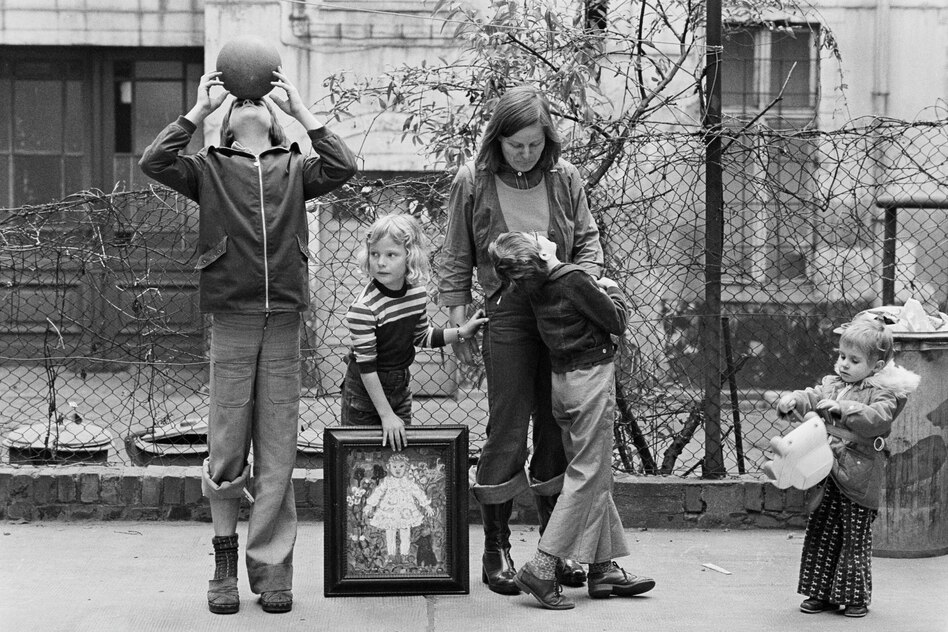
The clothes of the “Children from Prenzlauer Berg” shine in green, blue, yellow and red, and the three of them, probably friends of their daughter Amrei, are huddled together. In the picture “Child and Big City” the street behind the girl is folded up, motorcycles and buses push loudly into the picture, the elevated train rattles past.
These portraits welcome visitors to the Minsk Kunsthaus in Potsdam in the exhibition “Annemirl Bauer. Bruch is in the World”. Annemirl Bauer (1939–1989) was a painter from the GDR, often marginalized and bullied, but who nevertheless repeatedly intervened in a combative manner: she made recruitment attempts by the Stasi and their rejection public and criticized the lack of freedom to travel in public submissions as a major flaw in the system.
The Minsk, Potsdam, “Annemirl Bauer. Bruch is in the world”, until February 7, 2027
Galerie im Turm, Berlin, “Dreaming – Annemirl Bauer and Bärbel Bohley”, until November 8, 2026
In the GDR she was legendary as a resistant painter. In the art history of the post-reunification years, however, it remained unknown for a long time, probably also because, with its hope that the GDR could be changed, it did not fit into the Western reception pattern of conformity versus dissident. The exhibition in Minsk now wants to counteract her oblivion with a retrospective that presents at least 150 of her works.
“Male Glory of God” is the name of a picture with which she protested in 1988 against the militarization of GDR society and the military service of women in the event of mobilization and placed this in a context of sexism, patriarchal supremacy and aggression.
A row of helmeted, naked female soldiers, one leg presented like show girls, faces soldiers, bullet lines are indicated, a crucified woman bleeds from her womb. “Glory of God” is written on a floor on which a naked woman is riding. In the midst of this noise of war and cries of pain, a woman sits quietly and unhappy on a box.
Annemirl Bauer's style echoes Expressionism and Art Nouveau; the themes are reminiscent of Paula Modersohn-Becker and George Grosz. Some things resemble a caricature: a man crouches in a milking position behind a four-legged figure with dangling breasts, who writes the title of the picture on a typewriter with his front hooves: “Male leadership quality equipped with female input”. Font complements many of Bauer's images to point out the content and as a graphic element.
In Minsk, the curator Marie Gerbaulet juxtaposed images of imprisonment, in which Annemirl Bauer painted herself behind bars, with her travel collages. Bauer came from a cosmopolitan family; in the 1950s she traveled to southern France with her mother, also an artist.
Her refusal to be recruited as an IM led to travel requests being rejected and her temporary exclusion from the Association of Visual Artists, which also made exhibitions impossible. It wasn't until 1987/88 that she was able to travel again, to Paris. In collages she connects her face with the city map and flies over an audience applauding her.
"The wall is superfluous and outdated. If it were to be taken away immediately, of course, all of our muscles and ligaments would collapse, like opening a corset. That's why my demand for the next five years is to create a system for opening the wall that is manageable for everyone." This quote by Annamirl Bauer from 1984 is on the wall in the Galerie im Turm, Berlin Prenzlauer Berg. There the curators Sandra Teitge and Susanne Weiß are showing the exhibition “Dreaming – Annemirl Bauer and Bärbel Bohley”.
Both artists have in common that they were temporarily excluded from the Association of Visual Artists in the GDR, that they stood up for each other and fought for change in the GDR. Their “dreams” were for a better GDR. The location of the exhibition was not chosen by chance: the gallery in the tower, which was also a municipal gallery in GDR times, was one of the institutions where the two of them did not have an exhibition.
Annemirl Bauer's pictures, in which she showed herself behind bars, are juxtaposed here with a large work by Bärbel Bohley, which initially appears abstract, but then reveals footprints and handprints. It is associated with counting steps in a prison cell; The civil rights activist Bärbel Bohley was imprisoned twice.
Bohley's subject was also women. While Bauer's characters appear strong and often full of life, Bohley's women are more hunched, melancholy and quiet. Words seem to be swallowed up behind the hand covering the mouth. Bauer used language and writing as an aesthetic and discursive element in her pictures; with Bohley, the focus of her creativity shifted to the language of politics.
A photo by Barbara Klemm shows Bärbel Bohley on November 4, 1989 at a famous demonstration on Alexanderplatz, with Heiner Müller and Gregor Gysi behind her. A wall text in the exhibition contains Bohley's memory of how she was supposed to contribute a graphic for a portfolio in 1989, but her mind was already occupied with something else: “Sometimes art is absent,” she finally wrote on a piece of paper and later viewed this as her farewell to art.
Annemirl Bauer died of cancer in August 1989; she did not live to see the opening of the Wall. Her daughter Amrei, then only twenty years old, took over her mother's estate, 16,000 works: so many never-seen pictures, painted furniture, doors, windows. Homemade toys are one of them. Many of the works in the Minsk and in the gallery in the tower come from this estate.
At the beginning of the 1980s, Annemirl Bauer had several commissions for architecture-related murals. Her “Berlin Triptych” was commissioned by the Berlin magistrate, but was never exhibited: the magnificent picture was considered too provocative because of the title “The sky over Berlin is indivisible”.
A cut figure is painted on the outside of each wing, which only forms a whole when closed. Inside is teeming with scenes, realistic and fantastic. A crocodile opens its mouth over a writer who is sitting on a rooftop and writing. Traffic congestion in the center borders on the idyll at the swimming lake next door. Many small picture narratives are nested together. Last but not least, it is Bauer's joy in poetic storytelling that should not be missed.
Read the full story at the source
Source: taz