
Germany · taz · · 1h
Berlin Marathon 2026: Unfortunately only a world class time
Deutsch (original) · Auto-translated to English
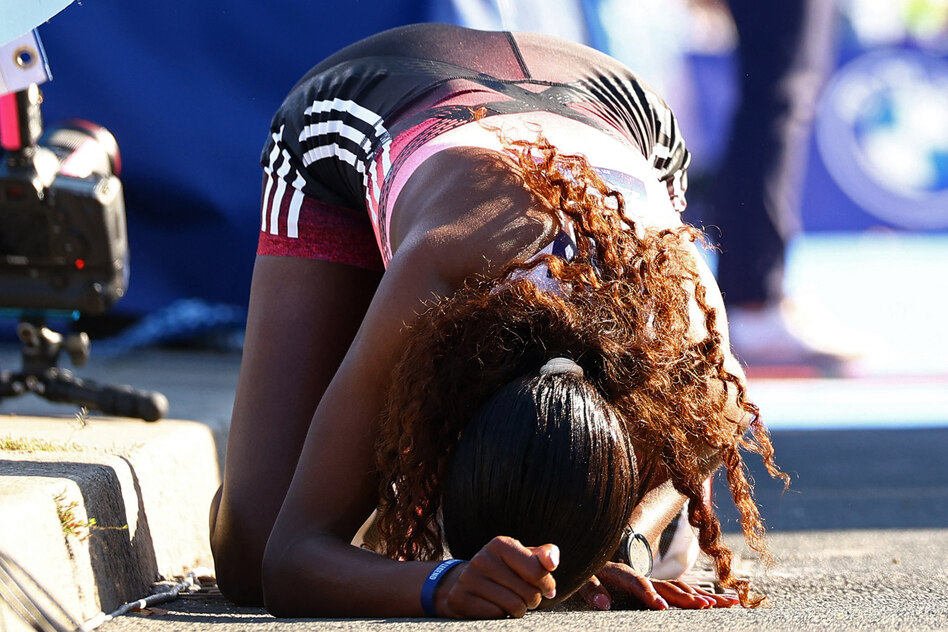
Tigst Assefa's project was supposed to be this: The 29-year-old Ethiopian wanted to become the undisputed world record holder in the marathon on Sunday in Berlin. That would have meant that it ran well under 2:10 hours. It didn't work.
Assefa was on course for a world record until about kilometer 40, but then muscular problems arose. Face contorted in pain, obviously cramps. It was then clear that all she could do was drag herself to the finish. Assefa limped the last hundred meters. Instead of a world record, it was a world-class time of 2:11.04 hours. Still just better than her previous best of 2:11.53 hours, which she also achieved in Berlin - in 2023, when it was still a world record. Instead of rushing from interview to interview, Assefa sat on the curb and received treatment.
Assefa ran well protected by a male pacemaker group. She not only paid attention to the speed, but also protected the world-class woman from annoying bumps. It wasn't another runner or even a spectator who affected Assefa. The cramp struck her at a time when she was almost always traveling alone.
Assefa already holds a world record: she ran 2:15:41 hours in a women-only marathon in London in 2025, without male pacemakers. The record is not considered very valuable, as many runners have already proven that women can be faster.
What Assefa is still missing after this weekend is the women's world record. It is 2:09:56 hours and was run by Ruth Chepngetich in Chicago in 2024. To date, the Kenyan is the only woman to stay under 2:10 hours. However, Chepngetich is banned until 2028 for doping. The world record will not be shaken because she took the substance HCTZ, which does not have a performance-enhancing effect but is often used to conceal it, after the record run.
It was Tigst Assefa's big goal to leave both things behind: Chepngetich's record and the strange best time of being the fastest woman without men. From the start, she not only said that she was aiming for a world record, but she also let everyone know. She had started almost too fast, and from kilometer 15 – around the Kottbuser Tor in Kreuzberg – she had slowed down a bit. But at the moment when the injury first appeared, she was 20 seconds below world record speed.
A group of 56,000 runners from 162 nations enriched the Berlin cityscape this Sunday. The weather conditions were optimal: sun, no wind, but temperatures around 19 or 20 degrees Celsius. There were also hundreds of thousands of spectators who cheered on the roadsides and in the start and finish areas. If you add wheelchair, skating and other competitions, 84,000 athletes took part in the Berlin Marathon this year.
He was protected by 1,800 police officers. The terrorist attack on Christopher Street Day (CSD) at the end of July was not the only warning. In 2013, an explosive attack on the Boston Marathon, in which three people died and over 260 people were injured, showed that such major events can also be targets of attacks.
The Berlin Marathon was broadcast again this year by RTL. The former top German runner Sabrina Mockenhaupt works there as an expert. “It’s bitter, but it’s just a marathon,” she explained. "It's really only at the finish that the decision is made. I think in her case it was her muscles that closed down."
The Tigst Assefa project will have to wait.
Read the full story at the source
Source: taz