
Germany taz
Modernist architect Eileen Gray: late fame
October 31st marks the 50th anniversary of the death of Irish architect Eileen Gray. Her biographer shows her as a figure of change in the 1920s. more...
Deutsch (original) ·Auto-translated to English
In addition to carpet weaving, including dyeing the wool and, very importantly, Asian lacquer art, Eileen Gray also taught herself photography. She was very aware of the central role of the photographic image in conveying modern design and construction and staged her designs herself. At the same time, she made sure that only a few photographs of her were circulated. Most people only know the striking profile picture that Berenice Abbott took of her. It would be time to look at her photographic work, says her biographer Charlotte Kerner.
Eileen Gray, who never married or committed herself sexually, wanted to maintain control over her life and her work. Of all places, she handed it over to her masterpiece, Villa E.1027 on the Côte d'Azur, in Rocquebrune-Cap-Martin: She had Jean Badovici registered as the owner of the house and land. The Romanian architect, 15 years her junior, had long supported her work as editor of the avant-garde magazine L'Architecture Vivante and was also her lover in 1925, when he encouraged her to build E.1027.
The name is made up of her initials: E for Eileen, 10 for J, 2 for B and 7 for G in the alphabet. With Badovici's support, Gray completed the house in 1929; he dedicated an entire issue of his magazine to him. After that the relationship went into crisis. In 1931 Gray left the house.
Charlotte Kerner: "Pioneer of Modernism. The Architect and Designer Eileen Gray: A Biography". E.A. Seemann Verlag, Leipzig 2026, 272 pages, 26 euros.
The fact that she never set foot there again was because of Le Corbusier, not Badovici. In 1938 he invited his colleague, whereupon he decorated the bare walls with his - sometimes obscene - paintings. Gray spoke of vandalism. Like other authors, Charlotte Kerner sees this as an act of violated male authority. Le Corbusier admired E.1027, envied Gray's house and therefore had to mark it - supported by Badovici. After all, the preservation of the building is ultimately thanks to its murals.
The name Eileen Gray was forgotten in connection with the house, as well as her famous, at times very popular, furniture designs. With a reserved character, she hardly put up any resistance. It was not until the 1970s that her work was rediscovered, including by Yves Saint Laurent. One of her early “Armchair aux Dragons” from his estate was auctioned off in 2009 for 22 million euros. But more importantly, Gray lived to see her designs finally go into series production - always her goal. Their functionality and timeless aesthetics were praised.
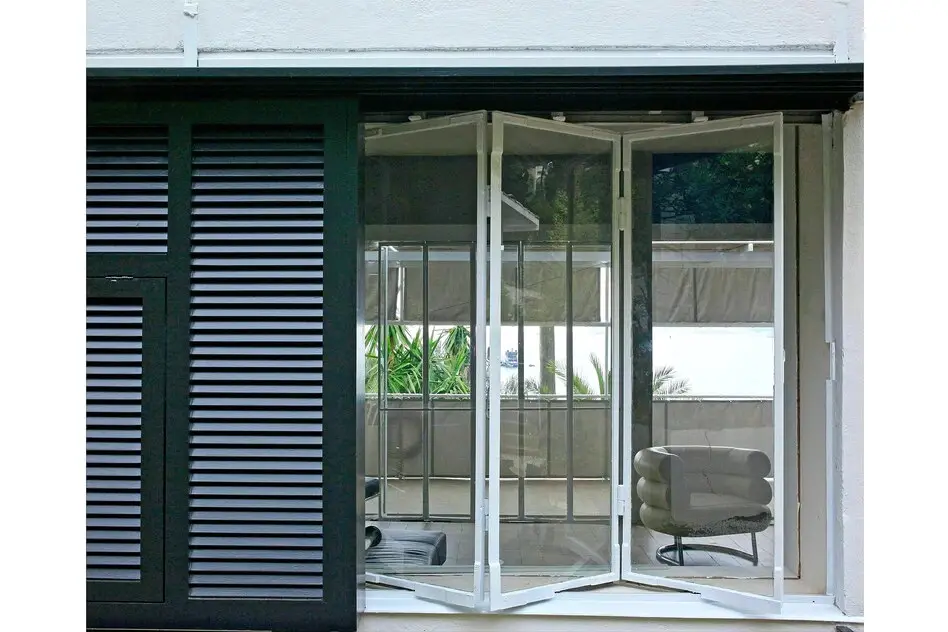
But her works were more. This is where the special appeal of Charlotte Kerner's biography lies: in the interpretation of what Gray's designs reveal about her time and its designer. “Bibendum,” for example, a tubular steel chair, is deliberately modeled on the funny Michelin Man that gives it its name. Thanks to the delicate tubular steel base, the leather beads stacked on top of each other appear to float above the ground. “Bibendum” is an early modern club chair that has been stripped of any patriarchal air of immovability, as Charlotte Kerner says. He was shocking, to use a term from the then fashion star designer Elsa Schiaparelli. And he is part of the movement through which a generation of designers removed their parents' house using nickel, steel, glass and canvas.
Gray's Irish parents were aristocratic and wealthy. This allowed her to live a life of comfortable independence. She drove fast cars, was the builder of three houses, ran workshops for carpets and varnish work as well as the Jean Désert shop and gallery project (1922–1930), which specialized in interiors. Her housekeeper, Louise Dany, who stayed with her from 1927 until Gray's death in 1976, was her closest caregiver. Eileen Gray needed little publicity, but needed people she could rely on. As a woman, she had created a life that gave her freedom and created spaces that made freedom possible. This is the real modernity of her works: they talk about a self-determined life.