
Germany Perspektive Online
Merz trip to Asia: Alliance against China and the USA?
During his trip to Singapore, Japan and South Korea, Friedrich Merz campaigned to build an alliance of the Central Powers. It was about free trade, new arms deals and the question of how Germany would develop
Deutsch (original) ·Auto-translated to English
Big in Japan: At the height of his trip to Asia on Wednesday and Thursday, Chancellor Friedrich Merz (CDU) agreed with Japanese Prime Minister Takaichi SanaeDeepeningthe strategic partnership of both countries. The governments signed six joint declarations on the sidelines of the meeting. 24 additional agreements were reached between companies from the two countries. This involves further developing joint defense and technology cooperation as well as more resilient supply chains.
German-Japanese cooperation in nuclear fusion
The German companies Siemens Energy, Focused Energy and Proxima Fusion will in future provide parts of their technological research to Japanese power plantsNuclear fusionprovide. These include, for example, the magnet-based stellarator technology further developed by the Max Planck Institute for Plasma Physics as well as laser-based approaches. In return, Japanese cooperation partners such as Kyoto Fusioneering and Fujikura bring their industrial manufacturing expertise to German fusion hubs. Large-scale production of high-temperature superconductor strip is to be established in Lower Saxony.
The development of nuclear fusion to generate electricity is considered a future technology because it does not require fossil fuels and, unlike nuclear power, would cause significantly less and no highly radioactive waste. Unlike solar and wind energy, it could also provide a constant base load of electricity.
The technology is not yet commercially usable. However, significant research breakthroughs have been made in the last five years, for example in the USA and inChina. In its current five-year plan, the People's Republic classifies nuclear fusion as one of six strategic future technologies. Whoever controls them will play a decisive role in the global energy market in the future. Germany and Japan now want to follow suit together.
German participation in new fighter aircraft?
Merz also brought Germany into play as a new cooperation partner in the Global Combat Air Program (GCAP) fighter aircraft project. This is a joint arms project between Japan, Italy and the United Kingdom. The goal is to develop a manned stealth fighter aircraft that should be operational by 2035.
The background to Merz's offensive on the issue is the recent failure of the German-French fighter jet project FCAS. In Tokyo, Merz said that Japan and Germany want to examine cooperation in fighter aircraft construction: “Japan would like to have a decision by the beginning of the new year,” said the Chancellor. Both countries have already agreed to strengthen the networking of their defense industries and examine how their armed forces could cooperate more closely with one another, for example in the context of joint military exercises. The defense ministers of Germany and Japan should meet soon for detailed discussions. Over 100 Bundeswehr members are already taking partmultinational exerciseKeen Sword in the Pacific.
More military spending and arms exports: Japan's new strategy on the way to becoming a great power
Before the meeting with Takaichi, Merz had already called for the establishment of a “global political alliance for rule-based trade” at a German-Japanese economic summit. Such an alliance could “provide political impulses and also react together if the rules-based order is in danger.” The alliance should not replace the World Trade Organization (WTO), but should advance WTO reforms. In addition, such an alliance could reaffirm that unauthorized tariffs or coercion are being avoided. The background to the proposal is US tariff policy, the trade conflict between the US and China, the closure of the Strait of Hormuz as a result of the Iran war and Canada's plea for an “alliance of the middle powers”. As a concrete next step, Merz suggested a free trade agreement between the EU and the Trans-Pacific Partnership (CPTPP), which includes Japan, Canada, Australia, Chile and the United Kingdom, among others.
Further stations in Singapore and South Korea
Before his trip to Japan, Friedrich Merz had already visited Singapore on October 27th and met Prime Minister Lawrence Wong and President Tharman Shanmugaratnam there. During the talks, a work plan to deepen the strategic partnership between the two countries was agreed. Plans include new collaborations in cybersecurity, submarines, critical underwater infrastructure and AI security. Germany is also interested in joining the ASEAN Power Grid, a project to further connect the power grids in Southeast Asia. Merz also held oneSpeechas part of the “Singapore Lectures” series, where he presented the principles of his foreign policy.
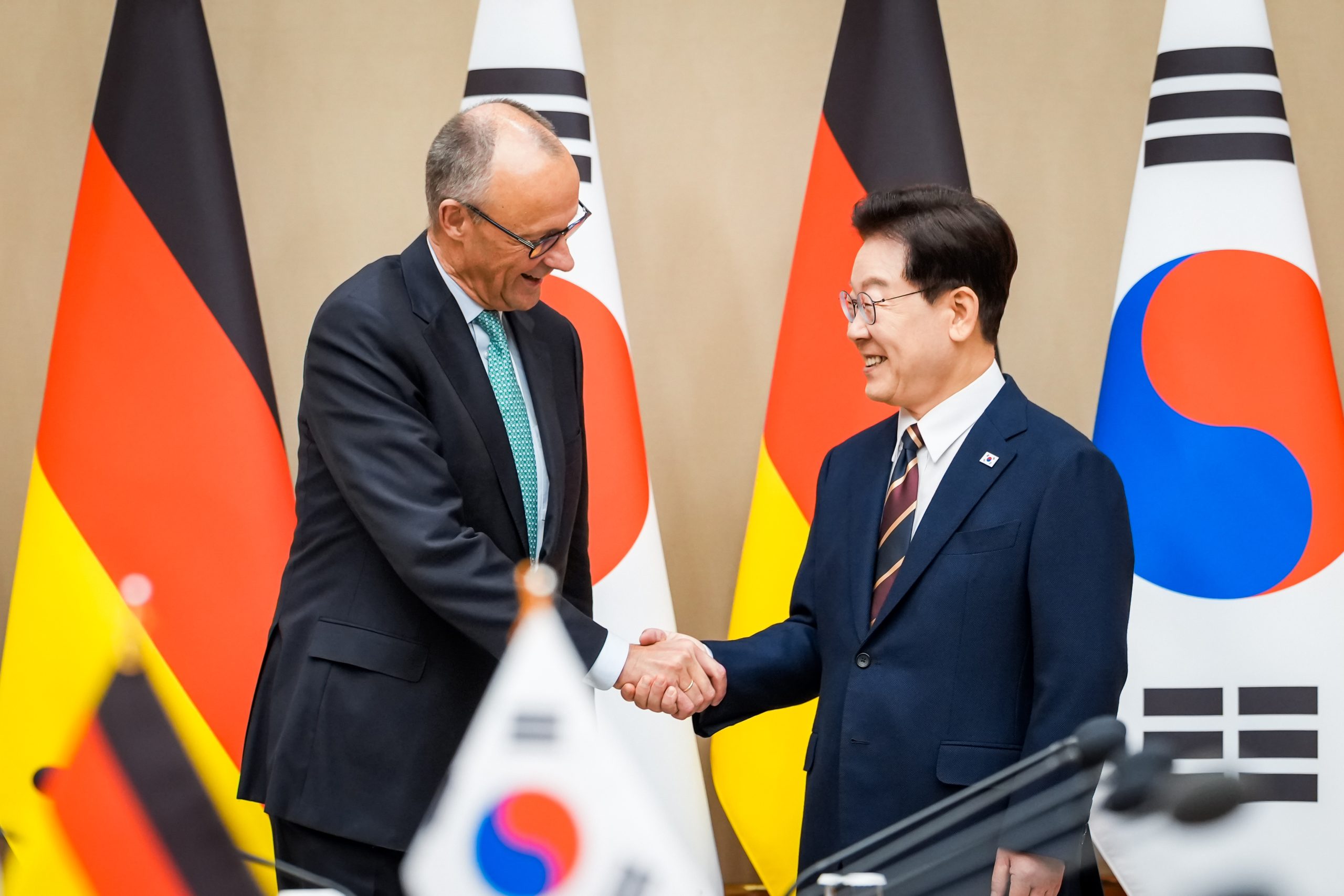
The Chancellor finally ended his trip in South Korea on Thursday and Friday. He spoke to President Lee Jae-myung about, among other things, a new framework agreement for future technologies and a partnership in the semiconductor industry. Germany also wants to expand its military cooperation with South Korea: both countries want to integrate their defense industries more closely, establish regular military exchanges and conduct joint military exercises. Likewise, the conclusion is oneconfidentiality agreementplanned for military classified information in order to be able to share sensitive data securely.
US-South Korea maneuvers: Trump relies on a deal with North Korea
Allies in a US-Chinese dominated world
Geostrategically, Merz's trip to Asia served to expand alliances with states that also have an interest in strengthening themselves against the USA and China. This is particularly evident in Japan and South Korea. Under Takaichi, Japan has only recently abandoned its restraint on the Taiwan issue and described a Chinese attack on the island as an “existential threat to Japan.” The formulation is explosive because it represents the legal basis for a military reaction by Tokyo in the event of such a war. Japan and South Korea have also been involved in close economic and military alliances with the USA for decades. However, under US President Trump, the USA is demanding higher financial, economic and military contributions from both states.
Japan, South Korea and Singapore are also, like Germany, export-oriented nations with a strong interest in open markets that have come under economic pressure from the US-China conflict. All three countries are already free trade partners of the EU.
Xi Jinping visits Trump: USA and China postpone trade conflict until 2027
However, strengthening relations with the three Asian economic powers does not mean that Germany is turning away from cooperation with China. While Friedrich Merz was commuting through East Asia to reduce Germany's dependence on China, Federal President Frank-Walter Steinmeier was traveling to the East at the same timePeople's Republicand was welcomed there by Xi Jinping as an “old friend of the Chinese people”. The former Federal Foreign Minister campaigned for a solution to the dispute over China's high export surpluses and, according to media reports, met with a conciliatory attitude from Xi.
This week, Germany's heads of state and government carried out traditional German diplomacy, seeking to protect themselves on all sides while purposefully advancing their own interests.
The postMerz trip to Asia: Alliance against China and the USA?appeared firstperspective.