
Politics · taz · · 3h
Application for Nazi commemoration in Saxony: Knobloch criticizes CDU cooperation with AfD
Deutsch (original) · Auto-translated to English
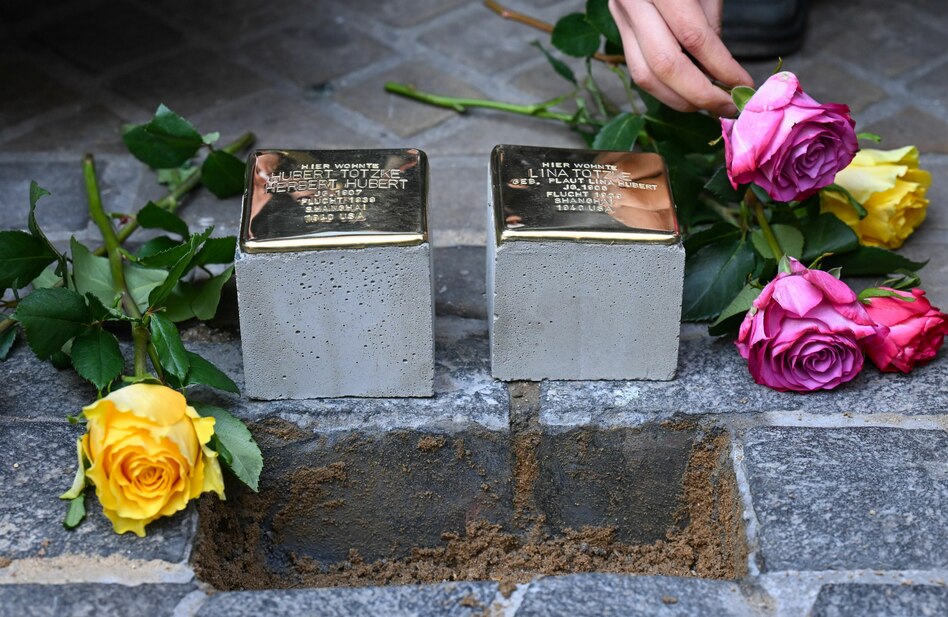
After the Heidenau city council, near Dresden, passed a motion against stumbling blocks supported by the CDU and AfD, Charlotte Knobloch is now speaking out. The Shoah survivor and President of the Jewish Community of Munich and Upper Bavaria is known throughout Germany as a critic of the memorial stones embedded in the ground for victims of National Socialism. But she describes the decision of the city council in Heidenau as “completely the wrong approach”.
“I was never a fan of the concept of stumbling blocks,” explains Knobloch when asked by the taz. But decentralized commemoration, which “permeates and shapes” the public space, is crucial “for a real culture of remembrance.” She had criticized the concept of the stumbling blocks, saying it was undignified that the name of the murdered was being trampled on the sidewalk.
But: Removing places of remembrance from the cityscape, as is now happening in Heidenau, is “in any case the completely wrong approach,” says Knobloch. “I am appalled that a democratic party would support such a transparent maneuver by the extremists from the AfD.” She demands that the democratic center should find itself again and “bring about a better solution.”
City councilors from the AfD and CDU had approved the request to stop laying stumbling blocks in memory of victims of National Socialism in Heidenau, Saxony, near Dresden. It was decided by a majority on Thursday evening, as the city administration announced to the dpa news agency. There were 13 yes votes, 6 no votes and one abstention.
In the cross-party motion for a resolution with the “Upper Elbe Alliance for More Democracy,” representatives of both parties called for stumbling blocks to be rejected “in public streets and sidewalks” in the future.
Many citizens, relatives and initiatives do not consider this form of remembrance of the victims of National Socialism to be appropriate, the application said. However, the applicants had no personal contact with memorial initiatives or relatives, as they confirmed to taz. Nevertheless, the commemoration should preferably take place in the city's northern cemetery, so that "direct entry into the memorial elements is excluded." There is already a memorial stone there for the victims of National Socialism.
The Alternative Culture and Education Center (Akubiz) association had previously applied for two stumbling blocks to commemorate the couple Fritz and Martha Goldstein, who were arrested, dispossessed and deported during the Nazi dictatorship in Heidenau for anti-Semitic reasons. As Mayor Conny Oertel told taz before the vote, the city council will reject the relocation of the two memorial stones.
The administration had recommended rejecting the proposal. “Presence in public space in particular enables a broad perception and direct engagement with history,” she wrote in an assessment of the application. Stumbling blocks should be decided on a case-by-case basis.
In Heidenau in the Saxon Switzerland-Eastern Ore Mountains district there are currently five stumbling blocks at two locations. One in memory of the former SPD mayor Paul Gröger, four in memory of the Jewish Reiner family. All of them were moved at the initiative of civil society by the initiator of the Stolpersteine, Gunter Demnig.
After the city council decided on Thursday to reject stumbling blocks in the future, Mayor Oertel cannot be reached for comment. They said she wouldn't be back in town hall until Monday. But before the vote, in response to an inquiry from the taz, she explained that stumbling blocks are sometimes covered by leaves, dirt or snow and that people pass over them “perhaps thoughtlessly”.
The chairwoman of the Saxony State Association of Jewish Communities, Ekaterina Kulakova, sees it differently. “People notice stumbling blocks every day,” she says. The Jewish communities have not yet been consulted about the plan for a central memorial site in Heidenau. But, says Kulakova, those interested only go to one twice a year. “This is not about remembering, but about forgetting.”
Christoph Heubner, Executive Vice President of the International Auschwitz Committee, said according to the statement: "This is a transparent and shabby attempt to throw Heidenau victims of the Nazis out of the city again and to dispose of them where, in the AfD's opinion, commemoration has long belonged: in the cemetery." The fact that CDU MPs “reach out to the AfD for such shabbiness” is a scandal.
Kerstin Köditz, current state spokeswoman for the VVN-BdA in Saxony, also believes that the stumbling blocks are about “that we encounter the crimes of the Nazi era in everyday life.” The victims were neighbors in the city, not outside. The idea of the stumbling blocks is to bring back to mind the people who were arrested, deported or murdered. A memorial in the cemetery “doesn’t represent this closeness.”
Köditz also says that a memorial area for “the victims of war, terror, dictators, expulsion and especially National Socialism in Heidenau” is so broad that concrete connections fade away. “How am I going to deal with certain aspects of crime if I lump everything together?” Depending on the context of the victims and the areas of phenomena, different concepts are needed. “It is different whether I talk about terrorist attacks, whether I talk about expulsion or the industrial extermination of Jews.”
The Stolpersteine form of commemoration has been around since the 1990s - and is now in many European countries. The small stones, which are usually financed by donations, are laid at the last known place of residence or work of victims of National Socialism - their names and dates of life are written on a brass plate on the top of the stones.
In Munich, according to a city council decision, stumbling blocks will not be laid on city property. They can be found primarily on private property - and are also permitted on properties that belong to the Free State of Bavaria. Instead, memorial signs with photos and brief life dates in front of residential buildings draw attention to the fate of the people who used to live there - before they were torn from their everyday lives by the Nazis. Such an alternative has not yet been discussed in Heidenau.
Unlike the stumbling blocks, Charlotte Knobloch praises the memorial signs on facades and steles. “I think the Munich concept of remembering at eye level is much more successful.” Your rejection of the stumbling blocks has been known for a long time. She finds it undignified that the name of the murdered is being trampled on the sidewalk. As a child, Knobloch experienced the Nazi terror in Munich. “In my mind’s eye I see the people who were repeatedly kicked while lying on the ground and who were kicked into the vans with heavy leather, steel-capped boots,” she described. (with dpa)
Read the full story at the source
Source: taz