
Germany taz
Aigner as Federal President: Plan A like Aigner, what else?
Friedrich Merz hesitated for a long time. Now he has proposed Ilse Aigner as a candidate for the office of Federal President. This promises a new unity. more...
Deutsch (original) ·Auto-translated to English
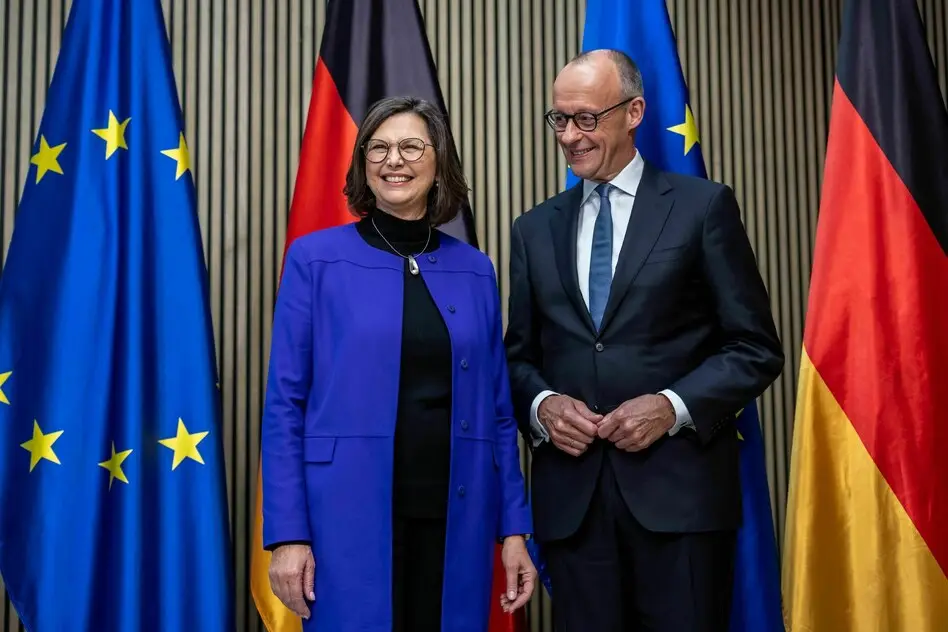
Ilse Aigner lets Friedrich Merz go first. And when she speaks, she only speaks for half as long as he does. “The Chancellor made it quite exciting, also for me,” says Aigner after the CDU board finally nominated her as a candidate for the office of Federal President on Monday morning. “But if this dramaturgy means that a broad political center can really come together behind me, I will be very happy about that.”
Two sentences with which the current President of the Bavarian State Parliament elegantly ticks off the Union's somewhat out-of-control candidate search for a suitable successor to Frank-Walter Steinmeier and then looks ahead. She wants to be a candidate from the strong middle and is working on a new unity, says Aigner. She does politics to overcome divides and bring people together. “My language will be clear and understandable,” promises the 61-year-old, whose Upper Bavarian tongue can also be clearly heard.
People will probably get used to the dialect over the next five years, because there is little doubt that when the Federal Assembly with its 1,260 members meets on January 30th, Aigner will be elected with the necessary absolute majority. CSU leader Markus Söder had suggested it, the SPD and the Greens had already signaled their approval, and on Monday the CDU's leadership bodies also gave their go-ahead.
Merz himself only decided on Aigner on Sunday evening at a presidium dinner. The fact that the Chancellor, who personally knows the district chairwoman of the CSU Upper Bavaria well and regularly meets her for hiking when he is in his holiday home on Lake Tegernsee, remained silent for so long was not well received by the CDU. There was a lot of complaining about Merz internally and publicly. CDU foreign politician Roderich Kiesewetter complained on ZDF that it would be “bitter” to “dilettantee and delay” in such a top office. Kiesewetter is known as a particularly harsh critic of Merz, but others in the CDU also made similar comments, albeit in secret.
However, there is another interpretation circulating in the Chancellor's circle. After the Bavarian Prime Minister Söder had already proposed Aigner as “his” candidate in April, Merz deliberately remained silent in order to give the CDU, which in his view actually has the right to propose, time to become friends with the woman from Bavaria and get behind her.
Other names such as those of Education Minister Karin Prien, Bundestag President Julia Klöckner or the Hessian parliamentary group leader Ines Claus were also mentioned in the meantime, but did not develop any real traction. So there is no hesitation on the part of the Chancellor, but rather wise restraint. That would even make sense, because Merz is now so controversial in the CDU that a word of power from him can easily have the opposite effect.
The joy that Merz expressed on Monday that the Federal Executive Board “followed my suggestion” certainly seemed genuine. The party chairman spoke extremely positively about Aigner, as if she had always been his secret favorite. He praised her political experience and her commitment to respectful interaction and discussed her human qualities, “her empathy and openness”.
“With Ilse Aigner, the Federal Republic of Germany has gained a federal president with dignity and heart,” praised Merz. One that brings people together and builds bridges between different social groups. The trained electrical engineer knows the reality of life for millions of people. At a time when many no longer feel seen, this is an important sign, emphasized Merz. It almost sounded as if the Chancellor had consciously been looking for a person who embodied the opposite of himself.
The term of office of Steinmeier, the 12th male Federal President in a row, ends on March 18, 2027. If Aigner takes office, a woman would hold the highest state office for the first time. “In my opinion, it’s high time,” said Merz.
He received encouragement from former Chancellor Angela Merkel. Aigner actually has a chance of being elected and not, like candidates before her, “just being nominated for this office,” Merkel wrote in a statement. For this reason alone, the decision for her to be the first woman to hold this office since the founding of the Federal Republic of Germany was “historic”.
Aigner also receives support from the Greens. Their party and parliamentary group leaders made it official on Monday that they will not nominate their own candidate, but will instead campaign for the CSU politician within their ranks. A letter to Green MPs at the federal and state levels states that “in view of increasing social polarization,” the election of a new head of state “is not the scene of party political intrigue.”
In the past few weeks, top Greens have repeatedly indicated that they would support Aigner, but not necessarily other possible Union candidates. Party leader Franziska Brantner said on Monday when asked: "Our criteria were: We would like to see a woman. And we need someone who will defend democracy and do it in a non-partisan way." It intentionally sounds like the Greens had an influence on the candidate search. However, it is unlikely that their conditions were actually decisive: the Union and the SPD have a clear majority in the Federal Assembly of around 50 votes.
Possibly as early as Tuesday, Aigner will introduce himself to the Union, SPD and Green factions. The AfD also announced that it wanted to invite Aigner. However, just like the Left, the party is also considering fielding its own candidate.