
Germany taz
Germany and Hungary: Still not an easy partner
Hungarian Prime Minister Peter Magyar outlines his course in Berlin - and contradicts Chancellor Merz, who wants to include aid to Ukraine in the EU budget. more...
Deutsch (original) ·Auto-translated to English
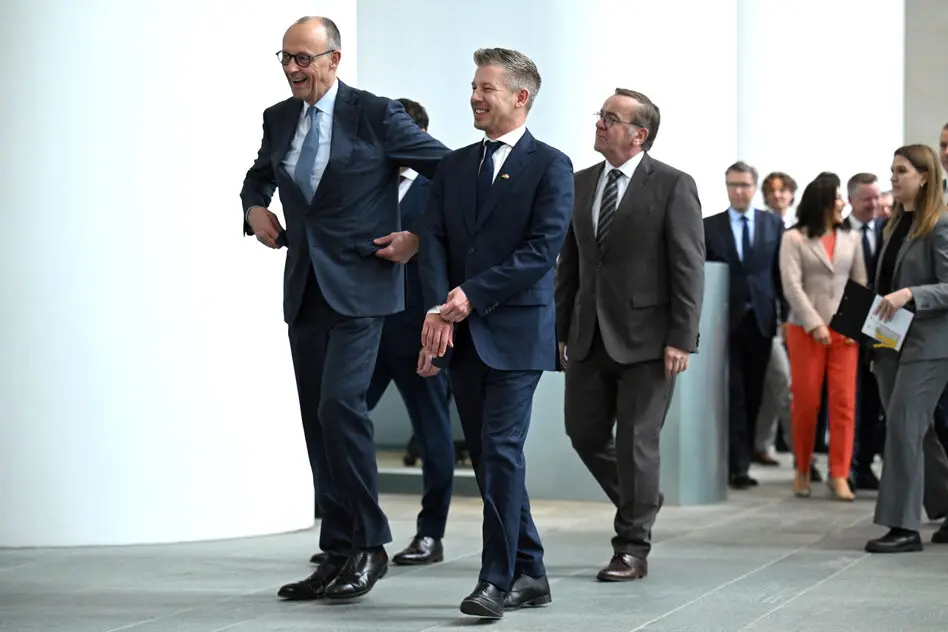
There has been “a lot of bad news” about Europe in the past, said deputy Bild boss Miriam Hollstein. An exception were those on April 12th of this year. Hungary elected Peter Magyar as the new head of government with an overwhelming majority. Since then, Hungary has been “back again”, as the “heart of Europe”, and Magyar has made that possible, said Hollstein when she moderated the “Europe Speech” of the Konrad Adenauer Foundation on Monday evening in Berlin’s Allianz Arena, which Magyar was allowed to give this year.
Hollstein's employer, the Springer publishing house, remained loyal to then Prime Minister Viktor Orbán until shortly before the election and had him write an anti-Ukraine and pro-Putin guest article. But now Orbán's rule is a thing of the past. On Tuesday, his brother Áron Orbán was arrested in Budapest on suspicion of human trafficking. It is one of many steps in coming to terms with the corruption and authoritarianization of the Orbán years, while Magyar continues Orbán's migration policy.
The 45-year-old lawyer Magyar was a Fidesz member for a long time and was in a relationship with Orbán's Justice Minister Judit Varga for 17 years. “I was a very close part of the system that ruled Hungary for so many years,” he says. “In 2024 the point was reached where I could no longer participate in silence.” He then founded the center-right Tisza party. He has since traveled around the country and spoken to “over 100,000 people,” said Magyar. With his supporters, Tisza ultimately asked millions of people in personal conversations what they were afraid of, what they wanted and what they expected. The result was that the two-year-old party received more votes than any party before, with the highest voter turnout in Hungary's history.
Magyar, who studied in Berlin and Hamburg as part of the EU's Erasmus program, gave his speech in German. He recalled the crucial role Hungary played in 1989, when “the world of borders changed into a world of possibilities”. Without the Hungarian struggle for freedom, the Berlin Wall would never have fallen, and German reunification met with greater approval among Hungarians at the time than initially among the Germans themselves. Magyar, who was eight years old at the time, noticed how clear it was to people that they “never again wanted to live behind closed doors and controlled by people we cannot vote out.”
Today the world is once again at historical turning points. The rivalries between the great powers, technological dependency, demographic problems and the unresolved migration issue have brought disruption to Europe and shaken trust. “The question is who is able to lead Europe in such a way that a total escalation that no one can stop is prevented.”
The political class that has to live up to this claim can no longer be defined by the categories of left and right, said Magyar. Rather, he concludes, there are three types of politicians today: There is an “old elite that too often paid attention to its own needs” and “spoke about society with arrogance from the ivory tower.” This type of politician is only of interest to citizens “when the next elections come,” says Magyar. In Hungary, such politicians persuaded people that everything was being done for them, while at the same time they saw that schools were being closed and bus services were being discontinued.
The second type of politicians are those who appear in opposition to the system and derive their legitimacy from dissatisfaction, anger and fear. These forces "call themselves patriots, but serve foreign powers that divide Europe and want a society that turns against each other internally," Magyar said. The popularity of such actors is increasing, but is “still a minority”.
Finally, the third type is the one he represents. The democratic criticism of the system is rooted in the vast majority of society and “listens to the voices of people who were previously invisible,” said Magyar. Some people unfairly vilify this as populism. Anyone who listens like this returns “to the heart of politics”, the service to the people, said Magyar. Trains that arrive on time, hospitals that actually provide treatment, schools that actually teach – the promise of a functioning state is “more valuable than any ideology,” said Magyar.
In this complacent typology that Magyar drew, politicians are either aloof, corrupt, right-wing extremist - or, like him, they make visible those who have so far been ignored. It is a latent anti-elite image that does not mention that there are and were integrity, non-corrupt, non-right-wing extremist politicians and parties in Europe before Magyar came.
Magyar said at the end of the evening that Europe cannot exist without common solutions and strategies - be it in terms of energy security, competitiveness or climate change. In order to look for common solutions, he met with Chancellor Friedrich Merz in Berlin on Tuesday. One of the top topics: the current EU budget negotiations and further aid to Ukraine. Magyar's predecessor Orbán did everything he could to block European aid to Ukraine.
Merz made his position impressively clear: "The tasks are big. We must not let up on the issue of Ukraine now," said Merz following the conversation with Magyar and the Hungarian delegation. Russia still only understands the language of strength. From the Chancellor's point of view, the pressure on Russia must be maintained: with sanctions, with arms deliveries to Ukraine, but also with a clear EU membership perspective for the country at war.
Further financial aid is currently the sticking point. While Merz and other EU states are pushing for the item for Ukraine to be fully reflected in the EU budget, countries like Hungary and Slovakia see it differently. However, Magyar expressed its willingness to enter into negotiations on Tuesday. It's not just about whether Ukraine can be supported, but also about the entire European security policy architecture. He would have agreed on a new beginning of relations with Ukrainian President Volodymyr Zelensky. There is also progress in support for the Hungarian minorities in Ukraine.
At a joint press conference with Magyar on Tuesday, Chancellor Merz reiterated his criticism of the draft for the next EU budget and again called for funding for Ukraine aid to be anchored in it. “We have to fully reflect Ukraine policy in the European budget,” he said. There was opposition from the Hungarian Prime Minister. Magyar said he doesn't think this is a good message to the outside world.
He believes it is “not necessarily a good course of action” if the seven-year budget, which is about aid for Europe’s farmers, students and companies, is “in some way linked to another matter”. He pointed out that Hungary contributes to European security elsewhere - for example by protecting the EU's southern external border. Although this costs billions, his country has never received recognition for it from the EU.
Magyar also expressed his opposition to the call for new priorities and cuts to existing priorities. “Hungary has slightly different interests, so the agricultural and cohesion funds, for example, should not receive less.” At the same time, Magyar reiterated that his country was negotiating constructively in the budget discussions. (with dpa)