
Politics · taz · · 51m
AfD with record results: city, country, a bit of frustration
Deutsch (original) · Auto-translated to English
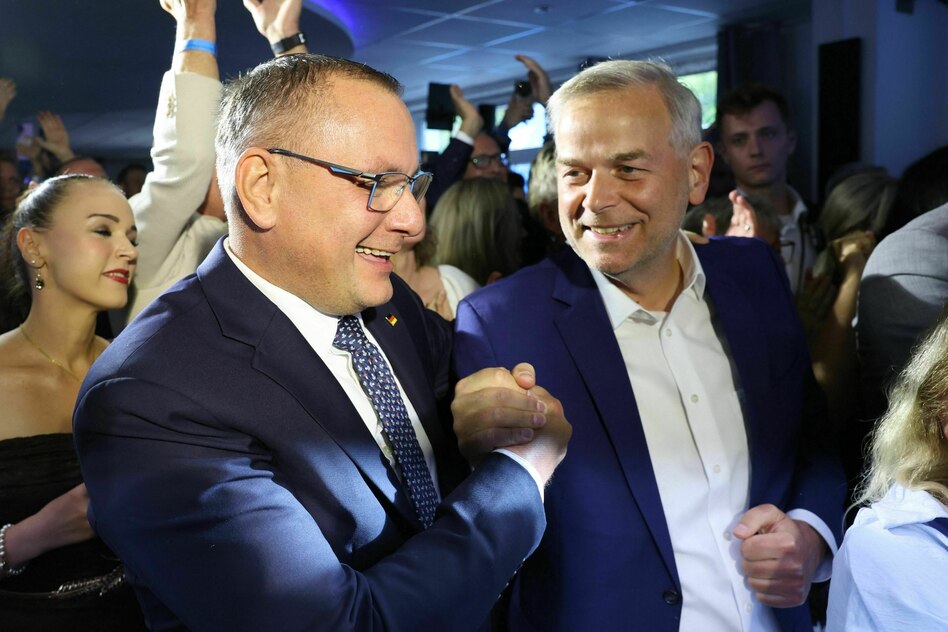
While Tino Chrupalla celebrated another record result alongside top candidate Leif-Erik Holm in Schwerin amidst storms of cheers, party leader Alice Weidel followed the election results in the Berlin House of Representatives. There was a party atmosphere here, only with some drawbacks: Surrounded by the media and right-wing extremist YouTubers, there was initially huge cheering about the result in Mecklenburg-Western Pomerania, but the results from Berlin then caused more disillusionment.
The extreme right-wing party made significant gains, but had hoped for much more. When, according to the forecast, the Left reached almost 25 percent at 6 p.m., people even spoke of a “catastrophe” before there was dutiful applause and hugs for the rather pale Berlin top candidate Kristin Brinker.
The bottom line is that it was a successful evening for the extreme right-wing AfD: in Mecklenburg-Western Pomerania, according to projections, it achieved 37.9 percent in the evening - an increase of 21.2 percentage points. This made it the strongest force, but remains far from the absolute majority.
In Berlin, the AfD is falling well short of its own expectations and, according to projections, reached more than 15 percent on Sunday evening. This was probably also due to the election campaign, which was influenced by social policy. Both Weidel and Chrupalla felt encouraged by their fundamental opposition course and both called for Chancellor Merz to resign. So you think you are one step further towards the long-term goal of destroying the CDU, which lost significantly in both countries.
Above all, the election results in Mecklenburg-Western Pomerania manifest the deep and, mind you, all-German democratic crisis. After Thuringia, Brandenburg and Saxony-Anhalt, the AfD now has another federal state in which it can block democratic processes with a blocking minority. A constitutional amendment that was intended to create more resilience failed before the election because of the CDU. Now the AfD can prevent the election of judges for the state constitutional court. In the coming legislative period, eight judge positions must be filled.
In the election campaign, the AfD in Mecklenburg-Western Pomerania relied on proven strategies from other eastern federal states: slogans such as “Complete the turnaround”, Simson exits and the demand to reintroduce the GDR school subject “Productive Work” were aimed at East German identity and hit a nerve.
But a charismatic top figure like Ulrich Siegmund was missing in Saxony-Anhalt. Leif-Erik Holm, the top candidate, did not even appear on the state list. He only wanted to become Prime Minister, otherwise he wanted to keep his Bundestag mandate. The sound of the former radio presenter could also come from the Lucke AfD. Not least because of this, Holm is seen by many in the extreme right-wing regional association as dispensable - and replaceable in the long term. Parts of the regional association are considered divided.
"After the three state elections in Berlin, Mecklenburg-Western Pomerania and Saxony-Anhalt, many questions arise that go beyond state politics. Is something currently shifting in the German party landscape? We'll discuss this live and in the stream in the Bundestalk in the taz canteen in Berlin tomorrow evening. You can register here.
This does not apply to the ethnic hardliners who are pulling the strings behind Holm - Secretary General Dario Seifert, for example, who used to be a member of the NPD youth. Or Thore Stein in second place on the list from a right-wing radical fraternity and with a history with the ethnic association “Sturmvogel”. Or Daniel Fiss with a past also in the NPD youth and the “National Socialists Rostock”. The list goes on.
Mecklenburg-Western Pomerania shows how far the AfD can come even without a driving force in an eastern German state. What used to apply to the SPD in the Ruhr area applies here: even a broomstick could be elected. Tailwind from Saxony-Anhalt further strengthened the AfD electorate.
In Berlin, however, it is clear how the AfD can be beaten: with an election campaign that focuses on social issues other than migration. Interesting: According to post-election surveys, the Left mobilized more non-voters here than the AfD, which is also strong in this area. The situation was different in Mecklenburg-Western Pomerania, where, according to Infratest dimap, the AfD mobilized around 67,000 non-voters and was therefore well ahead of all other parties, i.e. around a third of its electorate. She also won well here from the SPD and CDU.
Once again, especially with a view to Mecklenburg-Western Pomerania, the question arises as to what made the AfD strong: Is it the firewall, i.e. the political isolation of the right-wing extremists along formal power-political criteria, that now has to go?
The monocausal explanation that the firewall failed ignores the fact that the exclusion actually never took place. The CDU under Merz ultimately tried to fight fire with fire. Merz tried to be an “alternative with substance”. He wanted to win back AfD voters with anti-migration policies. As in many other countries, this has plunged the conservatives into an existential crisis: In doing so, he has proven that the right-wing extremists are politically right and thus also shifted the overall social discourse to the right. The AfD voters felt even more encouraged, but chose the original.
It is likely that there is not one explanation for the AfD's success, but rather a multitude: In addition to normalization, there are also empirically valid findings: the war in Ukraine, refugee movements, rising energy prices, inflation, the reduction of industrial jobs, an unpopular federal government, deficits in public services, the AfD's anchoring in rural areas and local politics as well as its dominance in social media.
Read the full story at the source
Source: taz