
Politics taz
AfD cultural policy in Saxony-Anhalt: With the cornflower on its lapel
In Saxony-Anhalt, the AfD is working on a romantic doctrine. The Novalis Center in Oberwiederstedt defends itself against ethnic appropriation. more...
Deutsch (original) ·Auto-translated to English
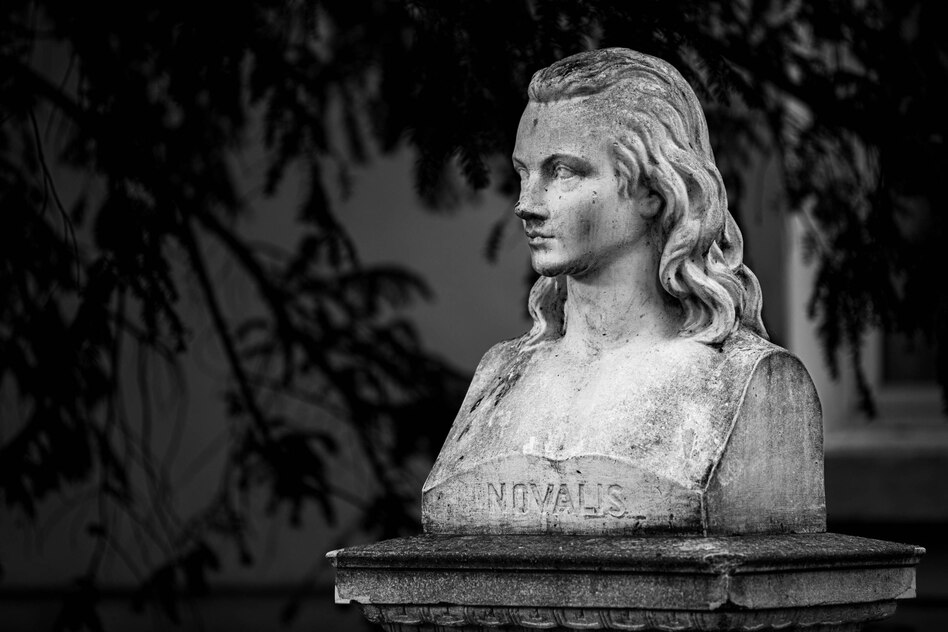
The AfD in Saxony-Anhalt is tinkering with its cultural-political ideology. In doing so, she delves deep into the state's rich intellectual history and discovers that Romanticism, which largely has its origins in Novalis' birthplace, the small Oberwiederstedt, is ideally suited for populist strategies. Because which AfD Biedermann from Anhalt would have something to object to German romanticism?
Many representatives of the ethnic wing have already pinned a blue cornflower to their lapels for advertising purposes. Finally, a few years ago, chief ideologist Hans-Thomas Tillschneider presented the elements for a ethnic romantic doctrine in the Magdeburg state parliament: "In German romanticism, we Germans find ourselves. German romanticism is the discovery of the national spirit and the discovery of national culture, which explains why it hardly plays a role in schools and universities today. This makes institutions outside of the state educational system that embrace romanticism all the more important."
The AfD now intends to fill this supposed void after its election victory in Saxony-Anhalt. That's why Tillschneider sees the AfD as a "party of romanticism", because the romantics "promoted and thought through the national idea". But the “institution outside the state educational system” he calls for has already existed for 34 years: Oberwiederstedt Castle, where the early romantic poet and philosopher Friedrich von Hardenberg, who called himself Novalis, was born. Today it is home to the Novalis Museum, the International Novalis Society, the Research Center for Early Romanticism and the Novalis Foundation “Dare to Walk with Novalis”. One asks oneself: What more could Hans-Thomas Tillschneider want?
Actually, all hitchhikers could be proud of the romantic center of Oberwiederstedt, not far from the Luther town of Eisleben. After decades of neglect under SED rule, it was an arduous journey to the castle in the Mansfeld province's current splendor. Some Wiederstedters still remember that the tragedy began in 1945, when the last Hardenbergs had died in the war, committed suicide or moved to the West. In the post-war years, the castle became a reception camp and later a nursing home. The SED cultural policy, which only supported authors who corresponded to the national understanding of the GDR, saw Novalis as a romantic fantasist from a former aristocratic class.
Many locals still remember the electrician Gerald Wahrlich, who founded the “Novelis Interest Group” – “IG Novalis” for short – in 1988 to save Oberwiederstedt Castle from the threat of demolition. It was only thanks to a courageous Halle SED district leader and IG Novalis that the demolition work could be stopped and large parts of the budget earmarked for the demolition could be used for reconstruction.
While Novalis's birthplace was in a miserable condition in the early summer of 1990, the castle shone in new splendor two years later after the Federal Ministry of Finance donated a large sum for reconstruction on the occasion of Novalis' 225th birthday. In the following years, state funds were added from the Magdeburg State Chancellery, funding flowed from the German Foundation for Monument Protection, while the Mansfeld-Südharz district continues to pay for the ongoing operating and personnel costs as well as construction projects.
The sociologist Steffen Schmidt, who heads the Novalis Museum and the research center for early Romanticism in Oberwiederstedt Castle, is pleased about the funding and the good connections to the Jena Center for Romanticism Research and the Frankfurt Romanticism Museum. He emphasizes that the Novalis Center has “privileged access to federal funds” and that former Prime Minister Reiner Haseloff was a regular guest in Oberwiederstedt.
Schmidt is combative: “We cannot be blackmailed.” He doesn’t want to hear about a “frightening perspective.” Nevertheless, he knows that Götz Kubitschek's now formally dissolved “Institute for State Politics” in nearby Schnellroda continues to play an important role under a different name and that the AfD in neighboring Wiederstadt won 62.9 percent of the vote in the last state election. Schmidt knows all too well that financial security can become uncertain in the future. The district administrator for Mansfeld-Südharz could cut the funds if the political situation changes after the office is filled in just under two years.
“The Novalis Center will remain in place,” Schmidt is certain. He is currently working on the new permanent exhibition, which begins in November. The focus is on the life, work and impact of the famous Oberwiederstedt romantic, with Schmidt paying particular attention to the posthumously edited philosophical fragments.
Perhaps the exhibition reveals unexpected parallels to another Anhalt writer and philosopher: Friedrich Nietzsche, who grew up two generations later in Röcken, in the immediate vicinity of Novali's later home in Weißenfels. The great Anhalt aphorist, who abhorred everything nationalistic and patriotic, would certainly have read enthusiastically the fragments in which Novalis wrote: “Life should not be a given novel, but a novel made by us.” And: "The possibility of philosophy rests on truly thinking collectively. If collective thinking is possible, then a collective will and the realization of great, new ideas are possible."
This is miles away from Tillschneider's drivel about folk spirit and German national culture. It remains to be hoped that the Oberwiederstedt Romantic Center will keep alive the spirit of contradiction of these two Anhalt thinkers.