
Labour Real Media
The Language of the Unheard
A historic town hall burned in Limoges. Shop windows shattered in Paris and Marseille. Within three weeks, a government that had offered striking students and workers little was talking about smaller
English (original) ·Read in Deutsch ⇄
France's Autumn of Unrest and the Mechanics of Change
A historic town hall burned in Limoges. Shop windows shattered in Paris and Marseille. Within three weeks, a government that had offered striking students and workers little was talking about smaller classes and an exceptional rise in the minimum wage. France’s autumn is an uncomfortable reminder of how social change tends to arrive, and of a pattern governments keep refusing to read until it is written in fire.
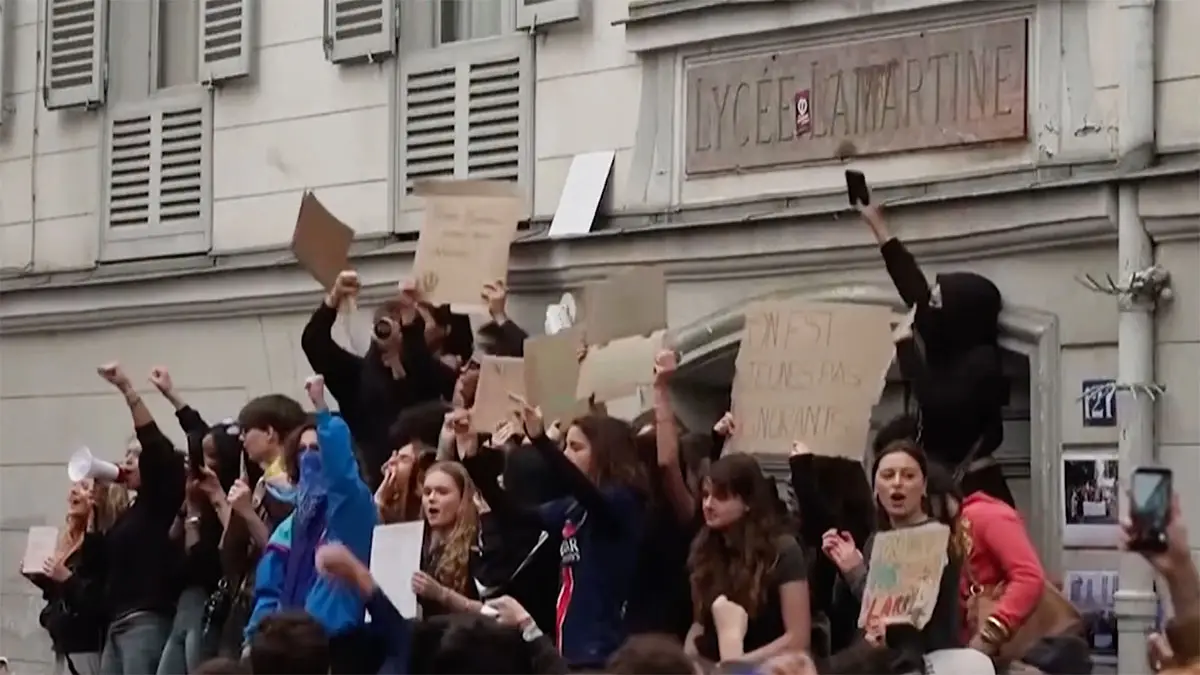
It began small. In mid-September, secondary students in Brittany, then in Seine-Saint-Denis on the edge of Paris, blockaded their lycées with bins and banners. They were protesting overcrowded classrooms, teacher shortages and crumbling buildings. By 2 October more than 400 schools and colleges were closed.
The movement soon merged with a revived Yellow Vest mobilisation over fuel prices, and with unions angry about wages and cuts to public services. The backdrop is a state running a deficit of around 5% of GDP and trimming budgets to reassure lenders.
The government’s first response was procedural. On 6 October, Prime Minister Sébastien Lecornu asked ministers to draft proposals on students’ demands by the end of the month. A release of strategic diesel reserves followed the next day. Neither slowed the momentum.
Then came 17 October. More than half a million people marched: students, teachers, farmers, pensioners, Yellow Vests. Most marched peacefully. But as night fell, shops were looted in Paris and Marseille and cars burned along the Canal Saint-Martin. In Limoges, masked groups broke into the 1883 town hall, a listed monument, and set it alight – its roof and bell tower collapsed. Around 1,800 people were arrested, and more than 500 police, gendarmes and firefighters were injured. The interior minister, Laurent Nuñez, admitted police had “lost control” in several cities. Curfews followed in Paris, Lyon, Bordeaux and Nice.
The state answered with force first. By one count, more than 6,700 minors had been arrested by 23 October. A 16-year-old girl lost the sight of one eye to a rubber bullet, and dozens of internal inquiries into police brutality have been opened.
But the politics moved too. On 26 October the government set out plans to cap lycée classes at 28 and an emergency plan for the poorest areas. Student unions dismissed it as crumbs. On 5 November a general strike brought between 575,000 people (the government’s figure) and 1.6 million (the CGT union’s) onto the streets, this time largely peacefully. The labour minister now says the government wants to move fast on an exceptional rise in the minimum wage (Salaire Minimum Interprofessionnel de Croissance), and Lecornu has called a social conference on wages for Monday 9 November. The CGT wants 10% on the minimum wage, while student unions want €10 billion for education. This weekend, Yellow Vests are defying a march ban in central Paris, and pan-European protests are planned for 20–22 November.
Strip away the specifics and France’s autumn follows a familiar script. Its protagonists are people who feel the economy has closed its doors to them – teenagers in underfunded schools, rural workers who need a car and cannot afford the fuel, low-paid public servants watching prices outrun wages. Similar coalitions have taken to the streets this year in Belgium, Italy, Spain, Portugal and Germany, under the same austerity pressure.
What unites them is not ideology but position. Exclusion, poverty and disempowerment are structural conditions, and they produce a predictable experience of politics. You vote, and the budget is decided elsewhere. You petition, and the petition is noted. You march, and the march is policed.
Most protest movements pass through recognisable stages. Not every movement climbs every rung, but the sequence recurs often enough to be read.
France ran through all four in about five weeks. The sociologist Charles Tilly called the set of tactics available to a population its repertoire of contention. Over a campaign, what usually changes is not the grievance but the part of the repertoire people believe will be heard.
The crucial point is that rupture rarely comes first. It tends to follow the visible failure of voice and movement.
The dominant public reading of riots is that they are mindless – opportunists using a political moment as cover. Half a century of scholarship on crowds has taken that view apart.
A recent analysis of the French unrest, The Anatomy of Unrest, draws these strands together – the riot as diagnosis, looting as a critique of property, the radical flank, and the reclaiming of streets and squares from the police. Taken together, they describe escalation as a process, not a pathology.
Property damage is the hardest part of this story to defend, and the most important to understand. Political theorists have long drawn a line between violence against people and damage to things. That line matters morally, and it matters to many protesters. In most riots the targets are not random – banks, police stations, luxury storefronts, chain stores, town halls. They are the visible architecture of a system that has excluded the people outside its windows.
Read that way, looting is a crude but legible statement. In a society that guards goods more carefully than it meets its citizens’ needs, taking the goods inverts the order. The Anatomy of Unrest frames it as a direct challenge to a system that values commercial assets above people. The writer Vicky Osterweil makes a sharper version of the case in In Defense of Looting (2020). You need not accept the whole argument to see its core – the shop window is chosen because it stands for something.
None of this makes every looter a political actor. Crowds include opportunists, and some violence is simply violence. The burning of Limoges’ town hall destroyed a building that belonged to the very community it served – it is hard to read that as anything but loss. But a phenomenon is not defined by its worst participants. When riots recur in the same neighbourhoods, under the same conditions, after the same sequence of ignored demands, “criminality” is not an explanation. It is a refusal to look for one.
History offers no clean experiment, but where entrenched norms have shifted, physical disruption is rarely absent from the story, and governments have often moved in its immediate wake.
The London experience matters. Physical disruption is not a guarantee – without organised demands and a wider movement around it, it can simply be punished and forgotten. The pattern is not that rupture always wins. It is that rupture keeps appearing at the moments when systems finally give way.
The comfortable story is that peaceful protest changes the world and violence only sets causes back. It is half true, and the false half matters.
The strongest evidence for non-violence comes from Erica Chenoweth and Maria Stephan. Their study of campaigns from 1900 to 2006 found that non-violent resistance succeeded roughly twice as often as violent insurgency. Omar Wasow’s 2020 study of 1960s America found that non-violent civil rights protests moved nearby white voters toward the Democrats. Protester-initiated violence after 1968 pushed them toward Nixon’s law-and-order message, enough, he estimates, to tip that election.
Any honest case for disruption has to reckon with that. But look at what “non-violent” means in the data. Chenoweth’s successful campaigns are not polite processions. They are general strikes, boycotts, occupations and blockades that shut economies down – disruption in everything but bloodshed.
The civil rights movement itself is misremembered as pure moral persuasion. The 1963 Birmingham campaign included a night of rioting after the bombing of the motel where King had been staying. President Kennedy’s televised civil rights address came a month later. The two events are connected.
So the accurate claim is this. Orderly marching on its own, the procession that ends on time and changes no one’s routine, has a thin record of overturning entrenched interests. What wins is pressure – the credible threat that normal life cannot go on. Mass non-violent disruption is the most effective form of that pressure. Physical rupture at the fringe is cruder and costlier, and carries a real risk of backlash. It recurs because, for the most excluded, it is sometimes the only form within reach, and because it is so often the moment authorities start to listen.
Under pressure, France’s government is now doing what it declined to do in September – talking about wages, class sizes and money for poor neighbourhoods. Perhaps the 5 November strike alone would have brought it to the table. No one can prove which lever moved Matignon, and that is the point. In practice the levers work together. The peaceful majority supplies legitimacy – the disruptive fringe supplies urgency.
That should trouble everyone. Protesters pay for rupture with their liberty and, in at least one case this autumn, their eyesight. Communities pay with their town halls and high streets. Governments pay with their authority, conceding in a crisis what they could have negotiated in the calm.
None of this is mysterious. The path from grievance to voice to movement to rupture has been traced across two centuries, from English grain riots to the Yellow Vests. A government that hears teenagers describe crumbling schools in September has been given notice. Waiting for the fire is a choice.
The evidence does not license violence. It describes a mechanism. Governments that understand it can act earlier, treating peaceful demands as the warning they are rather than waiting for the fringe to translate them into a language that cannot be ignored. Monday’s social conference is France’s chance to show it has learned to read the signs. If it offers crumbs again, history is fairly clear about what comes next.
— © 2026 Sul Nowroz – Real Media staff writer – Insta: @TheAfghanWriter