
War & Militarism Real Media
Ports for Peace Jobs with Dignity
Trade unionists, anti-war campaigners and Palestine solidarity activists will be at Tilbury Docks in Essex as part of the International Dock and Transport Workers Against Genocide day of action. This
English (original) ·Read in Deutsch ⇄
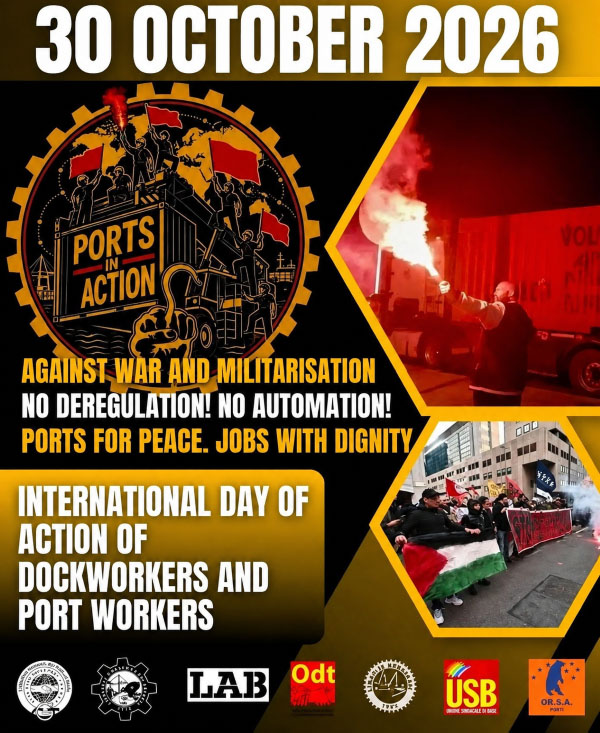
Tilbury joins the Global Dockers’ Day Of Action
Trade unionists, anti-war campaigners and Palestine solidarity activists will be at Tilbury Docks in Essex as part of the International Dock and Transport Workers Against Genocide day of action. This coordinated mobilisation will reach around 100 ports in 17 countries.
The demand is simple and old – dockers will not load the weapons and materials that sustain Israel’s assault on Ghazza. Alongside it sit the bread-and-butter demands of the waterfront – real pay rises, secure jobs and protection from automation that strips out work. The organisers’ slogan sums it up – Ports for Peace – Jobs with Dignity.
The Tilbury action is a solidarity protest at the dock gate, called by rank-and-file trade unionists and campaigners rather than by a union executive. Its purpose is to take the international call directly to the people who work the port and to put Britain on the map of the day of action. It will take place on Friday 30 October 2026, from 9am to 12pm, at Tilbury Docks main entrance.
The form of the UK action matters. In France, Italy or Greece, unions can call a political strike. In Britain, the law gives no protection to industrial action taken over an illegal foreign war or in support of workers elsewhere, because a “lawful” strike must be tied to a dispute with your own employer. That is why the British contribution begins at the gate, with an appeal, rather than with a walkout.
It is also why Tilbury matters. The port has a long fighting tradition – its dockers joined the great 1889 strike for the “dockers’ tanner” and struck again in 1912 and 1926. A presence at its gate signals that the international movement is knocking on Britain’s door – and with good reason.
What makes 30 October different is organisation. Since October 2023, Palestinian trade unionists have repeatedly asked workers abroad to refuse to handle arms bound for Israel. At first the responses were local, with dockers in Belgium, Sweden and Italy refusing to handle particular weapons components.
Those refusals have since been stitched together into a network:
The action is also spreading beyond the quayside. In Italy, the rank-and-file union USB has called a general strike for the same day, inviting all public and private-sector workers to join. The World Federation of Trade Unions, which initiated the day, argues that rail, energy, logistics and shipyard workers sit on the same supply chains and hold the same leverage.
This is the significance of 30 October. Solidarity with Palestine is moving beyond statements and marches into the one place where workers hold direct power over the war economy – the point where cargo moves.
Behind the war on Ghazza lies an occupation that the world’s highest court has declared unlawful. Israel has occupied the West Bank including East Jerusalem, and Ghazza, since June 1967. UN human rights experts have described it as the longest occupation in the modern world.
On 19 July 2024, the International Court of Justice delivered its advisory opinion. By 11 votes to 4, it found that Israel’s continued presence in the Occupied Palestinian Territory is unlawful and must end as rapidly as possible. By 14 votes to 1, it ruled that Israel must stop all new settlement activity, evacuate settlers and pay reparations. The Court based its findings on the prolonged occupation, illegal settlements and annexation of territory occupied since 1967, and discriminatory legislation.
The opinion places duties on every state, Britain included. By 12 votes to 3, the Court said states must not recognise the occupation as legal or give aid or assistance in maintaining it. In September 2024, the UN General Assembly endorsed the opinion and called for the occupation to end within a year. That deadline has passed. The UN Commission of Inquiry, which had concluded in 2022 that the occupation was unlawful, welcomed the ruling as authoritative.
Ghazza is part of the same occupation. Israel withdrew its settlers in 2005, but the International Court of Justice, the UN General Assembly and the Security Council still regard Israel as the occupying power because of its blockade and control of the territory.
For dockers, the legal point is direct. If states are obliged not to assist an unlawful occupation, then ports that load the means to sustain it cannot stand outside the question.
The dockers’ call uses the word Genocide because the world’s leading human rights bodies now do. Three findings stand out.
Amnesty International (December 2024). After a 296-page investigation, ‘You Feel Like You Are Subhuman’, Amnesty concluded that Israel has committed, and continues to commit, Genocide against Palestinians in Ghazza. It found that Israel carried out acts prohibited by the Genocide Convention with the specific intent to destroy Palestinians there, including deliberately inflicting conditions of life designed to bring about their destruction. Amnesty was the first major Western human rights organisation to reach that conclusion. Its UK section said Britain, as a party to the Convention, must immediately end all arms transfers to Israel to avoid the risk of complicity.
B’Tselem (July 2025). Israel’s best-known human rights organisation titled its report Our Genocide. Drawing on testimony from Palestinians in Ghazza, it concluded that Israel is taking coordinated action to intentionally destroy Palestinian society there, and warned that the pattern risks spreading to the West Bank. Latest events appear to be fulfilling their concerns. Physicians for Human Rights Israel published a parallel finding the same day.
UN Commission of Inquiry (September 2025). The independent Commission of Inquiry on the Occupied Palestinian Territory and Israel, set up by the UN Human Rights Council and chaired by former UN human rights chief Navi Pillay, found that Israel had committed four of the five genocidal acts listed in the 1948 Convention – killing, causing serious bodily or mental harm, inflicting conditions of life calculated to destroy the group, and imposing measures to prevent births. It named Israeli Prime Minister Netanyahu, President Herzog and former defence minister Gallant as having incited Genocide, and called on states to halt weapons transfers. It was the first UN-mandated investigative body to make a Genocide finding.
These conclusions sit alongside the Genocide case that South Africa brought against Israel at the International Court of Justice, which is still being heard. For dockers, the argument has a practical edge. Each of these bodies warns that states and companies supplying the war are at risk of complicity – and the workers who physically move those supplies are asking whether they are being made complicit too.
The day of action identifies a second target – Israel’s “system of apartheid”. That description, too, rests on the work of established human rights organisations, and it predates the current war.
B’Tselem (January 2021). In A regime of Jewish supremacy from the Jordan River to the Mediterranean Sea: This is apartheid, B’Tselem analysed, for the first time, the whole territory under Israeli control rather than the occupied territories alone. It concluded that roughly 14 million people, about half Jewish and half Palestinian, live under a single regime organised around one principle – advancing the supremacy of Jews over Palestinians. It showed how that principle is applied through control of land, citizenship and residency, freedom of movement, and political participation.
Amnesty International (February 2022). Amnesty’s report Israel’s Apartheid against Palestinians: Cruel System of Domination and Crime against Humanity found that land seizures, unlawful killings, forcible transfer, severe restrictions on movement and the denial of nationality and citizenship together amount to apartheid under international law. It found that the system extends across Israel and the occupied territories, and to Palestinian refugees denied the right to return, and it called for a UN arms embargo.
The UN Special Rapporteur (March 2022). The UN Special Rapporteur on Human rRghts in the Occupied Palestinian Territory concluded that Israel’s entrenched rule over the West Bank and Ghazza meets the evidentiary standard for apartheid.
What does that look like on the ground? Three examples.
Checkpoints and gates. As of December 2025, the UN Office for the Coordination of Humanitarian Affairs (OCHA) counted 925 obstacles restricting the movement of 3.5 million Palestinians across the West Bank. They include 90 checkpoints staffed around the clock, and 230 road gates. Israeli forces also set up an average of 15 unannounced “flying” checkpoints every week. Two decades ago, most obstacles were makeshift earth mounds and roadblocks. Today, fortified checkpoints and iron gates make up nearly 60% of the total – a sign that the system is becoming permanent.
The wall. Israel began building the West Bank barrier in 2002. Its planned route is about 700 kilometres long – more than twice the length of the 1949 Green Line – because 85% of it runs inside the occupied West Bank rather than along the border. In towns such as Bethlehem and Qalqilya it is a concrete wall up to eight metres high – in open country it is a wide strip of fences, ditches, razor wire and patrol roads. If completed as planned, it will cut off 10% of the West Bank, and the land between the barrier and the Green Line holds nearly half of all settlements and more than 85% of settlers. The wall separates farmers from their fields, and families from schools and hospitals – Palestinians need permits to pass through its gates. As early as 2004 the International Court of Justice ruled that the sections inside the West Bank, together with the gate and permit regime, breach international law and should be dismantled.
The Nation-State Law. In July 2018 the Knesset passed the ‘Basic Law’ defining Israel as the nation state of the Jewish people. It reserves the right to national self-determination in Israel to Jewish people alone, downgrades Arabic from an official language to one with ‘special status’, and declares the development of Jewish settlement a national value that the state will promote. It contains no guarantee of equality, even though around a fifth of Israel’s citizens are Palestinian. Critics, including Amnesty and B’Tselem, argue that it writes the supremacy of one group into the constitution. Combined with the Law of Return – which offers citizenship to any Jewish person while millions of Palestinian refugees are denied the right to return – it is a cornerstone of the apartheid case.
Britain was apartheid South Africa’s closest partner. In the 1950s and 1960s it was South Africa’s biggest trading partner and foreign investor, and successive governments refused to cut those links. Much of that trade came up the Thames. The Port of London, with Tilbury as its deep-water gateway, was where Britain met the South African economy, cargo by cargo.
So when ANC President Albert Luthuli appealed in 1959 for the world to boycott South African goods, the front line ran through British ports. The first products targeted by campaigners, Outspan oranges and Cape apples, arrived by sea. From that appeal grew the Anti-Apartheid Movement, which by the 1980s had become Britain’s biggest ever international solidarity movement, with trade unionists at its core.
Unions turned the boycott into action at work. Through the 1970s, a growing number of British unions refused to handle South African goods, and in 1976 the international union federation called a week of action. The movement later worked with the National Union of Mineworkers to embargo South African coal.
Dockers abroad showed what that power could achieve. In 1984, San Francisco longshore workers left South African steel, wine and car parts in a ship’s hold for 11 days. In 1985, Swedish dockers refused all South African cargo for a month, and Australian dockers mounted repeated boycotts. Historians note that shipping was apartheid’s Achilles heel, because South Africa’s economy depended on exports and imported oil. Organisers believe the same is true of the arms supply to Israel today.
Apartheid in South Africa fell in part because ordinary workers in the countries that traded with it refused to keep that trade moving. The dockers’ call for 30 October asks Britain’s ports to remember that.
— © 2026 Sul Nowroz – Real Media staff writer – Insta: @TheAfghanWriter