
World · Pressenza · · 3h
The Traitors Surface: translated excerpt from the recording made by Orlando Letelier in response to Joan Garces
English (original) · Read in Deutsch ⇄
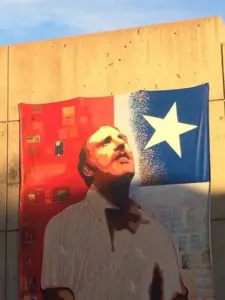
Edited and translated by Maxine Lowy, with a contextual introduction.
Originally published by Memoria y Justicia.cl in September 2007.
It was September 1975.
It had been a year since the Military Junta, headed by Augusto Pinochet, under international pressure—and particularly pressure from Venezuela—had deported Orlando Letelier, the first political prisoner to be released outside Chile. He had spent the previous twelve months imprisoned, first on Dawson Island and later in Ritoque, together with other Cabinet ministers of the Popular Unity government. At the Tacna Regiment, he had been subjected to the first of three mock firing squads—perhaps, in some sense, rehearsals for the assassination that would take his life three years later.
Over the next two years, Letelier traveled tirelessly, denouncing the dictatorship. He testified before the U.S. Senate’s Church Committee about the abuses being committed in Chile and played a decisive role in bringing together international opposition to the tyranny.
In Chile, the Military Junta had dismantled the democratic institutions of the state and maintained itself through a policy of instilling psychosocial fear. The machinery of terror, with its state-paid functionaries, operated at full force in Villa Grimaldi, Colonia Dignidad, and various other locations throughout the country. Beyond Chile’s borders, in Buenos Aires, former General Carlos Prats had been assassinated the previous year by a car bomb.
Augusto Pinochet’s character as a traitor and his desire for revenge were evident. Paradoxically, those who were to become his victims—President Salvador Allende, former Commander-in-Chief of the Army Carlos Prats, and government ministers such as Orlando Letelier himself—believed until only a few days before September 11, 1973, that they could count on his support and unconditional loyalty. Pinochet told them that he was visiting military units in order to calm those who had become agitated. History, however, has shown us that the mission entrusted to him had precisely the opposite purpose: to consolidate preparations for the coup and foment sedition among the military.
In response to questions posed to him by Joan Garcés, a special adviser to President Allende who was preparing the book Allende et l’expérience chilienne (Presse de la Fondation Nationale des Sciences Politiques, 1976), in September 1975 Orlando Letelier reflected on the circumstances that led to the coup and on the individuals who maneuvered it. In the tape he recorded for Garcés, Letelier’s measured voice describes how no one played his role better than Augusto Pinochet: that of the white dove.
A year later, on September 21, 1976, Orlando Letelier, whose voice had mobilized thousands in condemnation of the dictatorship, would be killed together with Ronni Moffitt, a staff member of the Institute for Policy Studies, in a crime against humanity ordered by Augusto Pinochet.
With the authorization of its editor, in September 2007 the website Memoria y Justicia (at the time coordinated by this journalist) published an excerpt from the transcript of the tape recorded by Orlando Letelier, published under the title Orlando Letelier: Testimonio y vindicación (Siglo Veintiuno Editores, Madrid, S.A., 1995). Now, 50 years after the assassination of Orlando Letelier, his recollection of the betrayal by Pinochet remains chilling.
Recording by Orlando Letelier
Let us move on to the second point.
You say that at another point during the lunch I alluded to the fact that, if they did not overthrow us that week, we would never fall. And that I had said that they had been preparing everything so that the situation would explode that week.
I remember that comment of mine perfectly well. The basis for that comment was varied, but I will try to point out to you the main elements of information that led me to that conclusion. First of all, the principal element: Carlos Prats.
On Friday [September 7], that evening, I had a fairly long conversation with him at his house. It was also frequently interrupted because, while I was talking with him, the operation at Sumar began. I received telephone calls from my home because Pedro Vuskovic was looking for me in connection with what had happened there. I spoke with Leigh, concerned. Leigh called my home several times. And I called him because at that moment I did not want him to know that I was at Carlos Prats’s house. Regarding the whole Sumar affair, I instructed Leigh to withdraw the Air Force personnel from there. He later called me—he called my home—to say that they had indeed been attacked. Finally, I summoned him to my office for nine o’clock the following morning. The next day was Saturday [September 8].
As I said, this conversation with Prats was quite interrupted. Moreover, Prats was in an extremely unusual state of mind. Nevertheless, he told me categorically:
“Look, Orlando, things have reached such a point that if the President does not take measures to remove some generals before next Friday, I believe that a coup d’état will take place next Thursday or Friday, the 14th [of September].”
I then asked him about the attitude of each of the generals. He had a fairly clear conviction that Bonilla, Arellano, Bravo, and, to some extent, Torres de la Cruz in the south, as well as another general you mentioned to me—I don’t remember his name—who was in Concepción [Washington Carrasco], were involved in the coup. He had doubts about some people, such as Brady, which to me was quite a complicated situation because of the way Brady had become commander of the Second Army Division, which had jurisdiction over the province of Santiago.
I had serious reservations about Brady. To some extent, Prats did as well. He said to me:
“Brady makes a great show of his friendship with President Allende, but in reality he is someone I would not place much trust in.”
Now, what is very clear is that Carlos Prats, until that very day I am talking about, Friday [September 7], had great confidence in Pinochet. At one point, after he had told me that some action had to be taken, I said to him:
“Well, but if Pinochet is acting loyally, he too could be placed in the position of having to resign. As happened to you, Carlos. Otherwise, it means that Pinochet is counting on the possibility that, at a certain moment, he will join whichever side has the greater number of generals—or forces—which could eventually be the side supporting the coup, against the Government.”
Carlos Prats did not categorically refute what I was saying. In any event, he insisted that he believed Pinochet was loyal to the President. And that, in any case, Pinochet would not be among the traitors.
That was one point arising from my conversations with Prats.
On the other hand, from the moment I arrived at the Ministry in the first days of September [1973]—in reality, my appointment was made on the 28th [of August], but I think there was a weekend—I realized that the coup was being organized. In other words, Carlos Prats gave me a specific date. He told me the 14th. But to me, the situation was quite obvious. It is true that I saw the main activity coming from the Navy. But I assumed that there could be no attempt at a coup without the Army. And eventually I want to tell you that, from the very first days, Pinochet—and this had to some extent led me to place a certain degree of trust in him—Pinochet told me:
“Look, Minister, there is a bunch of crazy, unbalanced people here who are arguing that it is preferable for a showdown [that is, a coup] to take place now, with one hundred thousand people dying, rather than have a confrontation and civil war in which one million people could die. I am doing everything possible, in accordance with what General Prats had previously asked me to do and what the President had asked me to do. I am visiting the units, and things are improving. But I want to tell you that on my latest visit there were people who were taking a very difficult position.”
I then said to him, “Well, those people must be immediately called into retirement.”
He said to me:
“But that would mean disrupting things. Why don’t you give me a little time, Minister, in accordance with what the President himself has asked me to do, so that I can gradually consolidate the position of the people I trust and continue visiting the units, etc.?”
The conversation with Pinochet concerned me. This must have been around [Monday] September 3. And perhaps that same day, or if not the following day, after the September 4 celebration—the anniversary of the 1970 presidential election—on Wednesday, September 5, I asked the President to convene a meeting of the leaders of the Popular Unity parties. There I explained that Pinochet had told me, quite plainly, that if there were an uprising, it would be a general affair; that it would not be another June 29. And that it would be general, not only within the Army but across all three branches of the Armed Forces.
From the first days, I also had the impression that Admiral Carvajal, as Chief of the Joint Chiefs of Staff, was the liaison man for the entire group of reactionary officers. I had mentioned this to the President. And to Montero. Montero had not strongly contradicted me. But he had said that we would have to wait a little for the evaluation of all the admirals that would take place toward the end of the year, essentially for the departure of two people. In the Navy, these were Merino and Carvajal, whose terms of service had already expired and who were therefore due to resign. That is, forty years of service, I believe. I am not sure whether it was forty years, but they had reached the required limit. I think it was forty.
Those were other elements: Carvajal’s attitude, what Pinochet himself had told me, and what Carlos Prats himself had told me only a few hours earlier.
To some extent, why was I saying that if they did not overthrow us that week, they would never overthrow us?
I had, in a certain sense, the feeling that by taking a very firm position regarding the situation of Montero, they had been unable to remove Montero [from the position of Commander-in-Chief]. We had already discussed with the President the need to accelerate the measures the Government should take against the officers involved in the coup. The impression was that, eventually, everything was in place for that week. But, to some extent, if it did not happen that week and they gave us a little more time—and if the President’s announcement about the plebiscite even took place—we would have had some room for maneuver to carry out the retirement of a number of officers whom we had already more or less identified. We would have had the possibility of speeding up the investigations, etc.
(I am going to continue the recording for Joan Garcés.)
As for the information Pinochet had been providing since he assumed command of the Army: the information was along the lines I had indicated to you earlier. As soon as I assumed the Ministry, he told me that the President—and I verified this with the President, and it was indeed the case—had instructed him to visit different military units in order to assess the situation there and strengthen his position as Commander-in-Chief. On the other hand, when he assumed command of the Army, he had requested the resignation of all the generals.
A few days later, I was informed—and I asked him about it—that two generals, one Bonilla and the other Arellano, had not submitted their resignations. I learned this from another source, not through him. So I spoke with him and told him that I considered this unacceptable and that he had to take immediate action in this regard. This occurred only a few days before the coup, and at that point Pinochet told me:
“Yes. These are the generals who have shown the least cooperation toward me.”
He never told me that they were directly leading a subversive movement. But he accepted my argument that he had to accelerate the process of calling these two men into retirement in the following days.
In summary, Pinochet’s attitude had initially been to tell me that there was an extremely difficult situation. But he claimed that he was gradually improving the situation through his visits. And at all times he had maintained, as I have said, an attitude of strong verbal and formal adherence to the President of the Republic, as you know very well.
Read the full story at the source
Source: Pressenza