
Politics · Pressenza · · 1h
Pakistan at Zero Hour: The Militarisation of Power and the Stakes of September 27
English (original) · Read in Deutsch ⇄
by Chrysoula Asteriadou
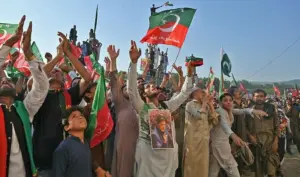
September 27, 2026 will not be just another day of political protest in Pakistan’s turbulent political calendar. The nationwide mobilisation being prepared by Pakistan Tehreek-e-Insaf (PTI), centred on demands for the release of imprisoned former prime minister Imran Khan and the defence of constitutional order, is set to expose once again one of the Pakistani state’s deepest structural weaknesses: its decades-long failure to build a political system in which civilian authority can function without the decisive intervention — or looming shadow — of the military.
General Zia-ul-Haq’s coup of July 5, 1977 was only one of the most dramatic manifestations of this historical pathology. Ghulam Mustafa Khar, a close associate of Zulfikar Ali Bhutto and one of Punjab’s most powerful political figures, experienced detention and later exile, while Benazir Bhutto was subjected to imprisonment, house arrest, and exile under Zia’s rule before returning to Pakistan and becoming prime minister in 1988. The periods and political actors cannot simply be equated. But the underlying institutional problem has survived. Almost half a century after the 1977 coup, Pakistan has still not fully resolved the fundamental question of who ultimately exercises power: political institutions deriving legitimacy from elections, or a military establishment that has repeatedly extended its influence far beyond a narrowly constitutional defence role.
The case of Imran Khan brings this contradiction back to the centre of Pakistani politics, but it does not lend itself to a simplistic narrative of a democratic politician confronting an all-powerful military establishment. Khan’s own political trajectory is intertwined with some of the same contradictions he now denounces. When he became prime minister in 2018, political opponents and analysts argued that his rise had benefited from the military establishment — a claim rejected by Khan and PTI. During his premiership, from August 2018 to April 2022, Pakistan continued to face serious criticism over freedom of expression and media freedom. His government was criticised over pressure on journalists and media organisations, the use of cybercrime legislation, and incidents involving the intimidation of critical voices. Khan also did not move to repeal Pakistan’s blasphemy laws and faced criticism over political choices that, according to his critics, failed to challenge — and in some instances strengthened — the influence of religiously conservative politics.
Khan’s subsequent rupture with the military leadership does not erase that political history. Instead, it illuminates a deeper pathology of Pakistan’s political order: civilian and military elites have repeatedly coexisted when their interests converged, only to clash when the balance of power shifted. None of this justifies any violation of Khan’s rights, nor does it make questions surrounding the legality and conditions of his prolonged imprisonment irrelevant. It does mean, however, that Pakistan’s present crisis cannot be reduced to a confrontation between a democratic politician and an authoritarian general. The Khan case is better understood as a symptom of a political system in which the relationship between elected authority and the military establishment has remained chronically unstable.
Under Field Marshal Asim Munir, that problem has acquired even greater significance because military power no longer appears solely as informal influence behind civilian authority. It has acquired stronger institutional foundations. Munir became Chief of Army Staff on November 29, 2022. On August 5, 2023, Imran Khan was arrested following his conviction in the state gifts case and, despite subsequent reversals, suspensions and further legal proceedings in different cases, has remained imprisoned. On May 20, 2025, the government of Shehbaz Sharif promoted Munir to the rank of Field Marshal, making him only the second military officer in Pakistan’s history to hold the rank after Ayub Khan. A still more consequential institutional change followed in November 2025, when the 27th Constitutional Amendment restructured the military command and created the position of Chief of Defence Forces, assumed by Munir alongside his leadership of the army.
By 2026, therefore, the question is no longer simply whether the military influences Pakistani politics — historically, that is beyond serious dispute — but whether Pakistan is moving from a system of informal military predominance towards one in which that predominance is acquiring deeper constitutional and institutional foundations. In May 2026, the Carnegie Endowment for International Peace argued that under Munir, the military had consolidated its control and formalised its dominant position within the constitutional framework, linking that process to political repression, internet controls, censorship, and constitutional restructuring. Carnegie described the underlying logic as a “hard state” approach.
Even more revealing is the concept of “constitutionalized militarism,” used by Pakistani analyst Ayesha Siddiqa and reported by Le Monde on May 23, 2026. The significance of the term is precisely that it describes something different from a traditional military coup. Contemporary Pakistan is neither a straightforward military junta nor a pure theocracy. What is emerging is a more complex hybrid order in which parliamentary and electoral institutions continue to operate while military authority becomes more deeply institutionalised and the space available for political dissent is placed under increasing pressure.
The militarisation of power, however, is only one dimension of a broader democratic deficit. Pakistan defines itself constitutionally as an Islamic Republic, but religion is not confined to the symbolic identity of the state. It has an institutional presence within the legal and judicial architecture, including through the Federal Shariat Court, while Pakistan’s blasphemy laws provide for exceptionally severe punishments. Human Rights Watch has described these laws as inherently discriminatory and documented the use of blasphemy accusations in personal disputes, extortion, economic exploitation and attacks against marginalised communities. Pakistan’s National Commission for Human Rights has reported at least 450 people allegedly falsely accused of blasphemy as part of an organised system of extortion and economic exploitation. In July 2025, the Islamabad High Court ordered the creation of a commission to investigate the abuse of the blasphemy laws.
The picture becomes still more troubling in the sphere of political and journalistic freedoms. In its 2026 World Report, Human Rights Watch documented that during 2025, Pakistani authorities intensified their crackdown on critical voices, using vague and broadly framed legislation against media organisations, political opponents and civil society. Journalists faced harassment, arbitrary arrest, physical attacks and enforced disappearance. In January 2025, the National Assembly approved legislation targeting online “disinformation,” providing for prison sentences of up to three years for “false or misleading” online content without clearly defining the term. Between January and August that year, authorities recorded approximately 689 cases under the Prevention of Electronic Crimes Act (PECA), many involving journalists.
The problem is further complicated by the very real and growing terrorist threat confronting Pakistan itself. During 2025, groups including Tehrik-i-Taliban Pakistan (TTP), Islamic State Khorasan Province (ISKP), Al-Qaeda and the Balochistan Liberation Army carried out attacks that killed hundreds of people, including civilians and members of the security forces. The existence of this threat is not in question. It raises, however, a second critical issue: whether counterterrorism can be pursued without further weakening the rule of law. On August 31, 2026, Punjab’s Provincial Assembly approved amendments to anti-terrorism legislation that Human Rights Watch criticised as threatening fundamental fair-trial protections. Pakistan thus confronts a double challenge: a state that is itself a target of extremist organisations must combat them without allowing the necessary fight against terrorism to become a mechanism for further restricting political freedoms.
Against this picture of domestic militarisation and shrinking political space stands a striking international contradiction: as the military’s role inside Pakistan has grown, Munir has simultaneously acquired greater recognition as an interlocutor for major powers. This shift has been particularly visible in relations with the United States. In June 2025, Donald Trump hosted Munir for lunch at the White House, granting an unusually high level of political access to a serving army chief. On September 25, 2025, Munir was again at the White House, this time alongside Prime Minister Shehbaz Sharif. Within months, a military leader whose power at home was expanding was simultaneously acquiring greater diplomatic visibility in Washington.
The US rapprochement acquired another dimension in 2026. On September 16, representatives of American defence technology company POWERUS met Munir at General Headquarters in Rawalpindi for discussions concerning defence technology, production and military capability development. The company said it had signed a Memorandum of Understanding with the Pakistan Army and secured an initial order related to unmanned systems. This was a private commercial arrangement, not a state-to-state defence agreement between Washington and Islamabad. Its political symbolism is nevertheless noteworthy: the same military institution at the centre of debate over the concentration of domestic power is simultaneously emerging as a principal gateway for new international defence and technology partnerships.
Here lies one of the central contradictions in the international treatment of Pakistan. Washington is well aware of the serious criticism surrounding political freedoms, pressure on the media and the expanding influence of the military. Yet counterterrorism, regional security, developments in the Middle East and the desire to preserve influence in a country with close ties to China all create powerful incentives for engagement. Munir’s position therefore exposes a persistent tension in American foreign policy: the gap between public commitments to democratic principles and pragmatic cooperation with centres of power considered strategically useful.
The same contradiction is particularly visible in Pakistan’s relationship with the European Union. Since 2014, Pakistan has benefited from the EU’s preferential GSP+ trade regime, which provides significant trade advantages in return for the implementation of international conventions covering areas including human rights, labour rights, environmental protection and good governance. In Islamabad on June 1, 2026, EU High Representative Kaja Kallas emphasised that Pakistan is the world’s largest beneficiary of GSP+ preferences and that continued preferential access to the European market depends on progress in implementing the international conventions underpinning the scheme.
According to the European Commission’s 2026 assessment, Pakistani exports eligible for GSP+ reached €7.5 billion in 2024, while the value of tariff exemptions was estimated at approximately €732 million. Yet the same assessment identified compliance problems and backsliding in a number of areas during 2023–2025, notwithstanding some positive legislative reforms. At the same time, Human Rights Watch has documented repression of critical voices, arbitrary arrests, disappearances involving journalists, discrimination and violence against religious minorities, and the continuing misuse of blasphemy laws. Amnesty International has likewise raised concerns over restrictions on freedom of expression, press freedom, and the activities of human rights defenders.
The European Union simultaneously works with Islamabad on counterterrorism, migration, trade and regional security. At the June 1, 2026 Strategic Dialogue, both sides reaffirmed cooperation against terrorism as well as the importance of protecting human rights and fundamental freedoms. Yet it is precisely this dual relationship that raises an uncomfortable question for Brussels: how effective can GSP+ conditionality be when a state receiving substantial European trade preferences continues to face documented criticism over religious discrimination, press freedom, political repression and the rule of law?
Pakistan’s deeper problem, therefore, cannot be reduced either to Imran Khan or to Asim Munir. It lies in a political order where military power, weak civilian institutions, religious restrictions, terrorist violence and pressure on individual freedoms coexist — while the country’s international partners continue to seek cooperation with Islamabad for economic and geopolitical reasons.
####
About the Author:
 Chrysoula Asteriadou. Social Worker with deep knowledge in Intercultural Education and Mental Health. A Social Policy specialist with a degree from Panteion University and a background in Social Work, specializing in mental health, intercultural education, and counseling, she possesses extensive professional and volunteer experience providing psychosocial support to vulnerable populations, refugees, and migrants directly impacted by modern geopolitical crises. Her field engagement with humanitarian organizations allows her to actively implement crisis management and social inclusion strategies for communities displaced by international instability.
Read the full story at the source
Source: Pressenza